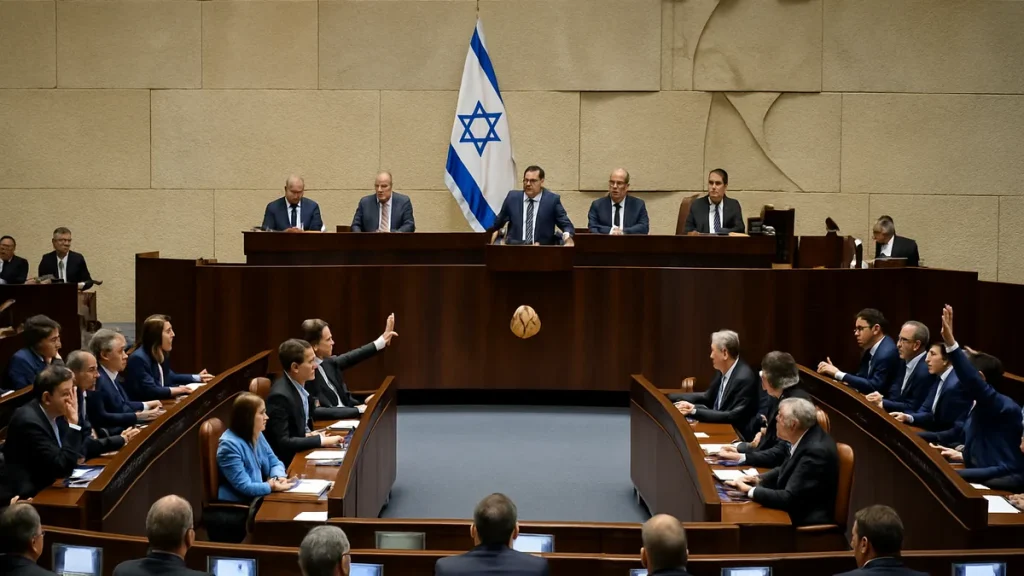

Israelis are set to vote on October 27 in an election widely viewed as a referendum on Prime Minister Benjamin Netanyahu’s leadership. Since the outbreak of the Gaza conflict in October 2023, Israel’s parliament, the Knesset, has passed numerous laws impacting Palestinians, including rejecting Palestinian statehood, supporting West Bank annexation, and cutting aid.
Despite opposition parties positioning themselves against Netanyahu’s right-wing government, voting patterns on Palestinian issues reveal broad consensus across much of the political spectrum, with left and right often aligned.
Political spectrum shaped by conflict with Palestinians
In Israel, traditional left-right political labels differ from global norms. The left is generally associated with territorial compromise and negotiations with Palestinians, while the right opposes a Palestinian state and supports settlement expansion. However, the entire political spectrum has shifted rightward, with positions once considered fringe now mainstream.
Palestinian political analyst Ehab Jabareen noted that much of Jewish Israeli politics today operates on assumptions that would have been deemed right-wing a generation ago. No party has ever secured an outright majority in the 120-seat Knesset, requiring coalition governments that often include smaller parties with significant influence.
Netanyahu’s coalition includes powerful far-right figures
Following the November 2022 election, Netanyahu’s Likud party, holding 32 seats, formed a 64-seat coalition with ultra-Orthodox parties Shas and United Torah Judaism (UTJ), and the far-right Religious Zionism alliance, which includes Otzma Yehudit. This coalition was Israel’s most right-wing government to date.
Far-right leaders Bezalel Smotrich and Itamar Ben-Gvir hold key cabinet positions. Smotrich, head of Religious Zionism, serves as finance minister and oversees civilian affairs in the occupied West Bank, including settlement planning. Ben-Gvir, leader of Otzma Yehudit, is national security minister responsible for the police. Both have advocated for annexation and settlement expansion and have used threats of resignation to influence government policy.
The coalition has experienced shifts: Benny Gantz’s National Unity alliance joined after the October 7, 2023 Hamas attacks but left in June 2024; Gideon Sa’ar’s New Hope joined in September 2024. Otzma Yehudit briefly quit over Gaza ceasefire disagreements but returned, while UTJ and Shas withdrew ministers over stalled legislation but remained in the coalition. By July 2025, the coalition held 60 seats.
Opposition parties and their stance on Palestinian issues
Opposition in Israel does not equate to left-wing politics. Yesh Atid, led by Yair Lapid, was the largest opposition party with 24 seats, followed by Benny Gantz’s Blue and White. Both are centrist and have opposed Netanyahu’s judicial overhaul proposals.
Yisrael Beiteinu, led by Avigdor Lieberman, is secular and right-wing, opposing ultra-Orthodox draft exemptions. Labor, part of the Democrats, is the only Jewish party openly supporting a two-state solution.
Arab-led parties represent Palestinian citizens of Israel and oppose the occupation. Ra’am, led by Mansour Abbas, entered government in 2021, while Hadash-Ta’al, led by Ayman Odeh and Ahmad Tibi, has never joined a government and runs as part of the Joint List alongside Balad.
Knesset voting patterns show broad consensus on Palestinian issues
An analysis of ten key Knesset votes between July 2024 and March 2026 reveals consistent support for right-wing policies on Palestinians. The only steady opposition came from Arab-led parties and the Democrats, who together held 14 of 120 seats.
In February 2024, the Knesset approved a cabinet statement rejecting unilateral Palestinian state recognition by 99 to 11 votes. The coalition, Yisrael Beiteinu, and most members of Yesh Atid and National Unity voted in favor. Labor boycotted, and only Arab-led parties opposed.
In July 2024, a resolution labeling a Palestinian state an “existential danger” passed 68 to 9, with National Unity joining the coalition and Yisrael Beiteinu in support. Yesh Atid and Labor abstained, and only Arab-led parties voted against.
Before the election, Israeli politicians across the spectrum uniformly rejected support for establishing a Palestinian state.
Public opinion has shifted accordingly. Pew Research Center data shows Israeli belief in peaceful coexistence with a Palestinian state fell from 50 percent in 2013 to 17 percent in 2026, the first time a majority explicitly doubted coexistence.
In July 2025, a nonbinding declaration calling for annexation of the occupied West Bank passed 71 to 13, with Yesh Atid and National Unity boycotting and Labor joining Arab-led parties in opposition.
When annexation legislation was introduced in October 2025, it passed a preliminary reading by a single vote, 25 to 24. Likud officially opposed the bill except for one lawmaker, and the bill’s passage depended on votes from United Torah Judaism.
Legislation targeting UNRWA receives broad support
Two bills passed in October 2024 barred the United Nations Relief and Works Agency for Palestine Refugees (UNRWA) from operating in areas Israel considers sovereign, including East Jerusalem. The first passed 92 to 10, and the second 87 to 9. Both took effect in January 2025 despite warnings from the UN and Western governments about the impact on aid.
Netanyahu’s coalition, Yisrael Beiteinu, Yesh Atid, National Unity, and Labor members present voted in favor. Arab-led parties were the sole opposition.
While the upcoming election may alter Israel’s government composition, the parliamentary consensus on Palestinian issues is unlikely to shift significantly, reflecting a broader rightward movement among the electorate.