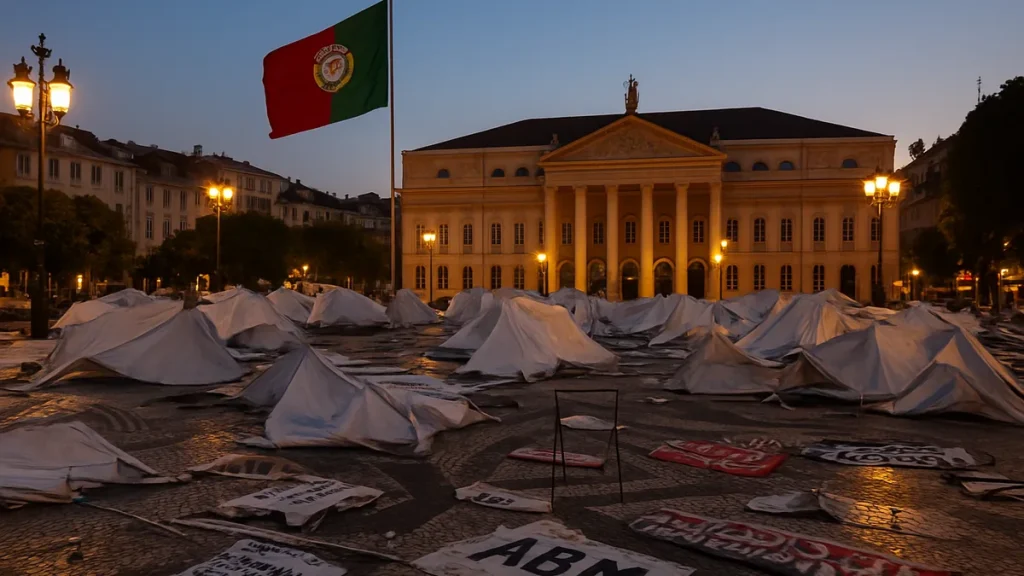

Thousands of demonstrators have gone back to two central squares in Portugal, hours after police cleared their camps in the capital, Lisbon, and the northern city of Porto and arrested 55 people. The protests target a housing crisis that protesters say is getting worse.
Activists want the centre-right government to withdraw a bill that would make evictions easier and end rent caps on new leases. The bill has passed a first reading in parliament.
Camps return to Rossio and Dom Joao I squares
On Tuesday, protesters in Lisbon tried to rebuild their sit-in at Rossio Square, while people in Porto went back to Dom Joao I Square. Organisers said more than 1,000 people gathered at each location. The Lisbon camp had stood since Saturday with about 200 tents, and the Porto camp had been in place for roughly 10 days.
Debora Miranda, 41, a communications consultant, said she joined the Rossio protest to speak for generations struggling with soaring costs. “If people don’t feel at home, in every sense of the word, they can’t move forward with their lives…enough is enough.”
Police clear both camps before dawn
Shortly before 6am, police warned protesters that the camps were illegal and then carried out coordinated operations in both cities. In Porto, demonstrators took down their own tents. Carla Valadao, a spokesperson for the Lisbon camp, described the operation at Rossio as “very aggressive”.
Public Security Police superintendent Sergio Soares told reporters the eviction was “calm, proportionate and appropriate, with no police charge”. The 55 detainees were later released pending a court appearance in Lisbon on Wednesday.
Rising costs fuel anger among young Portuguese
Portugal is facing one of Europe’s worst housing affordability crises, with purchase prices more than doubling since 2017 and rents on new leases nearly doubling. Jorge Paixao, 19, a history student, called it “a societal crisis”. He said his generation needs “the ability to live with dignity, start families and rejuvenate Portugal”.
The pressure is strongest in major cities, which have also seen opposition to excessive tourism and an influx of so-called digital nomads, people who travel while working remotely. The camps mirrored housing protests in neighbouring Spain.