
Sudan’s army has been accused of carrying out several drone strikes that reportedly killed more than 200 people, including dozens who were travelling to a funeral. Sources told the Sudan War Observatory, a group that monitors the conflict, that 150 people died in strikes on two areas of West Kordofan state on Sunday evening.
Separately, the information minister of Abyei said 73 people were killed when drones hit a market in the disputed border area on Monday. Abyei is claimed by both Sudan and South Sudan, which jointly administer it, and the attack has added to tension between the two countries.
Mourners and a market hit in West Kordofan
The wave of drone attacks began on Sunday evening. The Sudan War Observatory believes the drones may have been launched from Kadugli, a city in South Kordofan state that is held by the army.
According to the monitoring group, a truck carrying around 200 mourners was struck as it reached the town of Al-Dabab in West Kordofan. The vehicle had travelled from an area north of Abyei. Sources told the group that 145 people were killed there, and a tent where mourners had gathered was also hit, killing five more. A further 150 people were wounded in the attacks.
Army drones also struck a market in the town of Al-Mujlad in West Kordofan the same evening, the observatory said. It added that the exact number of dead and injured from that strike was not yet known.
The army has not responded to the allegation that it carried out these strikes. It has said, however, that it does not attack civilians, even when it believes Rapid Support Forces (RSF) fighters are among them.
Abyei market attack and its aftermath
The Abyei attack happened on Monday at about 11:30 local time, or 09:30 GMT, and killed 73 people, according to the region’s Information Minister, Yohana Akol Ngor. He spoke to Radio Tamazuj, a broadcaster that transmits from the Netherlands to audiences along the Sudan and South Sudan border.
Ngor described the scene in the market, which lies 10km from Abyei town. “We were surprised by bombing and thick smoke inside Amiet Common Market, which is located 10km [six miles] from Abyei town,” he said.
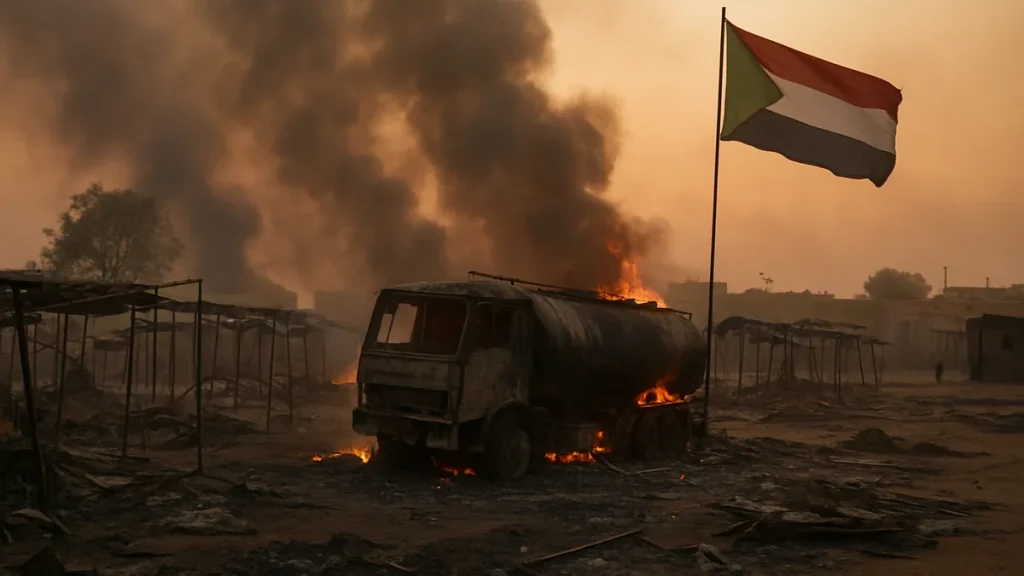
A verification team studied satellite images showing widespread burnt buildings in the north-east corner of Amiet Market, which is also known in Arabic as Al-Na’am Market. Older images of the area usually show it full of trucks. Verified footage from near the market showed a large plume of smoke, at least one petrol tanker, and a voice describing five missiles being fired.
A military source told a news outlet that the army had carried out the Abyei attack. The source said the market was a fuel supply site for the RSF. Ngor told a news agency that emergency workers had struggled to recover bodies because of fires caused by the strikes.
Medical charity Médecins Sans Frontières (MSF) said it had received wounded people from the attack at Ameth Bek Hospital in Abyei town. Christian Lindauer, the charity’s manager at the hospital, said in a statement: “So far we received over 20 patients, including several critical cases. Patients with burns were also admitted. We are providing surgical services and wound dressing, along with other emergency care.”
South Sudan has summoned Sudan’s ambassador to lodge a formal protest over the attack. Both countries claim ownership of the oil-rich region, a dispute that has stayed unresolved since South Sudan ceded it in 2011. There are fears the conflict could spill across the border.
Wider war, drones and humanitarian toll
Separately, a drone strike near the airport in Khartoum on Monday killed four people, including three children, according to a news agency citing a medical source. The same agency quoted a military source saying air defences in the Sudanese capital had downed several other drones launched by the RSF towards the airport.
Drones have become increasingly central to the conflict, which erupted in 2023 between the army and the RSF. Foreign countries have supplied both sides with drones, despite a partial arms embargo on Sudan. Fighting in Kordofan, a strategic area rich in gold and oil, has intensified over the past year, after the army regained control of Khartoum from the RSF.
The war has created one of the worst humanitarian crises in the world. It has killed hundreds of thousands of people and forced more than 14 million from their homes. UN spokesperson Stéphane Dujarric said on Monday: “We are alarmed by the continued deadly drone strikes across the country that are killing civilians, including children, and that are disrupting essential services.”
Dujarric also said that 20 million people were facing acute hunger, with a rising risk of famine in parts of the western region of Darfur and in Greater Kordofan. Greater Kordofan comprises three states and is a vital route linking Darfur, which the RSF controls, to the capital, Khartoum, now in army hands.