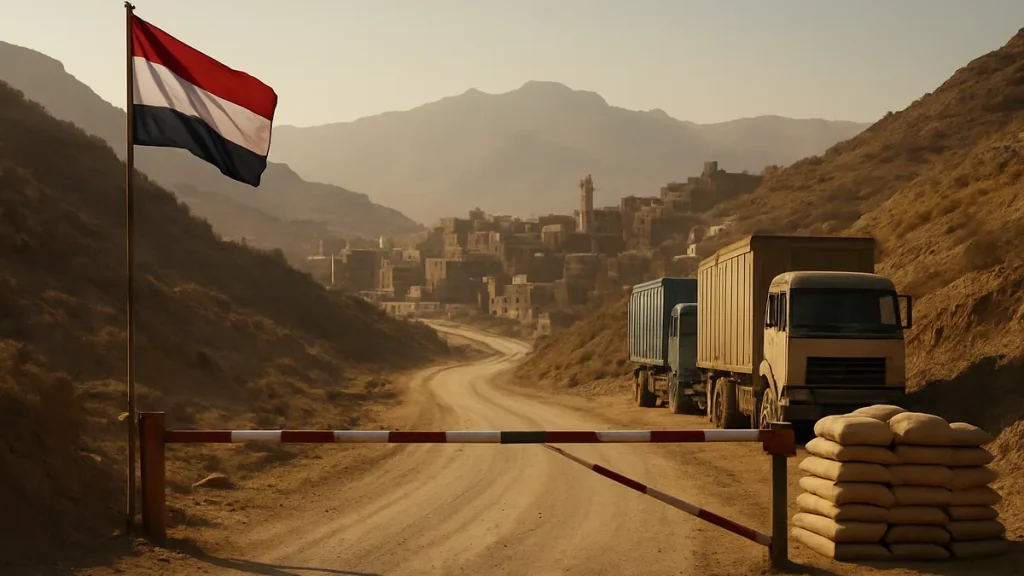

The United Nations has warned that a siege on Taiz, a city in Yemen, has cut off humanitarian supplies and left many residents without food and other essentials. UN human rights chief Volker Turk said on Tuesday that the Houthis, an armed group also known as Ansar Allah, meaning Supporters of God in Arabic, must immediately let relief reach the city or face a catastrophe.
The same day, local authorities raised the death toll from a Houthi attack on a military base in Shabwa governorate to 73. The Taiz and Shabwa developments have come as fighting intensifies across Yemen and spills across the border into Saudi Arabia.
UN warns Taiz is nearing a humanitarian breaking point
Turk said the Houthis’ closure of the only supply route connecting Taiz to Aden was putting civilians at grave risk. He said the blockade was preventing aid from getting in and cutting residents off from essential goods. He also called for civilians who wish to leave the city to be allowed to do so freely and safely.
Taiz has been besieged repeatedly during the war, and the Houthis have encircled it again after capturing a major road that links the city to southern Yemen. Prices of basic commodities have climbed sharply, and some goods are in short supply, according to the UN’s description of the situation.
Fighting in Taiz governorate has killed at least 32 civilians between August 1 and October 19, including 14 children. Fears of further deaths are growing as the fighting moves closer to the city. Turk urged all parties to avoid using explosive weapons with wide-area effects in populated areas and to take every feasible precaution to protect civilians and civilian objects.
The UN World Food Programme warned that shifting front lines and road closures have cut 800,000 people off from life-saving assistance, with the large majority living in Taiz. Across the country, more than 18 million Yemenis face severe food insecurity, the agency said. Yemen’s internationally recognised government had already appealed to the UN to intervene and lift the blockade, warning that the siege threatens more than 4 million people.

Government condemns Houthi missile strikes on al-Alam camp
Forces aligned with the internationally recognised government carried out air strikes in Taiz governorate on Monday. Those strikes destroyed Houthi reinforcements in Najd Qasim and a weapons depot in Jabal Habashi, according to the report.
On Monday, Houthi ballistic missile strikes hit the al-Alam camp. The Yemeni government condemned the attack as a “treacherous bloody assault” and described it as a war crime. President of the Presidential Leadership Council Rashad al-Alimi has formally asked the UN to designate the Houthis as a “terrorist organisation”.
The death toll from the Shabwa military base attack was raised by local authorities on Tuesday, bringing the figure to 73. The government’s response has focused on both the battlefield and the diplomatic track at the UN, with the government seeking stronger international action against the group.
Regional powers respond as cross-border attacks escalate
The United Kingdom said on Tuesday that it would deploy fighter jets to help protect Saudi Arabia from attacks by the Houthis, after cities and infrastructure were targeted by rocket and drone strikes. The British Ministry of Defence said the Typhoon warplanes would play a “defensive role” only and would not carry out attacks inside Yemen.
Egypt’s parliament delayed a vote on Monday on whether to authorise the military to support Saudi Arabia in its fight against the Houthis. Ali al-Dahab, a military and security strategic affairs expert, said that although international support for the anti-Houthi alliance appears to be growing, it is unlikely to lead to troops on the ground in Yemen. He said any foreign involvement would probably be limited to air and naval support.
The Yemeni military launched a broad offensive called “Dawn of Yemen” on October 5 to reverse recent Houthi gains. Early successes were reported, with hundreds of Houthi fighters said to have been killed in air strikes, but questions remain over whether the counter-offensives are losing momentum. Al-Dahab argued that the shift from defence to attack has stayed limited on the ground, and that government influence in al-Marib, an energy-rich part of central Yemen, has not grown as much as the operation’s name suggests.
The Saudi-led coalition said on Tuesday that it had intercepted and destroyed a ballistic missile fired by the Houthis toward Riyadh. The attack led Saudi Civil Defense to activate early warning platforms across the capital. The coalition has carried out waves of strikes on Houthi positions across Yemen during the past week.
Al-Dahab said such strikes could have a tangible long-term impact on Houthi military infrastructure and equipment. However, he questioned whether the government could use them to capitalise on the western coast, where it is trying to win back ground. He asked whether government forces had enough strength to advance toward Mocha or Hodeidah, noting that Houthi fighters are holding on to the Kahboub mountains in Lahij, which overlook the Gulf of Aden and the southern Red Sea.