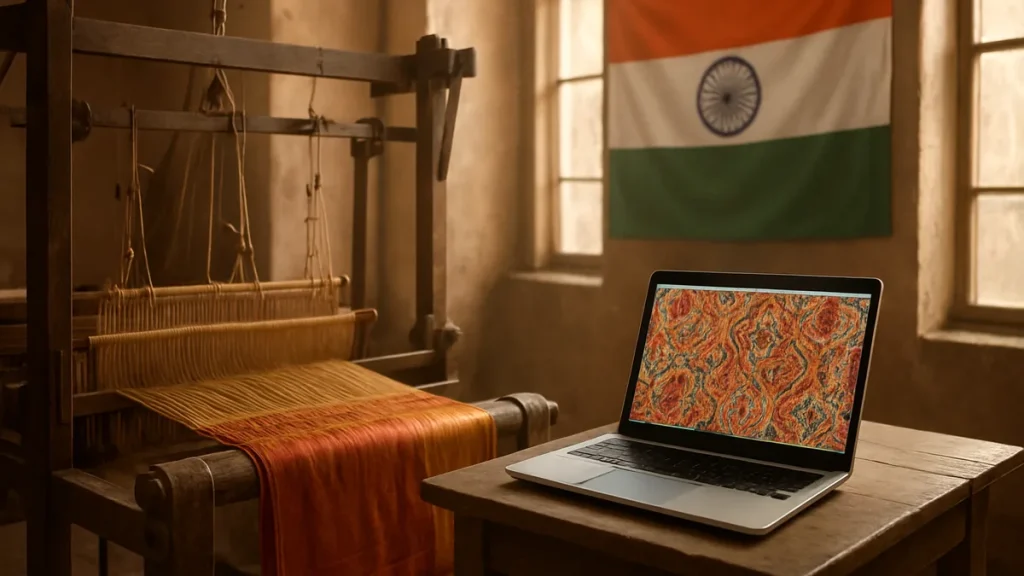

An Indian university researcher says he was inspired to build an artificial intelligence system after noticing repetitive patterns on traditional scarves in Meghalaya. Bitupan Deka, an assistant professor of computer technology at MIT University in Shillong, was shopping for a gamusa with his mother when he saw that nearly every shop was selling the same few designs. He told the news website that he had learned weavers in Sualkuchi, in neighbouring Assam, were paid a one-time fee of about 2,000 rupees ($21) per design rather than royalties.
According to Deka, manufacturers had been reducing the number of designs as a way to cut costs. He has since developed a system capable of producing a large number of new designs for such fabrics. He said the system is meant to support designers rather than replace them, and that his university’s research and development department is applying for a patent. He plans to offer the technology as a commercial design service for the textile industry.
Mass production pressures on weavers and artisans
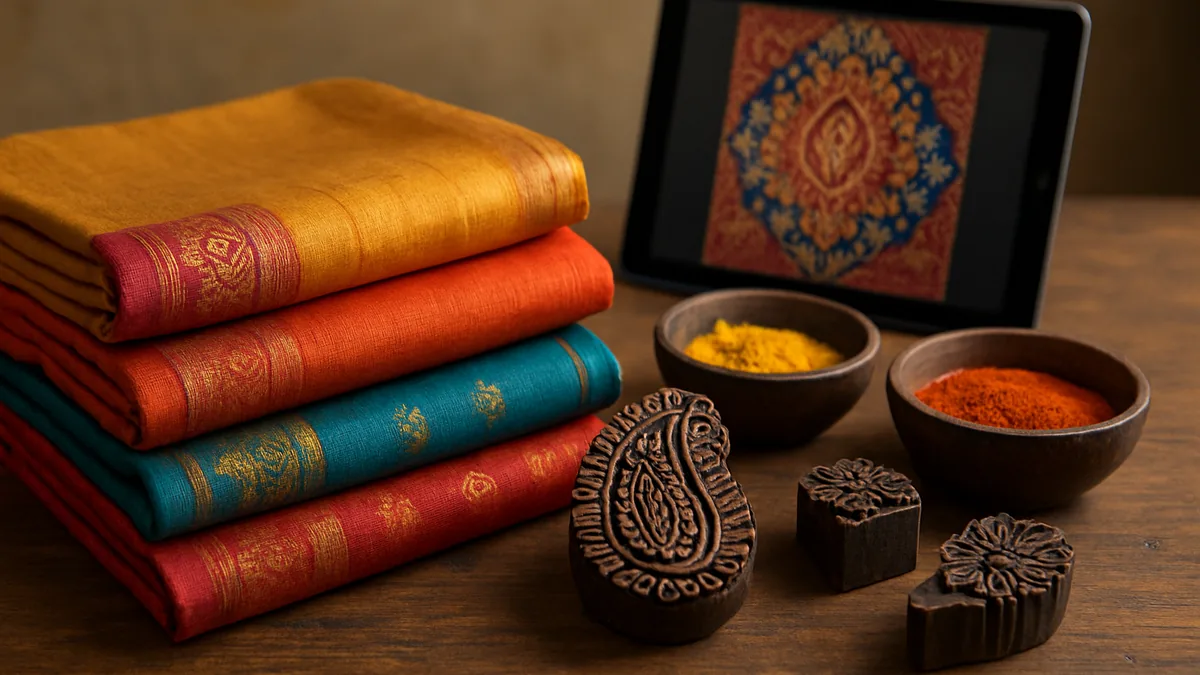
Textile traditions in India carry the history of a region, its myths and, in some cases, the record of migrations. Weavers typically draw their motifs from things around them and colour them with locally available materials, often applying them with carved clay and wooden frames. Their skill is passed down through families, so a pattern is not simply copied but inherited along with the judgement behind it.
A computer, by contrast, learns by studying images and generating variations of them. Deka’s work shows that such a system can now reproduce a traditional flower motif. Another example is the Rekh Sanganeri Dataset, which was built for hand-block printed textiles from Rajasthan. Its developer, Reddy Sai Nivas C, said it should serve as a resource for research and art and should not be used as a replacement for artisans. Critics of such tools would point out that a resource built to preserve a craft can also make its visual style easier to copy without the craftspeople involved.
Dinesh Chhipa, a Bagru designer and textile businessman from a family of dyers and block printers, takes a pragmatic view of the technology. He said traditional craft takes time, and that he did not blame producers who use digital tools and AI to meet demand. He was far firmer about names, however, warning against borrowing regional labels such as Bagru and Jaipuri, which he said grew out of the culture and needs of their communities.
Tata Consultancy Services, an Indian software company, showed a system called Bridgital Loom at the India AI Impact Summit in New Delhi in February. The AI converts textile designs into instructions a loom can follow, with LED lights guiding a weaver through the thread sequence of Banarasi and Kanchipuram patterns. A pilot is already running in Kanchipuram, a town in southern Tamil Nadu state. The company says the tool helps weavers complete complex work faster and with fewer errors.
Muthulakshmi Nellaiappan, head of AI strategy at Bridgital Loom, told the online platform Digit that a new weaver needs more than 15 years to master the craft. She argued that new technology could help younger weavers reach mastery much sooner. Critics might see a different trade-off, since the machine’s instructions can take over tasks such as remembering patterns and colour codes that once belonged to the weaver. Nellaiappan added that because many of India’s looms are not electronic, the system was also designed to work with handlooms.
Ananthalakshmi Vadivel, a third-generation weaver who runs Vadivel Silk Looms in Kanchipuram, said her business already competes with cheaper Kanchipuram sarees made on electronic looms. She suggested AI could let sellers produce trend-driven designs more quickly and cheaply. In her view, however, “these imitations can never replace the original,” and buyers who value authenticity will continue to seek handmade textiles.
Copyright rules struggle with communal designs
Who owns a design that becomes data is now a central question. For generations, India’s textile knowledge existed outside formal intellectual property systems, living in community memory without any certificate of ownership. Now that knowledge is entering generative models, and the systems trained on it owe nothing to the communities that developed it.
In December 2025, the Department for Promotion of Industry and Internal Trade, a federal government body, proposed a statutory “blanket licence”. Under the proposal, AI developers could train models on lawfully obtained copyrighted material without seeking permission from each rights holder, and would pay royalties to copyright owners at rates set by the government once the systems were commercialised. Intellectual property laws, however, are built around a traceable work and a traceable author, while a motif is often communal and has no single originator.
That gap leaves open who should be paid. The artisan who first made the design, the photographer who documented it, the researcher who assembled a dataset and the developer who built the tool all have some claim to the work. India’s laws, according to the article, offer no clear answer.
The government has announced further steps. It plans a dedicated AI-handloom research department under the Centre of Excellence for Handloom Technology at the Indian Institute of Technology in New Delhi. The $1.4m facility, inaugurated in August, aims to modernise the handloom sector by combining traditional weaving with contemporary technology. Officials also plan to register thousands of weavers, fit handlooms with sensors that turn weave patterns into digital data, and issue QR-coded tags to trace where products come from. Maharashtra’s Vingatha system already authenticates handloom sarees such as Paithani and Karvat Kathi at the state level.
Galleries turn traditional textiles into contemporary art
Traditional textiles are also moving into art galleries, where they are increasingly described as contemporary art rather than craft. Gurjeet Singh, an artist from Chandigarh, recently held a textile-based solo show in New York. His sculptures use discarded fabrics, buttons and embroidered scraps to explore queer identity and social prejudice. Sayan Chanda, an Indian artist based in London, cuts and rewoven vintage Bengali quilts to question fixed ideas of cultural belonging, while Gurugram-based Sumakshi Singh uses embroidery and suspended threads to rebuild the architecture of vanished homes and gardens.
In New Delhi, 20 artisans and craft-led collectives took part last month in an art show celebrating traditional textile crafts. Its curator, Aparupa Ray Ganguly, said the aim was to present these crafts as living practices that keep developing through contemporary makers, rather than as heritage to be stored away. She cited Kanmai Payun, the last practitioner of Fulor Saneki, an Assamese flower pattern, and said the team encouraged her to teach her 17-year-old son so the craft would outlast her.
Visibility in galleries does not automatically give makers control over their work. In April, another New Delhi exhibition, titled No ‘One’ Maker, had artisans missing from its preview. Chhipa said the names of communities should not be separated from their work, and that mass-produced items should be sold as digital prints, with traditional names kept for the original artisans.