

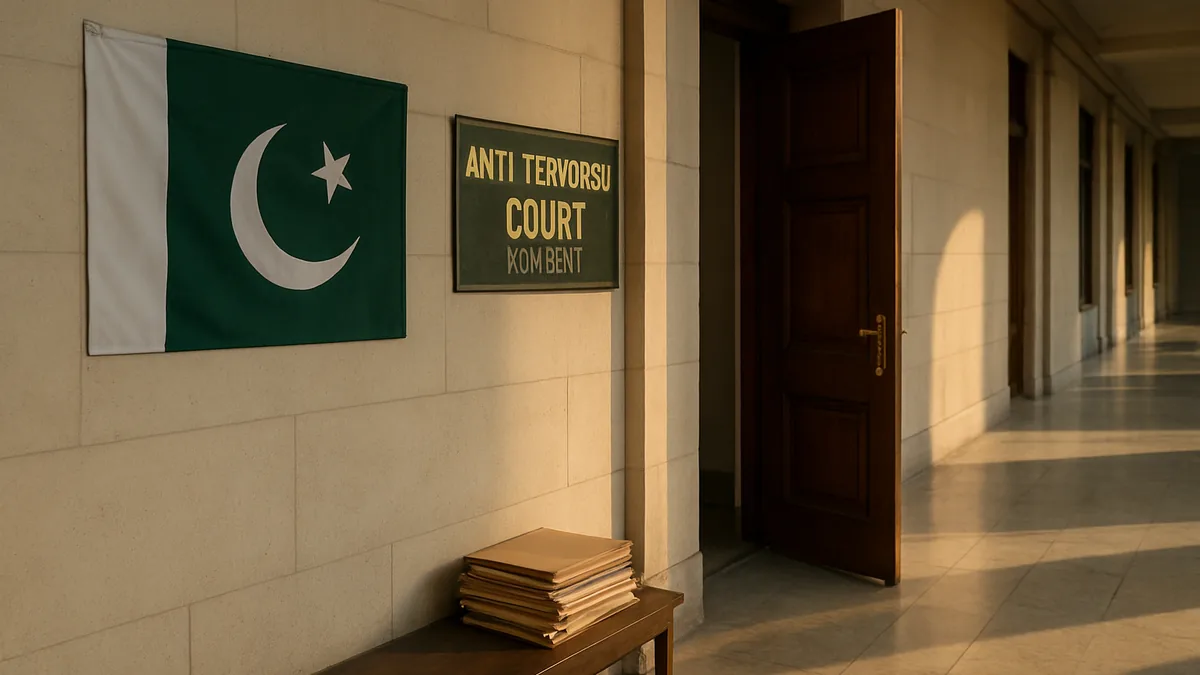
The Federal Constitutional Court of Pakistan (FCCP) on Wednesday reinstated three Anti-Terrorism Court (ATC) judges whom the Sindh government had removed from office. The court set aside an order of a division bench of the Sindh High Court’s Circuit Court at Hyderabad and held that the provincial notification removing the judges had no lawful authority behind it.
The judges had been ousted after amendments to the Anti-Terrorism Act, 1997, which set an upper age limit of 65 for judges of such courts. The case was brought by Muhammad Yameen, Ubaidullah Khan and Syed Zakir Hussain, who challenged how the Anti-Terrorism (Sindh Amendment) Act, 2025 applied to judges appointed for fixed terms before the changes took effect.
Sindh notification and the High Court ruling
Under the revised Section 14, judges and presiding officers of Anti-Terrorism Courts must step down on reaching 65. The amendment appeared in the official Gazette on September 2, 2025. Afterwards, the Sindh government issued a notification ordering the three judges to stop working immediately, even though their set terms had not run out.
The judges asked the Sindh High Court for permission to serve until their tenures ended. The high court rejected their petitions, holding that the age limit covered both sitting judges and those appointed later.
Arguments before the Federal Constitutional Court
The petitioners then approached the FCCP, where counsel Salahuddin Ahmed contended that the amended provisions could not be applied to appointments made before the law came into force.
Opposing the petition, Additional Advocate General Sindh Barrister Sandeep Malani and Additional Prosecutor General Sindh Siraj Ali Khan Chandio maintained that the changes also covered judges already in office. The court then considered whether the new age cap could reduce the fixed tenures of judges selected under the earlier law.
Court’s reasoning and order for Muhammad Yameen
The court found that the amending law contained neither an express provision nor any necessary implication extending the age limit to existing fixed-term appointments so as to shorten them. It said judges appointed for a set period under the earlier law had acquired a vested right to serve that period, subject to the conditions governing continuation or early termination.
Where an amended provision could reasonably bear two meanings, the court said the reading that protects an existing right should prevail. As a result, the newly prescribed age limit could not cut short the remaining tenures of these judges.
Setting aside the high court order, the FCCP held the notification to be unlawful and to have no legal force. It further ruled that Muhammad Yameen would be treated as having remained in office despite the notification, and could continue as Judge/Presiding Officer of Anti-Terrorism Court-IV, Karachi, until his two-and-a-half-year term ends, subject to the conditions of his appointment under the law.