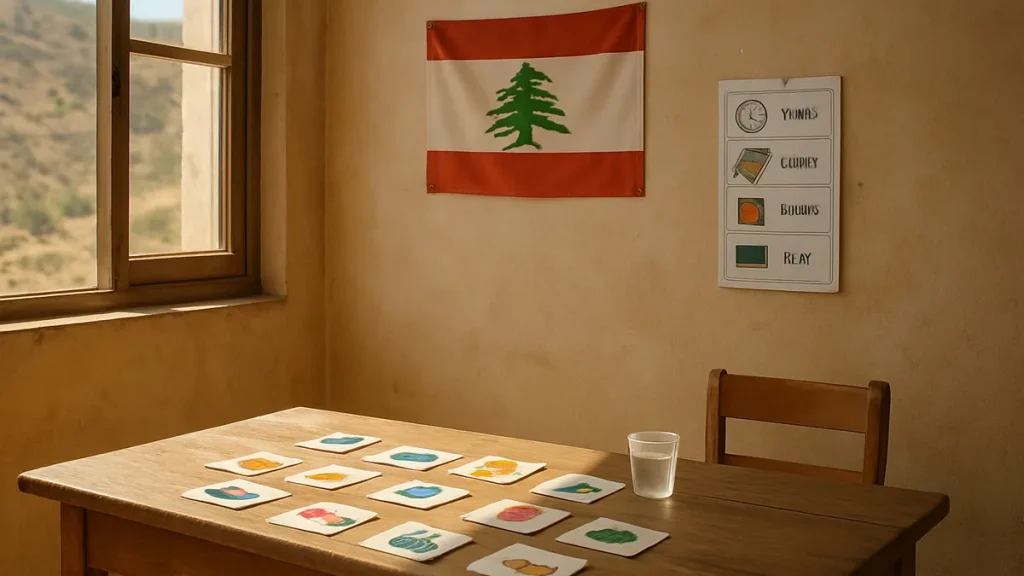

Families of young people with autism and attention-deficit/hyperactivity disorder (ADHD) in Lebanon say the war has disrupted their children’s routines, schooling and access to care. Lebanon has been engulfed in war since October 2023, with bombings across the country and an economic crisis that continues to affect all Lebanese, particularly neurodivergent people.
Lena Kouyoumjian, who moved back to her parents’ home in Mazraat Yachouh, a village about 20 minutes’ drive from Beirut, after her husband died from COVID-19 in 2020, says her 20-year-old daughter Vana needs constant support. Vana is autistic and non-verbal. When Israel escalated its attacks on southern Lebanon in March, Lena said she understood the impact this could have on her daughter.
A mother’s effort to keep her daughter’s routine
Lena said that autistic people, like many neurodivergent people, need a stable environment and a structured routine to feel well. Vana cannot tell her mother verbally how she feels, so Lena works to read her signals. Lena first noticed her daughter’s symptoms when Vana was two.
“Any sudden change in routine, loud noises, fear, or uncertainty can increase their anxiety and make them feel unsafe,” Lena said. She added that she could see the effect on Vana, who has become more anxious and sensitive to changes around her as the situation has grown harder.
Lena also described the strain of caring for a child with autism. “Being a parent of an autistic child isn’t something every parent can handle,” she said. “A challenge I often face is deciding the amount of time and energy I should allocate to my child.”
Sensory distress and a changed home life
Symptoms of autism and ADHD vary from person to person, but they often include sensory issues and emotional dysregulation. The two conditions frequently occur together, a combination sometimes called AuDHD. People with these neurodevelopmental conditions are often stigmatised by societies that do not fully understand them, including in Lebanon.
Ghada Hayek Makhoul’s son, Anthony, is a 27-year-old autistic man who is also non-verbal and relies heavily on helpers. Ghada said it is clear when he is distressed, because he puts his hands over his ears when he is in pain from sensory discomfort. She said the sounds of the war, including bombs and the sonic booms of warplanes, had a strong effect on him.
“So, imagine the drones all the time [for autistic people], the bombs, and the vibration of the bombs,” Ghada said. “All of this that we were hearing, so of course it affected him a lot.” She said her son had stopped watching television because the news was too triggering, and that he no longer wanted to go into a pool, though he had once loved the water.
Ghada said she did not know what had caused the change. “Because it’s outside? Because of the sound? I don’t know,” she said.
Rising costs put autism and ADHD services out of reach
The war has had a direct economic impact on the Autism Awareness Association (AAA), a nonprofit based in Antelias, outside Beirut, and on other organisations that provide neurodivergent or psychological support. Vana has attended the AAA’s classes for the past six years, and the group serves as an alternative school for young autistic people. Lena said rising costs have stopped Vana from attending regularly, and that transport became so difficult that at times she could not go at all.
Ghada, who co-founded the AAA with other parents of autistic children in 2015, said the group had made constant efforts to raise awareness of autism in Lebanon. She said many people do not understand the range of the condition, from mild to moderate to severe. The AAA’s services, however, cost $700 a month for children attending five days a week, and with 80 percent of the population living in poverty, few families can pay for them.
Lebanon’s economic crisis has also driven a brain drain of professionals who could support neurodivergent people. Ghada said the centre needed more trained staff and had to keep those who were leaving the country, but better salaries were not affordable. “Things are in crisis mode for everybody during the war,” she said.
Other mental health services face similar pressures. Many non-governmental organisations provide free therapy, but private consultations can cost more than $100 for a single 50-minute session. Nour Toukan, a public health researcher at Enmaeya, a media platform focused on sustainable development, described care for autism or ADHD as “very much an out-of-pocket expense.”
Government programmes leave gaps in support
The government launched a National Disability Allowance in 2023, funded by the European Union and the United Nations Children’s Fund (UNICEF). However, the allowance of $40 a month does not cover even basic needs in Lebanon, according to the reporting. People with autism can obtain a personal disability card issued by the Ministry of Social Affairs, which makes them eligible for support, but people with ADHD cannot.
Lebanon’s National Mental Health Programme, set up in 2014 by the Ministry of Public Health, is trying to close gaps in support caused by economic and geographic factors. Its founder and director, Dr Rabih El Chammay, said a national mental health strategy for children and teenagers is being finalised. He said national studies on autism and ADHD had provided evidence for this work, and that the programme was meeting organisations representing families of people with autism.
“War makes this work more difficult because it can increase support needs while disrupting the services people depend on,” Dr Rabih said. Displaced people have been hit hardest, but anyone in Lebanon whose schooling and routines have been disrupted is affected, the article said.
Adham Faraj, a 23-year-old psychology student at the Lebanese American University in Beirut who was diagnosed with ADHD in 2024, said that when his classes moved online because of the war, he began staying home more. “It’s less engaging, especially if you struggle with attention,” he said. He also said the cost of medicine worried him. “Maybe an $11 box of medication is affordable for some, but not for everyone,” he said.
Rim Ajjour, a psychologist and psychotherapist in Beirut who works with young people with autism, said many skills that neurodivergent people had learned before the war are now being lost. She said her clinic and others were keeping therapy accessible by freezing consultation fees, even as their own costs rose. With Israeli attacks continuing in southern Lebanon, which remains occupied by Israeli forces despite a US-brokered June ceasefire, she said many fear what a return to full-scale war would mean. “I don’t know how we’ll be able to take it again,” Rim said.