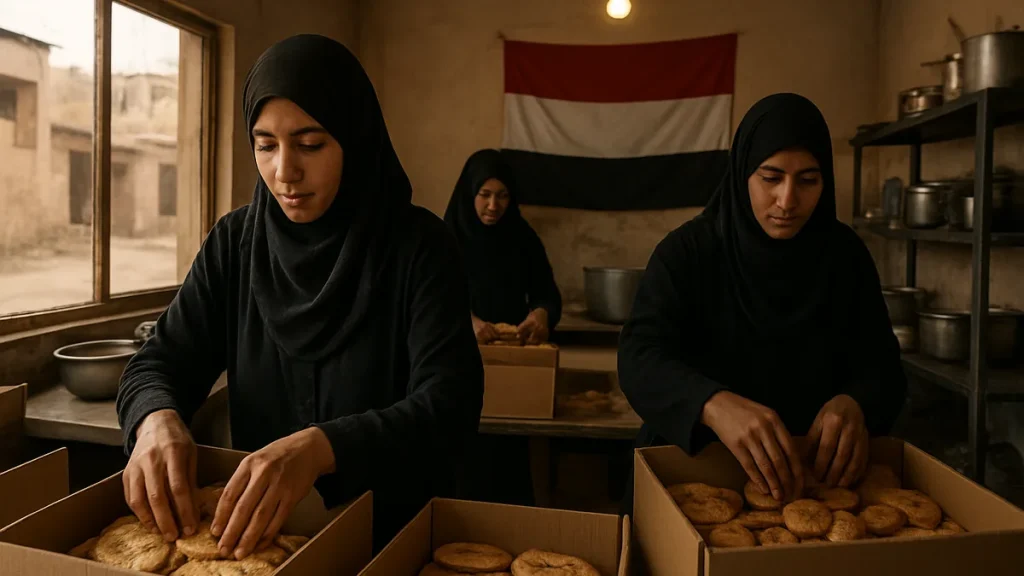
Women in the southwestern Yemeni city of Taiz, which is held by the government, have moved from organising food for soldiers to raising money for weapons and ammunition. The change comes as Houthi fighters tighten their siege on the city. The women began by preparing food deliveries for the forces defending Taiz.
The initiatives emerged spontaneously after fighting resumed in early September in the western countryside of Taiz governorate. The conflict pits Saudi-backed government forces, which are internationally recognised, against the Iran-backed Houthi group.
From baked cookies to ammunition as the siege tightens
The movement started with volunteers baking cookies for fighters on the front lines. Amira al-Saghir, an activist involved in the campaign, said the goal was to strengthen ties between the local community and the army and pro-government popular resistance forces. She described the city as besieged and subjected to daily shelling in preparation for an invasion.
Also read: Yemen's Taiz Under Siege as Shabwa Death Toll Climbs to 73
The cookie initiative drew wide participation from women and encouragement on social media. It overlapped with a broader community effort to send food, basic necessities and weapons to fighters, with contributions coming from districts and villages across the governorate. Over time, the women’s work expanded from baking and organising food convoys for arms kitchens to buying ammunition.
The fighting in western Taiz began with a major Houthi ground offensive in early September. The group, also known as Ansar Allah, quickly took territory along Yemen’s Red Sea coast, including the strategic port city of Mocha on September 10. That gave it a stronger presence around the Bab al-Mandeb strait, a vital shipping route. The Houthis then advanced towards other parts of Taiz governorate, seizing key routes into the provincial capital and effectively surrounding the city.
Government forces have since launched counteroffensives, though control of some areas remains contested. The renewed siege has severely restricted the movement of people and essential supplies into the city. Shortages of food, fuel and medicine have followed.

Why women say they moved beyond humanitarian aid
Women involved in the initiatives said they felt they had been forced to act because of the risk that the city could fall to the Houthis. The shift accelerated as more rural districts fell to the group. Some donors made their contributions conditional on part of the money going towards ammunition for fighters.
Al-Saghir believes the change was also driven by information and criticism circulating on social media. That material suggested government fighters in Taiz lacked enough ammunition to keep defending the city and the surrounding front lines.
Huriya Wabel, a humanitarian activist who joined the effort, said the group felt it had to take a firm stand. “After we saw that those [Houthi] militias … are waging a war of extermination against our city, we felt that we had to take a serious stand to support the army, not just with food and clothing, but with weapons as well,” she said. She added that many civilians wanted to fight alongside the army but had no weapons, so the group decided to focus more on that need.
Khadija al-Majidi said the move from humanitarian supplies to military equipment was a response to the growing threat. She described a situation in which the enemy had reached the city’s gates and imposed a complete siege, with residents facing being killed, captured or displaced. She asked what people expected of the women of Taiz in that situation.
Front-line trips and donations from families and abroad
When she spoke to reporters, al-Majidi had just returned from fighting around Jabal Sabir, the mountain that overlooks Taiz from the south. It was her second trip to the front that day, during which she delivered ammunition and other military supplies valued at $3,000 to a commander, along with winter clothing, shoes, food and other necessities.
She said that after more than a decade of living through Yemen’s devastating war, she no longer felt afraid to visit active battlefronts. Repeated visits, she said, helped remove fear by showing the courage of fighters defending the city and their confidence in victory.
The women’s department of Taiz’s Supreme Council for Popular Resistance launched a campaign on October 8 to equip 10,000 pro-government fighters with rifles and ammunition. The council has asked Yemenis at home and abroad to contribute. The campaign reflects the situation on the ground, where government forces face daily Houthi attacks while also attempting their own counterattacks.
Both al-Saghir and al-Majidi said many donations come from Yemenis living abroad, but people in Taiz are also giving whatever they can despite the humanitarian crisis. Al-Saghir said one woman whose husband was fighting in the army donated her wedding ring. Al-Majidi described other women handing over gold jewellery. She also recalled a woman who arrived at her home with envelopes containing Yemeni and Saudi currency, on which she had written: “God willing, we will win. Buy ammunition for the heroes with this.”