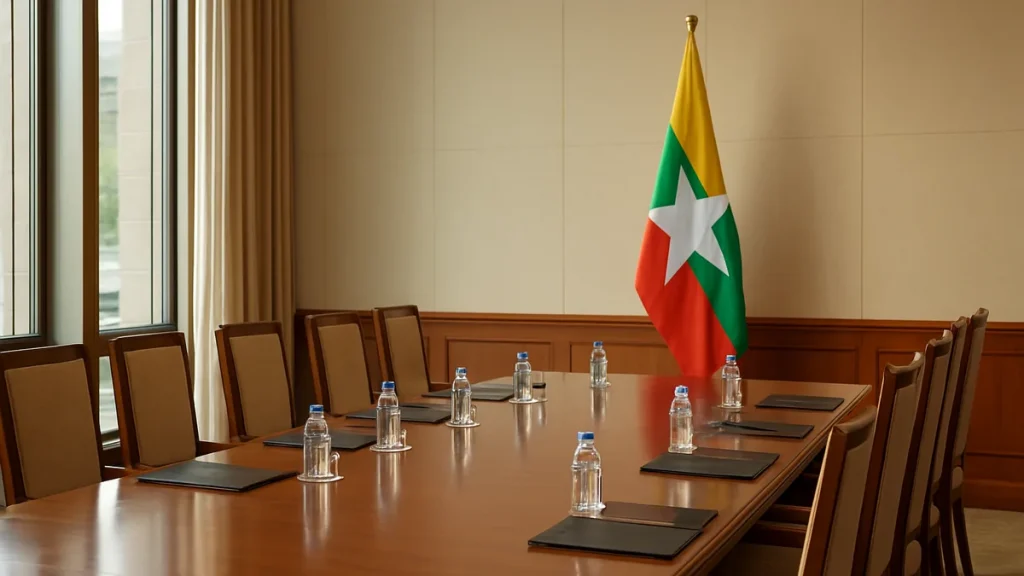

A senior United States official met Myanmar leader Min Aung Hlaing in mid-September, the most senior American contact with the military government since the 2021 coup. Michael Vance, the US Assistant Secretary of State for Intelligence and Research, held the talks on 15 and 16 September in the capital, Nay Pyi Taw. The meeting, along with the removal of some business figures from the US sanctions list, suggests Washington may be changing its long-standing policy of isolating the regime.
The stated purpose of the visit was to secure the release of Adam Castillo, a US citizen detained in June over a dispute with the American Chamber of Commerce in Myanmar. Vance is also known to have met Burmese officials in Tokyo in June and again this month, and to have met representatives of groups opposing military rule. Until now, Washington had maintained very little official contact with the regime, which took power after the military ousted democratically elected leader Aung San Suu Kyi in 2021.
Washington’s warming tone toward Min Aung Hlaing
The signs of a shift go back to July of last year, when President Donald Trump was in the middle of his tariff dispute with trading partners. Min Aung Hlaing and other regional leaders received a personal letter from the US president saying that tariffs of 40 per cent would hit Myanmar’s struggling economy. Many countries reacted with alarm to the levies on their trade with the United States.
Min Aung Hlaing responded quickly, thanking Trump for an “encouraging invitation to continue participating in the extraordinary Economy of the United States, the Number One Market in the World”. He also praised the US president’s “strong leadership” and “the spirit of a true patriot”. The reply echoed Trump’s own emphatic style.
The exchange stood out because Min Aung Hlaing had been widely shunned since the coup, and his regime was largely unrecognised. He has been accused of war crimes, with cases lodged against him at the International Criminal Court and the International Court of Justice. Apart from Russia and, more recently, China, other governments had kept their distance. Trump’s letter addressed him as “Your Excellency” and made no mention of the human cost of the takeover or of Aung San Suu Kyi’s imprisonment.
Lobbying, sanctions and a silent election stance
That same month, the regime signed a contract worth $3m (£2.3m) with DCI, a long-standing Washington lobbying firm. DCI had also been used by an earlier Burmese military government in 2002 to try to improve its image. The military government has since hired Roger Stone, a controversial lobbyist and confidant of Trump, at a fee of $50,000 a month.
At around the same time, Adam Castillo, a former US marine and Trump supporter who had recently stepped down as head of the American Chamber of Commerce in Yangon, was in Washington. He pressed the team of Vice President JD Vance that it was time to re-engage. Castillo argued that reliance on sanctions to isolate the junta had failed. In his book, Finding Our Voice: A Story of Leadership in Crisis and the American Spirit Abroad, he wrote that Myanmar mattered to America as a strategic interest, not only as a moral question.
Castillo’s argument fell on receptive ears. China had blocked rare earth exports in April in retaliation for Trump’s tariffs, exposing US dependence on Chinese supplies. Myanmar has large reserves of rare earths, which are currently being mined largely for Chinese use. Almost at the same time, the State Department issued guidance telling US embassies to avoid judging the fairness or legitimacy of elections abroad.
That guidance mattered when Myanmar held its general election in December and January. The vote, widely criticised, allowed Min Aung Hlaing to become a nominally civilian president. Unlike most Western governments, the US did not condemn it as neither free nor fair. Washington’s decision to lift sanctions on some figures targeted under the Biden administration appeared to confirm the new direction.
Doubts over what the US can gain from Myanmar
DCI described the change in a recent newsletter, saying the era of isolation and sanctions was over and praising Trump’s “courage to try something different”. Analysts are less convinced that the substance has changed. Richard Horsey, Myanmar adviser for the International Crisis Group, said “less has changed than the headlines suggest”, noting that Min Aung Hlaing remains sanctioned. He said the new elements were the level of contact and the location, and that the leader’s next goal was sanctions relief, which would be harder to achieve.
Another Trump initiative last year may have had a far greater effect on Myanmar. The dismantling of USAID cut aid to opposition groups, dissident media and refugees by more than half. The administration also withdrew Temporary Protected Status from 4,000 Burmese living in the US, a decision that human rights groups criticised. Those affected now fear being sent back, where many could face imprisonment or worse.
Few experts expect Myanmar’s rare earths to be of much use to the US. Most deposits lie in areas contested by ethnic armed groups, and they are currently extracted by Chinese companies and transported across the border for processing. It is unclear how Washington could gain access. Cooperation on scam centres also looks doubtful, since a few high-profile raids have pushed operators into smaller sites in remote areas, and many run with support from militia groups linked to the military.
Hunter Marston, Southeast Asia director at the Lowy Institute, said talks with Nay Pyi Taw were “not wrong in itself”. He said the key question was what Washington asked for and what it offered in return. He urged the US to use the channel to press for humanitarian access and an end to airstrikes on civilians, while continuing to engage the opposition and ethnic armed groups. The bigger question, according to the analysis, is whether Trump, distracted by domestic politics and the war on Iran, can give Myanmar sustained attention and challenge China’s influence there.