Measles has returned to the United States decades after the country was officially declared to have eliminated it. The US Centers for Disease Control and Prevention (CDC) has announced the third measles death in the country this year.
Pennsylvania has been hit especially hard in the latest outbreak. In September, the state asked the CDC for emergency support to curb the spread, even as state and federal health officials disagreed over how measles-associated deaths should be classified. State officials have recorded more than 1,200 cases and over 240 hospitalisations across 42 counties so far this year.
Pennsylvania’s outbreak and the push for emergency aid
Matt Ferrari, director of the Center for Infectious Disease Dynamics at Pennsylvania State University, said the United States had been so successful at wiping out measles that it could afford to forget how dangerous the disease is. He said many Americans, and people across the Western Hemisphere, had lost sight of how severe measles can be.
Also read: CDC confirms third measles death in the United States this year
The case surge has also alarmed neighbouring states. On October 5, New York Governor Kathy Hochul declared a state disaster emergency in response to rising cases in rural areas. The order widened the number of health professionals permitted to vaccinate and test people for measles.
Hochul said that no one should become seriously ill or die from a disease that can be prevented by vaccination.
Vaccination gaps in Lancaster and beyond
Experts warn that the risks extend well beyond state lines. Measles cases are rising around the world, particularly in communities that are sceptical of vaccines or have limited access to health care. Vaccination coverage among US kindergartners fell from 95.2 percent in the 2019-2020 school year to 92.4 percent in the 2025-2026 school year.
Pennsylvania reported in August that two unvaccinated people had died of measles in Lancaster County, in the South Central part of the state. Lancaster is the heart of Pennsylvania Dutch Country and is home to the nation’s oldest Amish and Mennonite communities, both of which have large numbers of under-vaccinated residents.
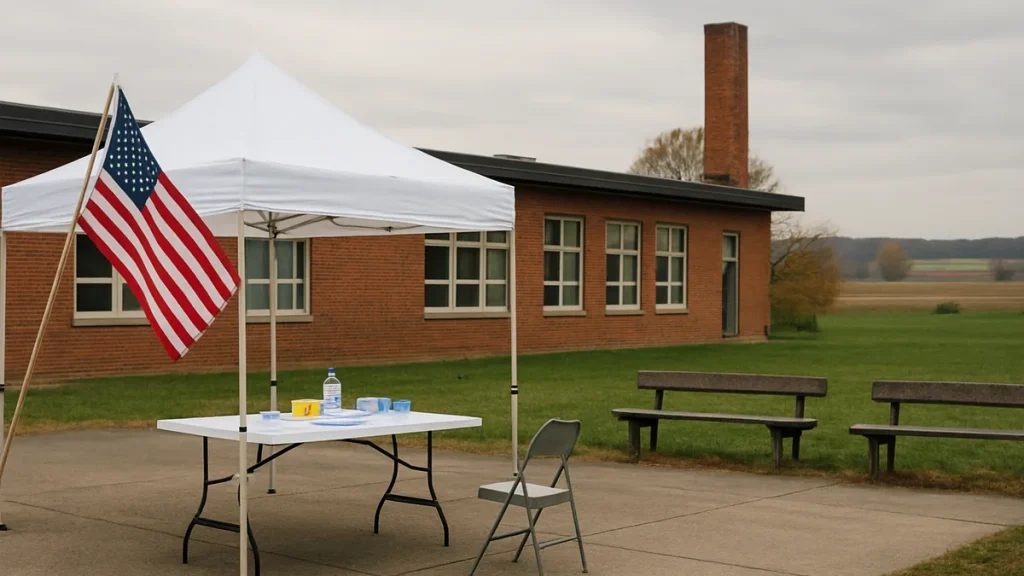
Joshua Good, principal of Ephrata Mennonite School in Lancaster County, said two students at the school had contracted measles earlier this year. He worked with state officials to set up a pop-up vaccination clinic at the school. Officials supplied communication materials, which the school adapted for its community, and helped identify families at risk.
Good described the response as productive, but he told state officials that vaccine scepticism remains strong in the Mennonite community. He said community members had made their choice based on their own judgement, not because they lacked access to vaccines. Good, who is vaccinated along with his children, describes himself as an advocate who answers families’ questions as best he can. Although several community members were vaccinated at the Ephrata clinic, rates remain below the level needed for herd immunity.
Officials urge early outreach and faster action
Public health officials argue that outreach must be built long before an outbreak. Jennifer Nuzzo, director of the Pandemic Center at the Brown University School of Public Health, warned that officials cannot simply arrive in a community during an emergency, when residents may feel they are being blamed or shamed. Communities need to know public health workers as a resource, she said, rather than as law enforcement.
Nuzzo said low vaccination coverage and distrust of government allow measles to spread even where vaccines are available. She argued that this should not stop governments from building relationships with sceptical communities. She also said that framing the problem around demographics lets governments off the hook for their responsibility to stop the spread.
Ferrari said the communities at the centre of the outbreak had long been vulnerable, but higher vaccination rates in the surrounding areas had acted as a barrier. Dr Daniel Salas, executive manager of the Special Program for Comprehensive Immunisation at the Pan American Health Organization (PAHO), said action in the first three days after a suspected case is critical. Health authorities should start investigating and responding without waiting for laboratory confirmation, he said, because delays of a week or more can let the highly contagious virus spread further. Its symptoms include fever, coughing and a rash across the whole body.
Elimination status at risk across the Americas
The continental Americas became the first World Health Organization (WHO) region to eliminate endemic measles transmission, in 2016. Keeping that status requires high and consistent vaccination coverage. PAHO says coverage across the region remains below target for both doses of the measles vaccine.
An independent technical body of international experts reviews whether countries in the region have eliminated measles, rubella and congenital rubella syndrome, and it meets each year at PAHO’s RVC Measles Elimination Status Conference. A country can lose its elimination status if the same measles virus genotype circulates continuously for at least 12 months. Canada lost its status last year, after an outbreak that began in 2024, and some have warned that the US may be on track to lose its status this year.
Salas said Mexico and Bolivia would also be closely assessed, because both could potentially lose their status. US Health and Human Services Secretary Robert F Kennedy Jr has repeatedly defended the American response. At an August 26 event in Florida, Kennedy said the US was doing a better job than any country in controlling the outbreak, citing higher case numbers in Mexico, Canada and Britain.
Nuzzo said the repeated outbreaks across the US showed a country struggling to contain transmission. She said the country had not seen the disease this bad, describing the pattern as a constant game of whack-a-mole. Scientific journals have found that the virus strain behind Canada’s latest outbreak was genetically linked to cases in US Mennonite communities, the same outbreak that cost Canada its elimination status. Nuzzo said: “The spread of measles in the United States imperils other countries.”