Twins Raghad Hassan and her brother Raad are seven weeks old, and they have been fighting to survive since the day they were born. They arrived prematurely as fighting intensified in Yemen’s long-running civil war between Houthi rebel fighters and government forces.
The twins were taken to al-Sadaqah hospital in the port city of Aden, where doctors diagnosed severe acute malnutrition. By the time the family arrived, the babies were barely clinging to life, according to staff at the hospital.
A three-day walk from the war to Aden
When the Houthis reached the family’s village in the Kahboub mountains in south-west Yemen, the family of seven was forced to flee. Bombs, missiles and drone attacks were falling around them, and the twins were protected only by blankets.
Also read: Houthis claim attack on Saudi position in Aden, third in a week
The family then walked for three days towards Aden. Their father, Bajash Ali Sagir Hassan, a shepherd, said they could not find any cars or transport. A stranger finally gave them a lift on the fourth day, after others had refused to help.
As they walked, the twins grew weaker, their mother Lina said. “They were exhausted,” she said, describing the cold, the dust and worsening vomiting and diarrhoea.
Overcrowded malnutrition unit struggles at al-Sadaqah hospital
When the family reached the hospital, Raad was the more critically ill of the two. His ribs were visible and his chest heaved as he breathed rapidly and shallowly. A doctor described the babies as “just skin and bone” as he looked at their wasted limbs.
Bajash said the twins were fed twice a day, but on some days he could only give them water. He said the war had pushed up the price of baby milk.
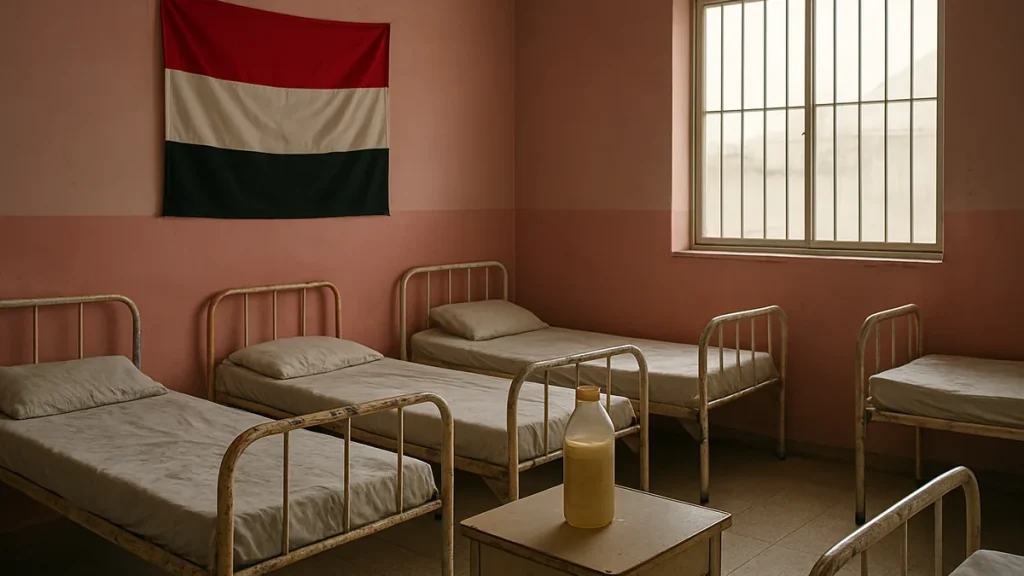
The hospital’s malnutrition unit had no free beds when the family arrived. Bajash rushed through the corridors to get an admissions slip, and he found help from Aisha Ragab, a supervising nurse who had herself fled the war in 2018. She said she had already lived through a similar situation.
Aisha told staff that the twins would share a bed so they could be saved. Within an hour, the two babies were lying together on one bed. Raad still could not keep down the fortified milk his mother gave him.
The unit has 22 beds, but staff said only 13 patients can be admitted at a time, the most critical cases, because of a lack of international funding, staff and equipment. Dr Noor Mohammed said the hospital lacks ventilation machines and oxygen bottles, and that laboratory tests are very difficult to carry out.
“It’s sad to say, but we lose patients [because of the conditions],” she said.
Families pushed deeper into hunger as fighting spreads
The United Nations says around 800,000 people can no longer receive lifesaving aid and more than 250,000 have been displaced. It says this followed the collapse of an informal ceasefire in the summer. The UN also said that half a million Yemeni children were expected to suffer severe acute malnutrition this year, even before the latest escalation.
According to the UN, the Houthis have advanced along the Red Sea coast and have completely cut off Taiz, Yemen’s third largest city. The UN says civilians there are “at grave risk” and lack food because prices have soared. The internationally recognised government is fighting back against the Houthis with the help of Saudi air strikes.
Dr Mohammed said many families who come to the hospital have no money or insurance and cannot afford a private hospital. Children often return soon after being discharged because their parents cannot afford proper nutrition, vitamins or antibiotics. “Sometimes it is the same day,” she said. “They come back and we admit them and the story begins again.”
Bajash had to leave his 10 sheep behind when he fled, and they were his only livelihood. While doctors treated his twins, his three older children, all under five, had nowhere to sleep. They spent the night on the street after being unable to stay in the hospital reception.