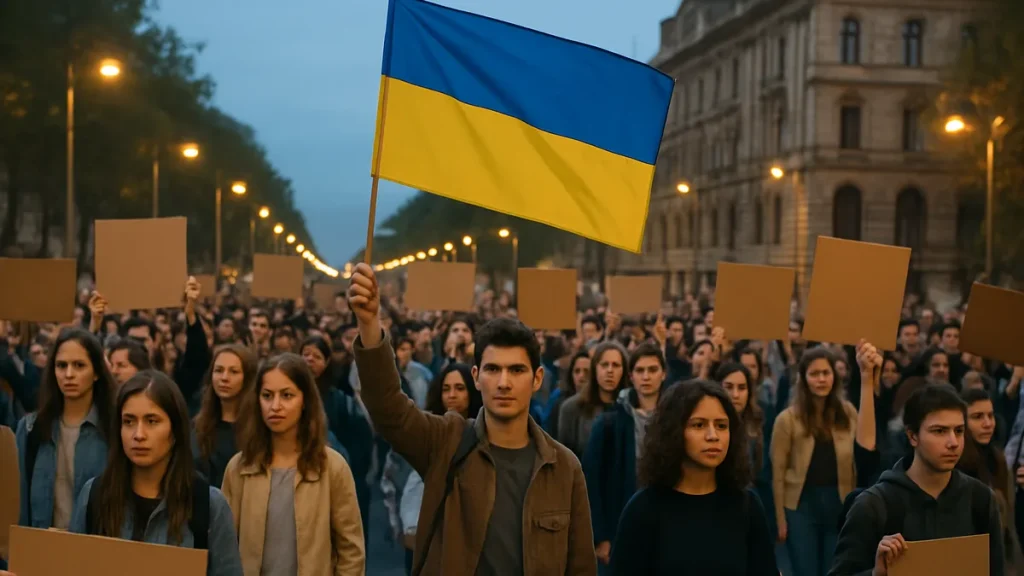
Protests led by young people are spreading across Europe and beyond, with many being dubbed “Gen Z protests”. The demonstrators are roughly aged 13 to 29, and they are taking to the streets over issues that particularly affect their generation, according to an opinion article on the movement.
The author argues that grievances over inequality sit at the centre of the wave, even though conditions differ from one country to another. Anger is being expressed on the streets of Paris, New Delhi, Rome and Madrid.
Protest movements in France, India and Spain
- France: protests began several weeks ago over deteriorating conditions in severely underfunded schools. Between half a million and 800,000 people reportedly took part across the country last weekend.
- India: the Cockroach movement has emerged as the strongest challenge to Prime Minister Narendra Modi’s increasingly authoritarian leadership. Its leader was arrested last week as anger grew over the removal of more than 130 million names from electoral rolls.
- Spain: anger has arisen over a broken housing system and laws that fail to protect households against eviction. The forcible eviction of 87-year-old Maricarmen Abascal was followed by parliament voting down widely popular anti-eviction legislation, which prompted Prime Minister Pedro Sanchez to call snap elections. Maricarmen died two weeks after her eviction.

Inequality and eroding welfare states in Europe
The author says inequality has increased significantly across Europe since the 2008 crisis, visible in growing income inequality and spiralling wealth inequality. The once-proud European welfare states, which were meant to guarantee a minimum standard of living and a meritocracy, have been eroded.
Also read: France protests test Macron's centrists before 2027 election
Years of austerity, the author argues, have weakened the state’s ability to deliver good education, healthcare, social care and other services. As the state retreats, some people can pay for better services while many cannot, which deepens the gap between rich and poor.
These inequalities are often felt more acutely by young people, the author says. In one area after another, they face governance failures that leave them with a bleaker outlook and much worse prospects than their parents and grandparents had.
Education, AI, housing and climate as governance failures
The author links underfunded education systems to a sharp decline in reading and maths skills shown by the most recent PISA results. A common explanation for this decline is worsening mental health and school absences, with social media often cited as a contributing factor.
The rapid rise in the use of AI is another driver of declining educational attainment, the author says. Efforts to regulate both social media and AI have been slow and hampered by strong lobbying from tech giants. AI’s impact on employment is still in its infancy, but entry-level work is already increasingly being done by machines.
Young people also spend a much higher share of their income on rent than any previous generation did, which the author describes as another failure of governance. The climate crisis, in the author’s view, is perhaps the largest governance failure of all. The latest IPCC report, the author notes, starkly illustrates how much more precarious life will be for those born in 2020 than for their parents and grandparents.
More equal societies would be better placed to withstand climate-driven instability because they could offer collective forms of adaptation. The increasingly unequal societies seen today instead put the burden of adaptation on individuals and households.
Government responses and the risk of further unrest
The author says the main government response has been repression, following a global trend of criminalising and repressing protest. This takes the form of anti-protest laws, arrests and police violence.
Repression sometimes succeeds in killing off protest movements, the author writes, but at other times it inflames them. The author says that has certainly been the case in France and India so far. What is really needed, the author argues, are genuine efforts to address the inequalities and governance failures that motivate young people, and without them political crises are bound to follow.