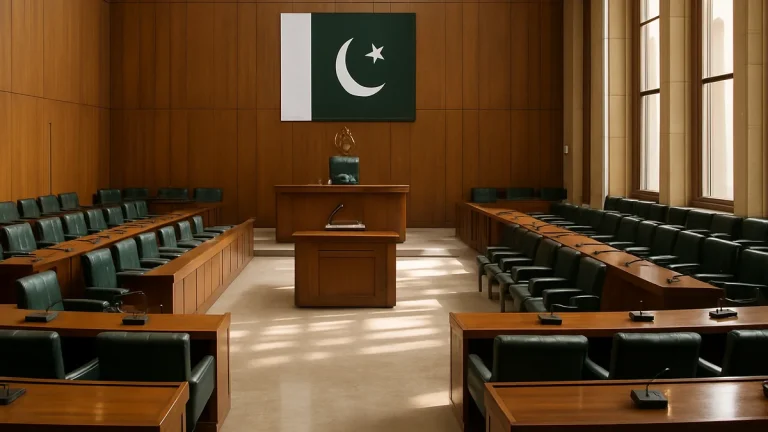

Senator Rana Sanaullah, the prime minister’s adviser on political affairs, used a Senate address on Tuesday to call on political parties to put their rivalries aside and stand together against terrorism. He accused the Pakistan Tehreek-e-Insaf (PTI) of declining to endorse the counterterrorism operation underway in Khyber Pakhtunkhwa (KP) while negotiations with the government continue.
Sanaullah told the chamber that the fight against militancy required a single national response. Citing the recent death of an army major, he said security personnel were still losing their lives. “Set aside all other matters and unite on the issue of terrorism,” he told political leaders, arguing that party differences should not stand in the way of tackling militancy.
Sanaullah presses for a unified response to militancy
Sanaullah said the sacrifices of soldiers and their families called for a collective answer from the political leadership. He said a Pakistan Army major had been killed in a terrorist incident a day earlier and that such attacks were happening regularly. Some of the personnel who had died, he added, had young children, while others had weddings planned for the coming months.
His remarks come amid rising tension between the federal government and the PTI over counterterrorism policy, political talks and the future of governance in KP. The federal government has imposed governor’s rule in the province. It accuses the former PTI-led provincial government of not cooperating adequately in the fight against militancy, while the party has challenged the government’s emergency measures in court.
Dispute over a signed commitment and provincial security meetings
Sanaullah alleged that the PTI refused to sign an agreement committing it to support the ongoing operation. He argued that this dispute had undermined efforts to reach a broader political understanding. He also said the government had tried to resolve political disputes through negotiations, but that the PTI had repeatedly backed away from understandings reached during talks.
He pointed to provincial apex committees, which bring civilian and security officials together to discuss security matters. According to Sanaullah, PTI representatives had not attended meetings in KP in the same way that officials in other provinces had. He said the federal government had sought cooperation from the KP leadership, and that political disagreements should not prevent coordination between the Centre and the provinces.
Sanaullah said the deposed KP chief minister, Sohail Afridi, had been brought to a provincial apex committee meeting only with considerable difficulty. He also referred to a claim by PTI leader Mashal Yousafzai that the party had been asked to sign an agreement within 72 hours. The adviser said the government had proposed settling issues linked to prison meetings with the party’s founder, Imran Khan, who has been imprisoned since 2023, through a political committee with representatives from both sides.
Speaker’s chamber dispute and warnings over prison statements
Sanaullah also questioned the opposition’s refusal to meet the prime minister in the speaker’s chamber. He noted that the opposition leader had been appointed with the speaker’s signature, yet was unwilling to recognise the speaker’s role. “If you do not recognise the speaker, why are you availing the privileges?” he asked.
He criticised PTI leaders for what he called “statements against state institutions and the military leadership.” He argued that inflammatory remarks and social media campaigns had added to tensions surrounding the meetings with Khan in prison. Warning about the prison-based messaging, he said that if an “anti-institution” narrative was promoted from within jail, restrictions on meetings could be imposed under applicable rules.
The government has said it remains open to negotiations with the PTI. It insists, however, that dialogue must not be used to pressure it into accepting demands or to undermine counterterrorism efforts. The PTI, for its part, has opposed the federal government’s measures in KP and challenged the governor’s rule in court, describing it as a political move against democracy and the party.