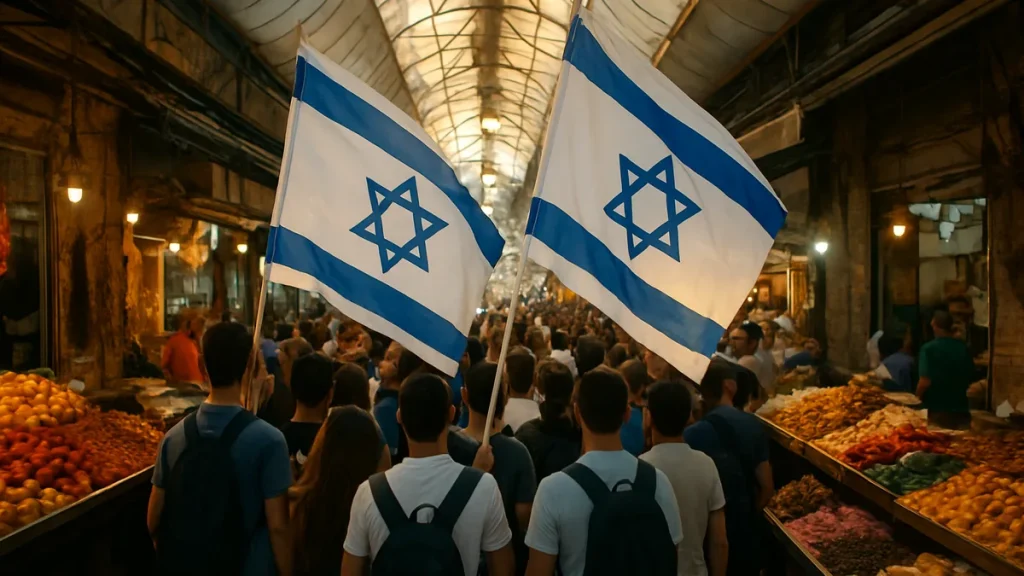

Israel’s far-right National Security Minister, Itamar Ben-Gvir, is drawing strong support from young voters as the country prepares for general elections next week. On the campaign trail in Ramle, a mixed city of Jewish and Arab Israelis, he is often surrounded by a cheering group of young fans waving large party flags. Ben-Gvir was once rejected from the army for being too politically extreme. The reporting notes that his views have changed little since then, but that the political establishment has changed around him, and he now sits in the government’s inner circle of ministers.
More than half a million first-time voters will cast ballots in the election, which many Israelis see as decisive for the country’s future security and identity. Polls suggest the race will be tight, and the new young voters could help determine the result.
Young supporters back Ben-Gvir’s message of strength
A poll for one of Israel’s most popular newspapers found that more than 16% of first-time voters planned to back far-right parties, either Ben-Gvir’s Jewish Power or the Religious Zionism party led by his ally Bezalel Smotrich. A separate survey for the leading Channel 12 television network found that almost three-quarters of young voters described themselves as right or centre-right.
Speaking in Ramle, Ben-Gvir told reporters that his message to young voters was to get out and vote. He said his supporters showed their backing and that he intended to win.
Nadav, an 18-year-old voter, said he believed Ben-Gvir was trying to show that Israel is a strong country. He said he expected the minister to protect young people when they serve in the army. Mordechai, 20, said Ben-Gvir gave him a sense of security and dismissed the politician’s verbal slips as minor, saying that most of what Ben-Gvir says is good.
Meir Schreiber, a 23-year-old ultra-Orthodox man who grew up in London, said the Hamas-led attacks on Israel on 7 October 2023, which triggered the Gaza war, convinced him that Ben-Gvir was the right choice. He argued that experiences in youth shape people, and pointed to the events of 7 October.

Tight race turns on social media and turnout
Surveys show that first-time voters are highly motivated, with more than 80% saying they are likely to vote. The same research suggests they are more sceptical of democratic institutions and less engaged by political protests or petitions. The race is largely deadlocked between two stable blocs, one supporting the government and one opposing it, so bringing new voters to polling stations could prove decisive.
Opposition parties have been trying to reach younger voters with warnings about threats to democracy, new social media videos and younger candidates. Yonatan Shalev, a 24-year-old candidate for the centre-right opposition party Beyachad, led by former prime minister Naftali Bennett, said that in 2022 only 59% of citizens in Tel Aviv voted. He said turnout in areas that voted for Ben-Gvir reached around 90%.
Shalev said Ben-Gvir understood the power of social media faster than other politicians. He said that liberal politicians had not believed in platforms such as TikTok and Instagram, while Ben-Gvir had used them to his advantage. Shalev said he had pushed his own party to reach young voters online, and that Bennett’s Instagram account now features videos of him lifting weights and talking with voters. Netanyahu has also shared a fast-paced, militaristic video on social media.
The same poll that found 16% of first-time voters backing far-right parties suggested that Beyachad alone would take almost 9% of their votes. The centre-right Yashar party of Gadi Eisenkot was also projected to win almost 9%.
Analyst links youth shift to wars and debate norms
The fact that Ben-Gvir appears more popular with 18 to 22-year-olds than with their parents’ generation is often attributed, at least partly, to the 7 October attacks. Political analyst Dahlia Scheindlin, who has run many Israeli political campaigns, said the trend goes further. She said that for about the last 20 years, young Israeli Jews had been more right-wing than average, and significantly more so on many measures than voters aged 55 and over.
Scheindlin said this generation had grown up through a series of wars without personal experience of efforts to achieve peace. She argued that many young people had been taught that the most extreme positions, including annexation, settlement expansion and, after 7 October, annexation of Gaza, were legitimate subjects of debate.
Israeli satirist Lior Schleien recently filmed classroom debates in which he challenged racist or extreme views. The debates drew wide attention in Israel, including one exchange in which a student advocated killing all Arab citizens of Israel. That video has since been removed from Schleien’s website.
Ben-Gvir’s record draws condemnation and protest
Ben-Gvir’s political positions include annexing the occupied West Bank, Jewish settlement of Gaza and the “voluntary emigration” of Palestinians. These views are widely condemned by liberal Israelis. Several Western countries have imposed sanctions or travel bans on Ben-Gvir and Smotrich for incitement against Palestinians. Both men are powerful ministers in Prime Minister Benjamin Netanyahu’s governing coalition.
Opponents of the minister are also visible among voters. In Ramle, some shopkeepers threw sweets at Ben-Gvir as he walked between the stalls, while others gave him dark looks. One stallholder said he did not like Ben-Gvir, who he said sowed discord, and that his message preyed on young, uneducated people.
At a student event in Tel Aviv last weekend, protesters shouted “Fascism will not pass” and interrupted Ben-Gvir, forcing him off the stage. Israel’s young voters may be moving to the right, but the reporting concludes that they remain as divided as the country over who protects its security and identity, and who poses an existential threat.