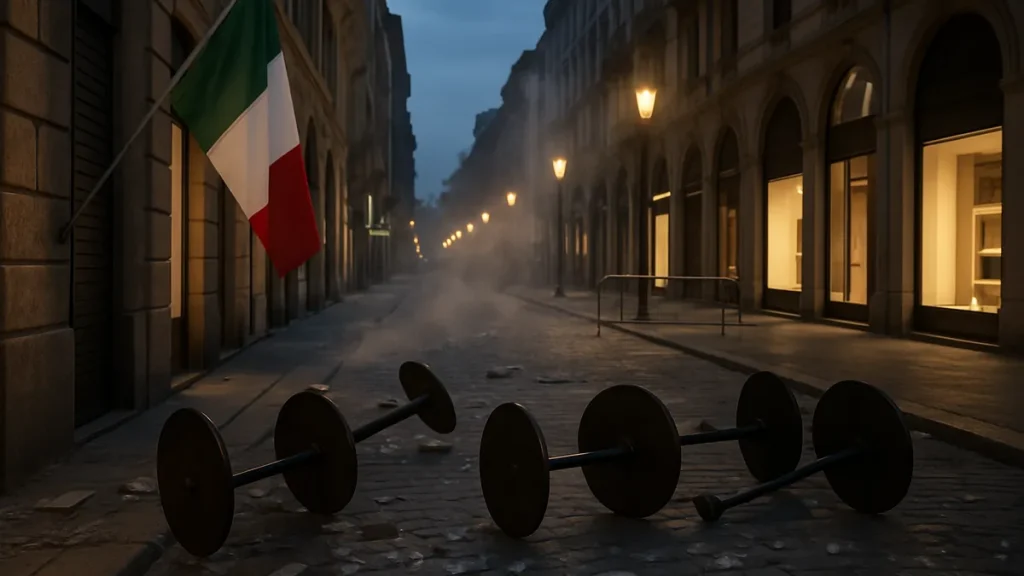

Italy’s right-wing government, led by Prime Minister Giorgia Meloni, has approved a package of security measures. They include sending 500 troops to the financial capital, Milan, to contain youth-led protests that turned chaotic over the weekend.
Meloni announced the decree on social media on Tuesday, writing: “There is nothing revolutionary about vandalising and stealing. Vandalism and theft are not protest, they are criminality.” The unrest began on Saturday in Milan, during a rally that had started peacefully over rising living costs and poor conditions in schools. Similar mobilisations in neighbouring Spain and France had served as an inspiration for the demonstrators.
Troops deployed to Milan with limited powers
The cabinet approved the deployment of 500 soldiers to Milan until the end of the year, according to a statement from the Defence Ministry. Their job is to guard key sites, increase surveillance of sensitive locations and expand monitoring across the area.
Also read: France announces curfews as unrest over soaring prices grows · France school protests grow into a wider political crisis
It remains unclear what the soldiers will actually be able to do. The cabinet did not give the army extra policing powers after objections from President Sergio Mattarella. In Italy, the armed forces handle national defence, while the police conduct investigations and make arrests.
New offences, parental liability and detention rules
The decree creates a new crime called “violent participation in public demonstrations.” It targets groups of more than five people who carry potentially harmful objects such as stones, sticks and fireworks. The offence carries a prison term of up to five years and a fine of as much as 20,000 euros ($22,440). The measures take effect immediately.
The text also draws on the saying “You break it, you buy it” to make parents of minors financially responsible for damage caused by their children. The state can recover losses from parents’ property or by cutting public subsidies the family receives. Young people aged 14 to 18 can also be placed in administrative detention, even without having committed a crime, if there is evidence they pose a danger. Until now, such powers applied only to adults.
Further provisions raise prison sentences to as long as 12 years for anyone who uses social media or other online tools to organise violent demonstrations.
Protest violence spreads across Italian cities
On Saturday, hundreds of thousands of people marched in Italy, France, Spain, Belgium and Portugal. The protests were largely uncoordinated and aimed at the rising cost of living. In Milan, rioters clashed with police, looted stores and set fires in the city centre. They emptied Piazza del Duomo and a luxury arcade that would normally be busy with shoppers.
A march against wars and high living costs had begun calmly, but masked protesters later threw stones, paving blocks and other objects at riot officers. They also set fire to barricades built from bar tables. Police responded with water cannons and tear gas. According to the Italian news agency LaPresse, at least two officers were hurt and about 50 demonstrators, many of them minors, were detained.
Groups of mostly young people again looted shops, smashed windows and fought police on Sunday. Riots were also reported in Bologna and Turin. Police in Bologna said that peaceful rallies were held alongside incidents in which protesters threw stones. In Turin, hooded demonstrators built barricades from bins and outdoor furniture and threw firecrackers, sticks and stones at officers.
Critics say the decree ignores poverty and prisons
Protesters argue that the new measures do nothing about the underlying cause of the anger, which they link to rising prices pushing families into poverty. Many young people say they no longer expect to be better off than their parents, citing a shortage of affordable housing, higher household costs and weak public services.
Official data cited in the reporting show that prices rose by about 2 percent a year on average, but jumped in 2022, when annual inflation reached 8.7 percent. Energy costs drove most of that surge after Russia invaded Ukraine in February 2022. Between 2000 and 2025, the price of everyday essentials such as food, energy, transport and household bills rose by 68 percent, while the average full-time wage fell by almost 5 percent.
Genoa Mayor Silvia Salis said: “Young people must be listened to, but in Milan and Turin we have seen violence with the sole aim of destruction.” She added that the answer “should be inclusion,” according to Italian media.
The NGO Associazione Antigone, which campaigns for human rights in prisons, warned that mass arrests of young people would add to existing problems. In its view, longer sentences would deepen prison overcrowding. Government data show the prison population has already grown by more than 17 percent over four years. In a Facebook post, the group said that about one child in seven, or 13.8 percent, lives in poverty and that the government has not introduced any policy to address this.
Historian Gregorio Sorgona of the University of Palermo said the measures overlook a growing discontent among young people, which he linked to a “fundamental contradiction”: “On one hand, the ostentatiousness of wealth and richness as a model of success; on the other, a profound crisis marked by economic precariousness.” He added that tougher policing was unlikely to stop the unrest. Pointing to the G8 anti-globalisation protests in Genoa in 2001, when 300,000 people marched and police used tear gas and rubber bullets, he said the approach had failed before. “Deterrence is not necessarily a valid tool to prevent the radicalisation of conflict, especially in a society that is swept by poverty and social segregation,” Sorgona said. “The decree risks intensifying the protests and leading to the arrest of thousands of suspects on the basis of ill-defined legal grounds.”