
Israeli Prime Minister Benjamin Netanyahu has unveiled an updated national security doctrine and displayed a map of rival regional alignments. The doctrine, published by the Prime Minister’s Office on Sunday, signals a security approach that favours preemptive military action, wider buffer zones and new regional partnerships.
The document was developed with help from Israel’s National Security Council. It was released just nine days before parliamentary elections that could end Netanyahu’s time in office. It sets out a formal policy of preventing perceived threats through military action rather than containment, a approach that analysts say has already been visible in recent years as Israel has pursued multiple wars and attacks against its neighbours.
Preemptive force and buffer zones in the new doctrine
The doctrine describes military action as the preferred way to deal with threats before they mature. It also points to the expansion of buffer zones as a tool for protecting Israel. Together, these elements mark a clear shift away from containment as the main organising principle.
The timing of the release carries particular political weight. Netanyahu is fighting to keep power amid criticism of his conduct in office, an ongoing corruption trial in which he is a defendant, and his handling of the October 7, 2023, attacks and the wars that followed. As the October 27 vote approaches, he is trying to reinforce his image as Israel’s ‘Mr Security’.

Election pressure and a warning about Washington
According to analysts, Netanyahu is hoping to win over Israelis who may dislike some of his other policies or conduct but still see him as the leader most likely to defend the country. Presenting his leadership as essential to handling both regional military threats and diplomatic isolation is central to that effort.
Netanyahu, who received the endorsement of US President Donald Trump on Sunday, told reporters during the briefing that Israel could face a far less supportive administration in Washington in two years, after the end of the Trump presidency. “In two years, a president… who is extremely hostile to Israel could come to power [in the United States],” he warned.
He argued that Israel must “expand our network of alliances and develop capabilities that make us a valuable asset” to other countries. In his view, this would protect Israel if US policy towards it changed.
Mohanad Hage Ali, deputy director for research at the Malcolm H Kerr Carnegie Middle East Center, said the framework “incubates and nurtures existential fears, which would lead Israeli voters to feel the need for a decisive leader”. He said Netanyahu stands to benefit by presenting himself as a familiar leader able to manage those dangers, making him “the devil you know” for voters wary of change at a sensitive time.
Netanyahu’s opponents have pushed back quickly. Gadi Eisenkot, one of the prime minister’s main challengers, said the published doctrine was “two hollow pages, full of slogans that have nothing to do with a security concept”. Former Prime Minister Yair Lapid described the document as “superficial”.
Competing blocs on the map and their risks
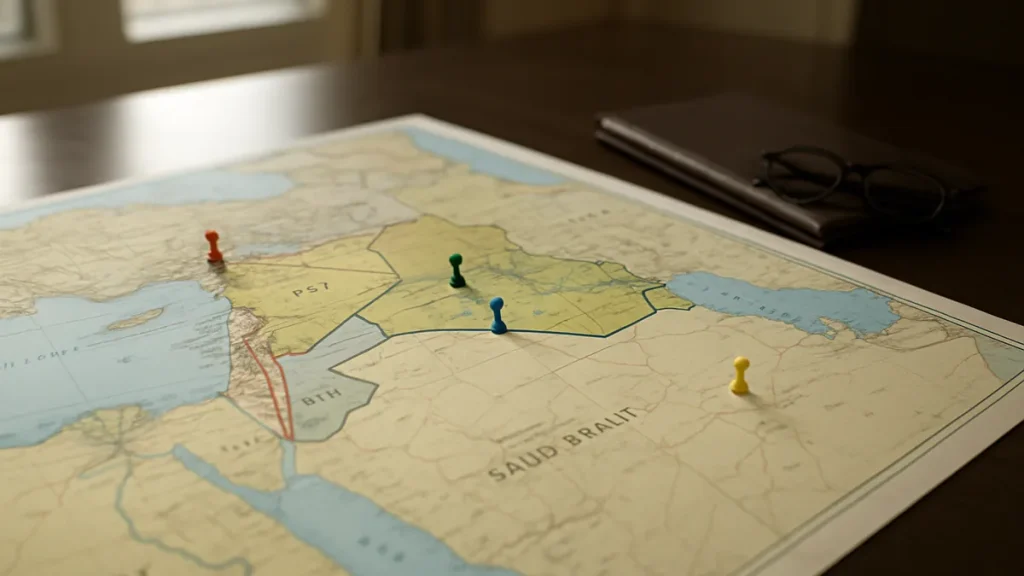
The map shown during the briefing was originally published in May by Friedrich-Ebert-Stiftung, a German political foundation. It divides the Middle East and parts of Africa into competing blocs, including states, unrecognised entities and non-state actors.
It places Israel and the United Arab Emirates in a grouping described as the “Hexagon Alliance”. A separate bloc includes Egypt, Turkiye, Pakistan and Saudi Arabia, three of which signed the Mecca mutual defence pact in August, and is labelled the “Sunni Diamond Alliance”. Iran and its regional allies appear as a separate axis.
The map illustrates the doctrine’s core themes: the threats Israel says it faces, the alliances it wants to build, and the case for buffer zones, which the analysis describes as the occupation of territory in other countries. Israel’s occupation of territory in Gaza and southern Lebanon was cited as an example of where that approach can lead. Hage Ali warned that expanding military control could bring “more conflict and more ethnic cleansing” under the guise of security.
The map also explicitly labels non-state actors as friendly. It highlights territories held by the paramilitary Rapid Support Forces in Sudan and by Khalifa Haftar’s self-styled Libyan National Army as part of a grouping cooperative with Israel and the UAE. Hage Ali said Israel sees these actors as pragmatic partners, but that a public link to Israel could damage their standing across the Arab world. He added that “what Israelis think matters more than the reputation of your allies and the viability of these alliances” for Netanyahu’s immediate priorities.
The framing also carries diplomatic risks. Earlier this year, Netanyahu proposed a “hexagon of alliances” involving Israel, India, Greece, Cyprus and unnamed Arab, African and Asian partners, set against what he called “radical” regional alliances. That grouping has not been formed as an alliance, and commentators in Israel and abroad have described it as a branding exercise rather than a binding military pact, noting that India prioritises non-alignment and pragmatic trade.
For Tehran and its regional partners, the map offers political leverage. Hage Ali said the visual layout “will certainly help their propaganda machine”, giving Hezbollah and other Iranian allies material to support the claim that Israel seeks to expand and dominate the region.