
A senior adviser to Ukrainian President Volodymyr Zelensky has said people have died because Kyiv still does not receive dependable American warnings about incoming Russian attacks. Serhii “Flash” Beskrestnov made the claim in an interview, saying there has not been enough time to alert citizens about ballistic missile strikes. “It’s dangerous… I think it’s really very bad… People [have] already died,” he said.
He also said restrictions on Ukraine’s use of the Starlink internet network remain in place. The White House said there had been no changes to intelligence sharing with Ukraine. Kyiv first reported a disruption to US intelligence sharing last week, at a time when ties with the Trump administration had fallen to new lows over a row about Ukraine’s controversial deal to import Russian oil. Many in Kyiv do not believe the timing is accidental, despite Washington’s denials.
Missed alerts over ballistic missile attacks
Zelensky wrote on social media on Monday morning that two ballistic missile attacks had been reported overnight on the capital. One came without any warning, and the second gave only minimal time to take shelter. Hours earlier, an interview he gave to NBC had been published, in which he said intelligence sharing had been restored after a three-day pause.
He described the renewed flow as something Ukraine was grateful for, arguing that only the United States holds the unique intelligence that can alert Kyiv when Russia fires ballistic missiles. Beskrestnov, however, painted a less reassuring picture. He said American intelligence remained incomplete and inconsistent, and that Washington had not clearly explained the problem.
“This looks very strange,” he said. “Sometimes we receive this information before the attack, another time we [do] not.” He gave an example from the previous night, when the warning reached Ukraine only one minute before the strike. He added that other cooperation with the US was continuing, saying: “Intelligence data keeps flowing, and the issue is solely with the air raid alert component.”
Starlink and Starshield limits hit Ukrainian forces
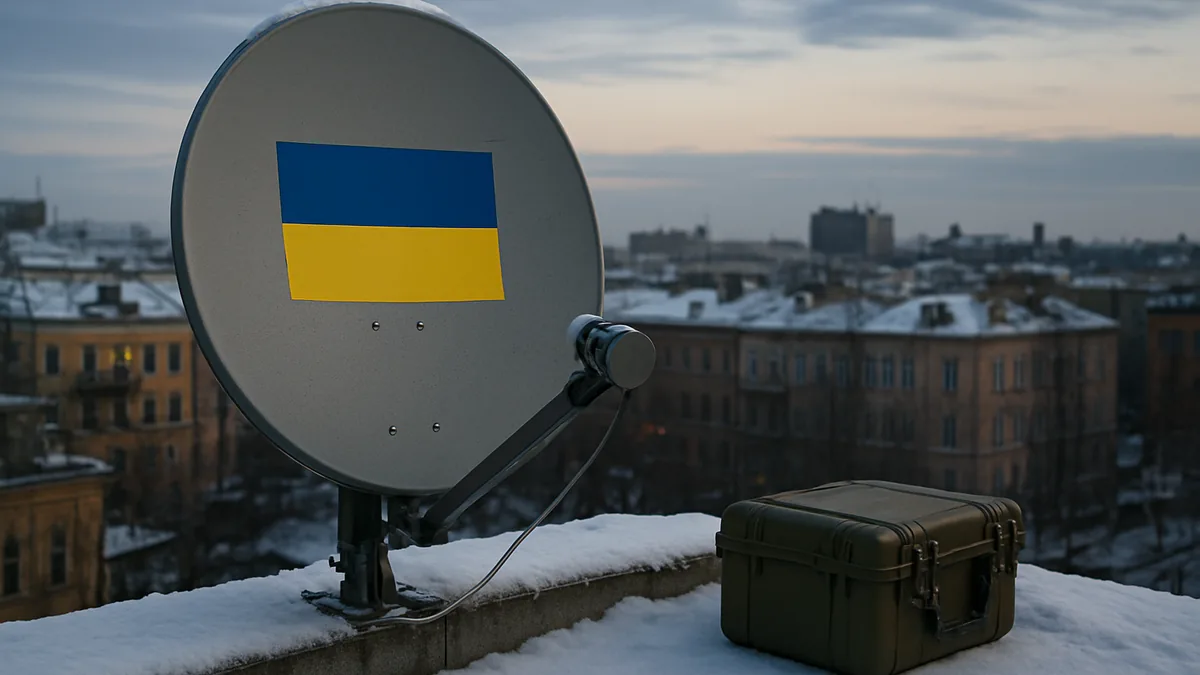
Beskrestnov said Washington had not made clear who was responsible for the continuing restrictions on Starlink and its military service, Starshield. Kyiv relies on Starshield to provide connectivity for drones, helicopters and military communications. Last week, Starshield capped the speed at which mobile units could move while remaining connected to the network at 100mph (160km/h).
According to the adviser, that cap has limited Ukraine’s ability to shoot down incoming drones and to carry out mid-range drone attacks into Russian-occupied areas. Starlink owner Elon Musk said last week that the US government ultimately controls access to Starshield, which was designed for the Pentagon, suggesting Washington could be behind the restrictions. Trump has denied any involvement.
Beskrestnov said he believed the two problems occurring at the same time were “probably” a deliberate move to put pressure on Ukraine. “It’s probably the United States trying to say [to] us, ‘let’s have the conversation, negotiation with Russia, you should find the compromise’,” he said. He added that Ukraine has its own radar data, which provides some limited early warning, and that it is urgently looking at alternative communication systems.
“We understand that we should be prepared for some problems in future,” he said. He said Kyiv was considering alternatives to Starlink not only for air defence but also for communication between forces, staff and civilians, because it did not know what to expect from the service in future.
Rubio and White House deny any pause
Earlier on Monday, US Secretary of State Marco Rubio said there had not been a “pause” in intelligence sharing. “I don’t know where [Zelensky is] getting these things or why he’s saying these things to the press,” he told reporters. Rubio said he could not comment on the specific incident, but added: “I know a few nights ago there was a software problem involving their early warning system.”
A White House official, speaking on background to discuss intelligence matters, said there had been no changes to intelligence sharing operations between the United States and Ukraine. The official said Trump was focused on ending the war and that the US had given more aid to Ukraine than any other country. Those reporting the story said they had approached Starlink for a response.