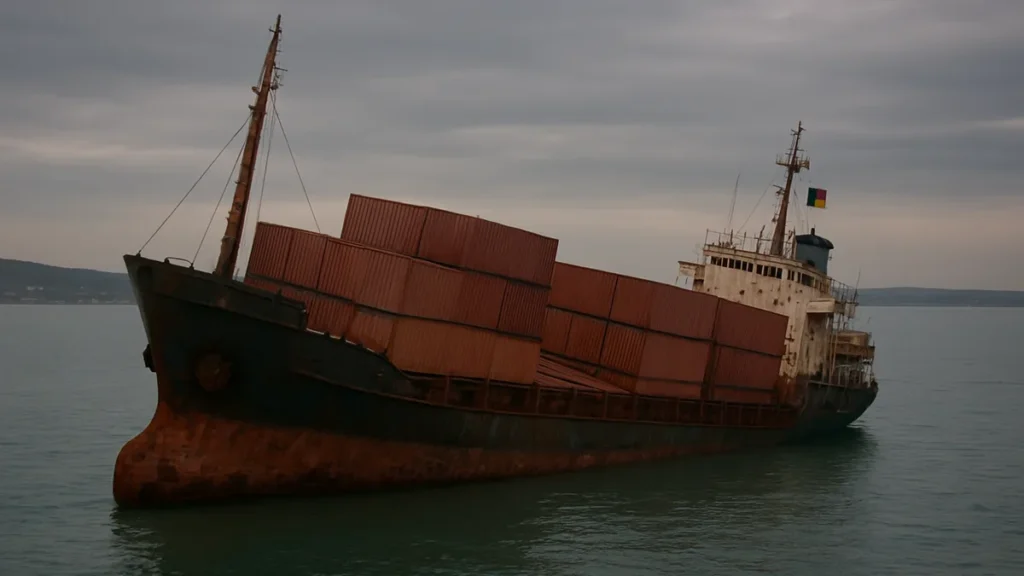
Three black naval drones struck a freighter moving slowly through the Black Sea off the coast of Bulgaria on October 28. Aerial drones joined the assault, and explosions rocked the Liberian-flagged Contship Jet Monrovia, which was carrying more than 400 terracotta-coloured containers.
The ship was sailing from the Israeli port of Haifa to Romania when it listed and sank. Bulgarian authorities said all 18 crew members were rescued. The daytime attack was filmed by crew members and other ships, and a French surveillance plane photographed it.
Kyiv blames Russia for the Black Sea strike
Kyiv said the drones were Russian and argued that the attack was designed to make the Black Sea unsafe for civilian ships. According to Kyiv, the aim was also to paralyse Ukraine’s grain exports and further hobble its war-ravaged economy.
Ukrainian President Volodymyr Zelenskyy said Kyiv’s forces conducted “no operations in this part of the sea.” He described the sinking as part of Russia’s effort to make the western Black Sea “completely unfit for navigation.”
The European Union’s delegation to Kyiv said in August that Russia is “systematically strangling Ukraine’s ability to feed the world.” It added that by targeting ports, shipping lanes and farm infrastructure, Moscow was waging war not only on Ukraine but also on food supplies for millions of people in Africa, Asia and the Middle East.
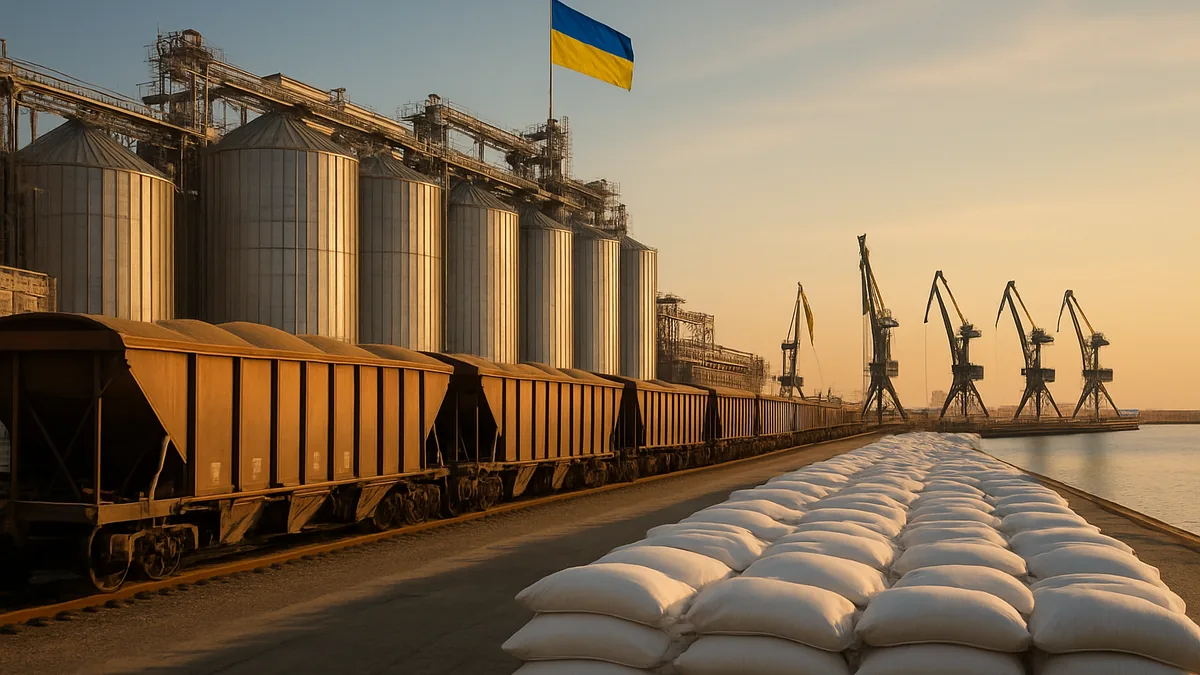
Growing toll of attacks on Black Sea shipping
At least 30 sailors have been killed or gone missing in the recent surge of attacks, according to Bulgarian and Romanian authorities and maritime tracking services. The incidents follow Ukrainian strikes on Russian freighters and oil tankers in the Black Sea and the adjoining Sea of Azov, which were carried out alongside attacks on oil refineries, military plants and warehouses.
Those Ukrainian strikes intensified in July, and observers say Moscow’s suspected retaliatory attacks may have been prevented. Nikolay Mitrokhin, a researcher at Germany’s Bremen University who analyses the Russia-Ukraine war, said an informal arrangement not to strike each other’s cargo ships “was breached by Ukraine in the summer.”
Mitrokhin said Russian President Vladimir Putin “definitely liked the idea of completely ruining Ukrainian exports.” He added that Putin had issued several warnings before systematic strikes on the Odesa group of ports began. In December, Putin said: “If the attacks on [Russian] tankers continue, we will consider taking retaliatory measures against ships from countries assisting Ukraine.”
Paula Ritter-Moschutz, a spokeswoman for Agriculture and Customs at the European Commission, said the bloc was not facing a threat to its own food security. She said the EU was “fully committed to continue supporting Ukraine’s access to international markets.” She added that the bloc was continuously assessing the implications for agriculture, global food security and the economy, and that it supported initiatives for a moratorium on Black Sea attacks.
Grain exports squeezed as wheat prices climb
Before Russia’s full-scale invasion in 2022, about a third of the world’s grain exports passed through the Black Sea. Ukraine supplied a tenth of global wheat exports and 15 percent of corn, and its customers include nations in the Middle East and North Africa.
Russian farmers and grain exporters usually ship more than two-thirds of their harvests through the Black Sea. Because of the lack of security, they are now testing exports through the Arctic port of Murmansk, although the longer distance between farms and buyers will significantly raise costs.
Wheat prices have risen by a fifth over the past 12 months. Chicago wheat futures, a global benchmark, climbed from $5.03 per bushel (35 litres) in October 2025 to $6.03 in October this year. The US-Israel war on Iran, global warming and a drought in South Africa have also contributed to the spike.
Constant Russian strikes using jet-powered drones, cruise missiles and ballistic missiles have brought operations in Ukraine’s largest maritime hub, Odesa, to a halt.
Ukrainian farmers and analyst warn of wider fallout
Viktor Honcharenko, president of the Association of Farmers and Private Land Owners of Ukraine, said: “Today, after the ports of Odesa are paralysed, there’s no way out. Hardly more than 50 percent of grain can be exported via land routes.” He added that “lots of wheat remained on the fields, it’s not being harvested.”
Honcharenko warned that the consequences would have a domino effect across Ukraine’s entire economy. “There will be penniless farmers, penniless medium-sized businesses, taxes will practically be not paid, the state budget won’t get any money, and jobs will be lost,” he said.
He said the paralysis of maritime grain shipments would hit small farmers hardest, because larger industrial farms would be first to export their grain by rail and truck.
Aleksey Kushch, a Kyiv-based analyst, said up to 60 million tonnes of grain had been harvested in Ukraine this year, but only half could be shipped out of the country. Ukraine’s overloaded railways cannot carry larger volumes, he said.
Kushch said Ukraine could make use of its surplus by developing domestic production of flour, starches, glues and paper-making additives. However, he said the country had lost its chance to “start full-scale processing.” Ukraine could also switch to legumes and oil crops that would appeal to the EU, whose member states protect domestic wheat farmers but are interested in vegetable oils and protein.
That shift would significantly reduce Ukrainian farmers’ profits, Kushch said, and the government should have negotiated EU subsidies for growing chickpeas and soy. “The price of the matter is one billion euros,” he added, referring to the estimated cost of the subsidies.