Lebanon’s Ministry of Energy and Water has started cutting electricity to roughly 100 public institutions that have unpaid bills, according to local media. The measure took effect on Monday and marks a further escalation in the dispute between Energy Minister Joe Saddi and the government.
Saddi has been boycotting cabinet meetings, saying the government has not acted on his demands. He wants a larger power supply, lower fuel costs and the settlement of unpaid bills owed to the state-owned electricity company.
Years of outages and a sector in decline
Lebanon has dealt with power cuts for years, but state-supplied electricity fell sharply after the economic and banking crisis that began in 2019. In Beirut, the state supply was once available for about 21 hours a day. In recent years it has dropped to just two to four hours, and some days bring no power at all.
Analysts say deep structural problems explain why the state has failed to deliver electricity, and that little will change without far-reaching reform. Jessica Obeid, a Lebanese energy expert, blamed corruption. “This sector has corruption across the entire supply chain, and it’s in the billions of dollars, so it is not something that is going to disappear overnight,” she said.
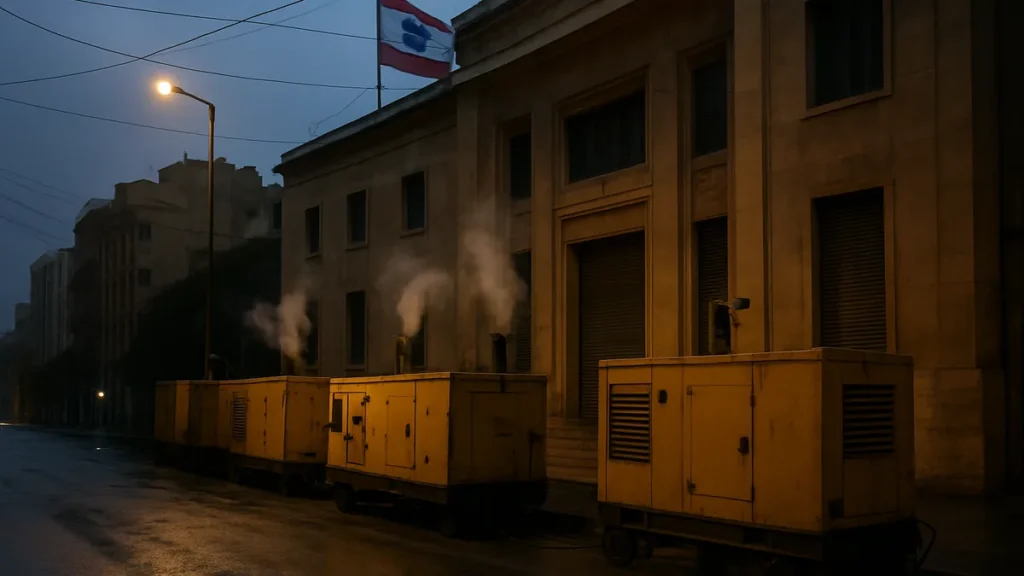
In the absence of reliable state power, an informal economy has grown up around private generators. Many of these are run by political parties or by individuals with close ties to those in power. Fuel costs have made them far more expensive for many households and businesses. The World Bank projects inflation in Lebanon will reach 17.5 percent this year, and fuel prices linked to the United States-Israel war on Iran have pushed up generator costs sharply.
A government led by reformists took office in early 2025, and many hoped conditions would improve. More than a year and a half later, state electricity remains scarce, while energy costs and inflation have risen steeply.
Saddi’s boycott and the political fight over the ministry
The dispute has fuelled speculation about a possible cabinet reshuffle and the resignation of Saddi, a member of the right-wing Lebanese Forces (LF) party. Saddi told local media that he had pressed Prime Minister Nawaf Salam’s government earlier this year to give his ministry priority. He said he eased that pressure when Israel’s war on Lebanon intensified in early March.
The LF and Saddi objected after the draft 2027 budget was announced in October. They argued that the electricity sector was not getting enough attention. In early October, Saddi pledged to boycott cabinet meetings, and last Thursday three ministerial colleagues from the LF joined him in skipping a session. Saddi said the aim was to push the government to focus on the electricity crisis.
Sami Zoughaib, an economist and research manager at The Policy Initiative, a Lebanese think tank, described the boycott as a political move by Saddi and his party to protect their popular support. “If they fail in the eyes of people, it would be very difficult for them to have the ministry again,” he said.
The Energy Ministry has at times been run by the LF’s main Christian rival, the Free Patriotic Movement (FPM), under earlier governments. FPM leader Gebran Bassil has recently criticised Saddi’s management of the ministry. Bassil is a former energy minister who did not deliver on his promise to raise state electricity to 24 hours a day.
Qatar offer and doubts over investment and reform
Qatar has stepped in with an offer of support. Its Prime Minister, Sheikh Mohammed bin Abdulrahman bin Jassim Al Thani, visited Beirut last month and confirmed plans for an energy partnership that includes a solar power project. A news agency subsequently reported that Doha had offered to build two power plants over the next three years and to supply Lebanon with liquefied natural gas under a 20-year deal.
Analysts said that if the deal is approved, it would benefit Lebanon’s energy sector. They added, however, that the sector still needs structural reform to meet residents’ needs, and that this could include rebuilding the entire grid.
Zoughaib said the ageing infrastructure meant the pre-2019 model of state-subsidised electricity consumed a large share of the government’s annual budget. “The state cannot reproduce the model of the past,” he said. “It definitely doesn’t have the money.”
Saddi has proposed bringing in private investors through public-private partnerships, a model widely used around the world. Experts said Lebanon’s instability, including repeated Israeli attacks and the possibility of more, would discourage investors. Failure to reform the financial and banking sectors, seven years after the crisis began, would be another major obstacle.
Obeid said political stability was essential for any investment. “Secondly, this is a bankrupt country that has been bankrupt for at least seven years, and nobody has done anything about it, so it does not show any actual will for reform and increases risks [for investment],” she said. She added that the grid is damaged and needs rehabilitation. Experts said successive governments have favoured short-term fixes and political gains over lasting change.