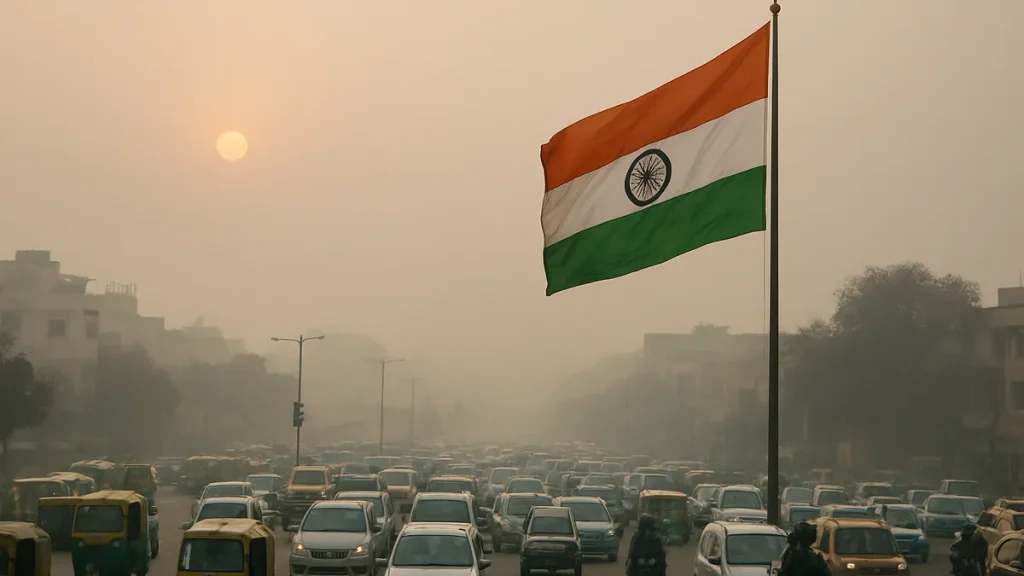
India launched its yearly campaign on Thursday against dangerous air pollution in New Delhi, a city of 30 million people that often ranks among the most contaminated capitals in the world. Air quality in the city worsens during winter, when colder air keeps pollutants near ground level.
Officials and the city’s sources include coal-fired power plants, vehicles, building sites and crop stubble fires in nearby areas. The Delhi government announced on Wednesday that open rubbish burning would be banned and told food stalls to stop using coal or firewood.
New curbs on burning and cooking fuel in Delhi
Such steps have not stopped pollution in previous years. Levels usually peak between November and January, when PM 2.5 particles, which can cause cancer, often exceed 300 micrograms per cubic metre. That is about 20 times the World Health Organization’s recommended daily maximum.
Monitors recorded 233 micrograms per cubic metre early on Thursday, roughly 15 times the limit. The government’s Commission for Air Quality Management has predicted that air quality will remain “poor” in the coming days.
Health risks and tighter rules from November
A 2024 study in The Lancet Planetary Health estimated that 3.8 million deaths in India between 2009 and 2019 were linked to pollution above the country’s own air quality guidelines. Last year, pollution peaked at 846 micrograms per cubic metre, 56 times the WHO limit. The UN children’s agency warns that polluted air places children at greater risk of acute respiratory infections.
Further restrictions take effect on November 1. Parking fees will double, and government office staff will work from home to cut traffic emissions. Tighter construction rules will also start then, followed by a complete ban on construction and demolition from December 10 to January 20.