Punjab Chief Minister Maryam Nawaz Sharif has put forward an aim of equipping one million young people with skills over the next three years. The goal was revealed at a meeting she chaired in Lahore, where she was briefed on current and planned skill development schemes. The provincial government intends to widen technical education, launch fresh training courses and set up specialised centres of excellence.
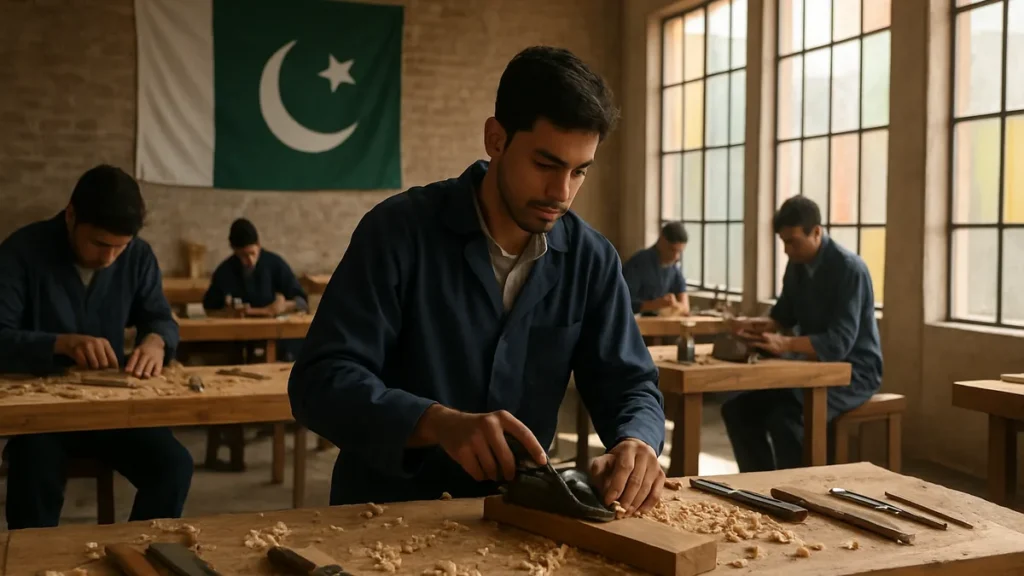
The gathering approved plans for the province’s first modern Woodworking Centre of Excellence, along with specialised centres for electrical work, vehicle-related trades and digital marketing. The government also agreed to start a Chief Minister’s Language Learning Programme, which will offer courses in 13 languages for the first time in Punjab.
New centres, language courses and digital exams
A digital examination system is also due to be introduced, with online registration, electronic question papers and QR codes. Officials expect the system to lift examination capacity from 200,000 candidates to 600,000.
The meeting cleared training and certification programmes in agriculture and heavy machinery operation. It also approved Punjab’s first Cleaning and Cleaner Academy, where trainees under the Punjab Central Cleaning Authority (PCCA) will learn cleaning support, healthcare, hospitality, domestic assistance and related fields.
Trainees placed in jobs across key sectors
Officials told the meeting that roughly 400,000 young people had completed skills courses in Punjab, and more than 45 per cent of them had found work. Many others chose to keep studying. According to the briefing, close to 175,000 people trained under the Skills Development and Entrepreneurship Department had secured jobs, and more than 38,000 had found work abroad.
Sector-wise figures presented at the meeting showed the following:
- Manufacturing: 113,333 completed training, with more than 50,000 hired immediately.
- Information technology: 111,607 trained, with 49,588 finding employment.
- Agriculture and livestock: 23,269 trained, with 10,033 in jobs.
- Construction: 27,069 trained, with 12,026 employed.
- Energy: 35,227 trained, with 15,651 obtaining jobs.
- Hospitality and tourism: 15,319 trained, with 6,807 hired immediately.
The briefing added that 90,029 trained people had found jobs in local industries, while 53,509 had become self-employed and 38,557 had secured overseas employment. Another 39,325 had chosen to continue their education. Officials also said 3,000 women in rural areas were earning income from home under the Empowering Women through Information Technology programme.
Industry programmes and upgraded training facilities
The meeting also reviewed plans to expand industry-focused training and improve existing facilities. Under the Mahir programme, 25,000 young people are to be trained in industrial clusters in Lahore, Faisalabad, Sialkot, Gujranwala and Multan. The Global Rozgar programme targets 25,000 people for jobs in business process outsourcing (BPO), while the Advance Tech programme will give 7,500 trainees international certifications in emerging technologies.
The Rs2.6 billion Haryali programme aims to train 20,000 young people in agriculture and green-environment fields. Under the Pehchaan and Umeed programmes, 2,474 transgender people have completed training, and Umeed plans to provide skills training to 10,000 persons with disabilities. Officials said 15,065 teachers and staff had been trained in industry practice, management, teaching and skills development.
The government has upgraded 220 computer laboratories, 100 industrial stitching laboratories, 70 solar laboratories and 27 healthcare laboratories, as well as virtual reality welding and electric vehicle laboratories. A further initiative will see 69 institutions of the Technical Education and Vocational Training Authority (TEVTA) train 45,700 young people annually, in line with the European Qualifications Framework.
The meeting was also told that an electrician trained at a technical college in Punjab had placed fourth at the 48th WorldSkills competition in Shanghai.