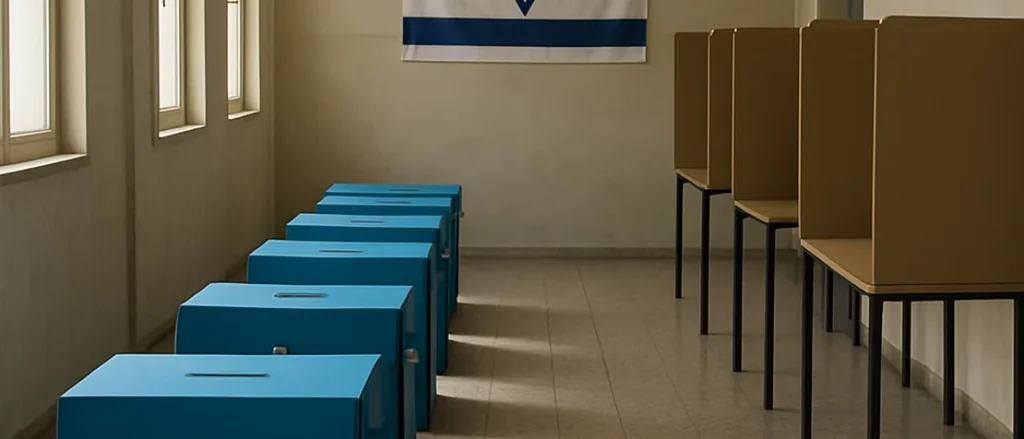

US President Donald Trump has taken a notably cautious public stance ahead of the October 27 Israeli election, despite a long relationship with Prime Minister Benjamin Netanyahu. The vote puts Netanyahu’s Likud party and the far-right coalition it leads under growing threat from Gadi Eisenkot, leader of the Yashar party, and an opposition bloc he is trying to build.
Trump has been reluctant to give Netanyahu a direct endorsement. In a recent interview with Time magazine, he dodged a direct endorsement three times, while defending the Israeli leader’s record before the October 7, 2023, Hamas-led attack on southern Israel. Asked about Eisenkot, Trump said, “I don’t hear bad things.”
Trump’s measured public tone ahead of the vote
Trump’s approach so far has been low-key, and analysts see that as shaped by several factors. Yousef Munayyer, head of the Palestine/Israel programme at the Arab Center Washington DC, said the ambivalence was likely fuelled by shifting political conditions in both the United States and Israel. It also reflects the changing relationship between Trump and Netanyahu.
Munayyer said Trump appeared to be keeping his distance more than would be expected. He pointed to Trump’s past endorsements of right-wing allies and to how close the two leaders had been. “He seems to be keeping greater distance from it than you would think,” he said.
Still, the article notes that Trump’s actions towards Israel, and Netanyahu in particular, have often carried more weight than his words. Public comments have rarely matched the scale of policy moves made during his time in office.

Past policies that boosted Netanyahu’s standing
During his first term, from 2017 to 2021, Trump moved the US embassy to Jerusalem and recognised Israel’s annexation of the Golan Heights. He also withdrew from the 2015 Iran nuclear deal. In addition, he led a series of normalisation agreements with Arab countries that sought to bypass the Israel-Palestine issue.
In his second term, which began in January 2025, Trump continued to supply Israel with some of the most destructive US weapons during the conflict in Gaza. He also escalated a crackdown on the International Criminal Court (ICC). He entered a war with Iran that has rattled the global economy.
Trump has also called for Netanyahu to be pardoned in his ongoing corruption trial. Since returning to the White House last year, he has hosted the Israeli leader at least seven times, more than any other world leader, the article said.
Signs of disagreement between the two leaders have surfaced over time. These include Netanyahu’s resistance to Washington’s push for a more lasting peace in Gaza and an end to the war with Iran. However, the article says those hints of discord have never led to actual changes in policy.
Analysts see limited change under an Eisenkot government
Michael Omer-Man, Israel-Palestine director at the Washington-based DAWN think tank, described the relationship as carefully managed for public view. “It’s a relationship they’ve carefully choreographed for public consumption, and the few juicy bits that we’ve learned have been almost entirely of Trump’s choosing,” he said.
Omer-Man did not rule out a sweeping US gesture aimed at boosting Netanyahu in the final stretch of the campaign. He said he did not believe Trump had abandoned the Israeli leader, but noted that Trump is also a realist. “He’s seen a lot of his preferred candidates in various countries lose elections as well as win them,” Omer-Man said.
Omer-Man also suggested the stakes may not be especially high for Trump. Eisenkot has promised a more moderate approach than Netanyahu’s, particularly on rampant settler violence in the occupied West Bank. However, those changes are largely aimed at improving Israel’s standing with European governments and the global public, and would have little effect on relations with the Trump administration, which are already permissive.
“I don’t think we would see a whole lot of change vis-a-vis the US, because there doesn’t seem to be a whole lot of friction in the relationship,” he said. He added that an Eisenkot government “might stop taking over every single hilltop in the West Bank” and “might allow more [aid] into Gaza”, but said it would not reverse steps already taken.
Shifting politics in both countries shape the race
Mairav Zonszein, a senior analyst on Israel at the International Crisis Group, also pointed to changing conditions around the Trump-Netanyahu relationship. She said Trump’s reticence partly reflects a divide within his administration over Netanyahu’s government. That split mirrors a wider Republican Party divide as US midterm elections approach.
Zonszein said the situation was probably a mix of the Iran war and the split within the administration. She pointed to figures such as Vice President JD Vance, who she said had come out strongly against Netanyahu’s role in pushing for the US to strike Iran.
Public opinion polls have repeatedly shown that support for Israel remains high among Republicans, although it has declined in recent years. Confidence in Netanyahu has also fallen within the party. In Israel, the perception of Trump’s influence has also changed. Netanyahu’s critics have focused on the US role in restraining Israeli operations in Lebanon, which threatened a June memorandum of understanding that briefly paused the US-Israel war on Iran.
An Israeli Democracy Institute poll released in June found that only 44 percent of Jewish Israelis believed Israel’s security was a top consideration for Trump. That was down from 61 percent in March, shortly after the US and Israel launched the war with Iran.
Netanyahu has also changed his campaign messaging. Zonszein said he has avoided billboards boasting of his close relationship with Trump this election cycle, a shift from his approach in past years. Instead, he has highlighted those he considers Israel’s top regional and international foes. These include Hezbollah Secretary-General Naim Qassem, Turkish President Recep Tayyip Erdogan and New York City Mayor Zohran Mamdani.
Zonszein said Netanyahu is emphasising “his enemies versus his friends”.