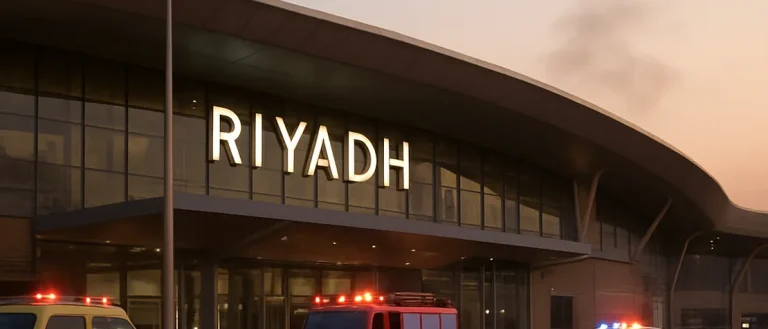

Yemen’s Houthis said they had targeted the airport in Riyadh, the Saudi capital, late on Monday. The strike came after two days of attacks on King Khalid International airport that left 14 people dead and hundreds injured.
A Saudi military spokesman, Turki al-Maliki, said air defence systems had intercepted an incoming missile fired from Yemen, but he did not say what it was aimed at. Residents reported several powerful explosions shaking Riyadh that night, moments after a text alert reached their phones warning of an aerial threat.
Airport closure and deadly strikes in Riyadh
Saudi authorities have extended the closure of the capital’s international airport until Saturday, and airlines have cancelled flights because the attacks are continuing. The airport has been shut since a Saturday attack that killed 13 people and wounded more than 300, which is the deadliest incident in the kingdom in over ten years. A Sunday attack killed one more person and hurt nearly a dozen others.
Separately, Houthi military spokesperson Yahya Saree said the group had also struck Khamis Mushait airbase, close to the Yemeni border, with a drone. The Saudi military spokesman said air defences had repelled that attack.
Probe into how missiles and drones evaded interception
Saudi Arabia has launched an investigation into why its air defences failed to stop a barrage of missiles and drones fired by the Houthis, according to two regional officials who spoke on condition of anonymity. The officials said the initial probe found that the Houthis first sent several drones to clear a path for a mix of cruise and ballistic missiles heading for King Khalid International airport.
The officials noted that the Houthis possess ballistic missiles and advanced systems with warheads that can change direction in flight, which can challenge the Patriot interceptors and other systems Saudi Arabia uses. One official said the inquiry is also trying to establish why no earlier warning was issued, given that the missiles and drones travelled more than 1,000 km (620 miles) to reach Riyadh.
US response and pressure on the Saudi economy
US President Donald Trump criticised the Houthis over their escalating attacks on the kingdom but did not signal any American military involvement. When asked what he planned to do about the group, he told reporters that the Houthis were “misbehaving very badly.”
The escalation has also raised concerns about the wider economic impact. Saudi Arabia’s real gross domestic product is projected to contract by 3.6 percent this year, amid several factors including lower oil activity. The attacks have also put pressure on events scheduled in Riyadh this month, including the kingdom’s flagship investment conference and the WPC Energy Congress, where several senior oil executives were removed from the programme.
Delta Airlines said on Monday that it would delay the launch of its planned nonstop Atlanta-Riyadh service until March 2027 because of ongoing geopolitical tensions.