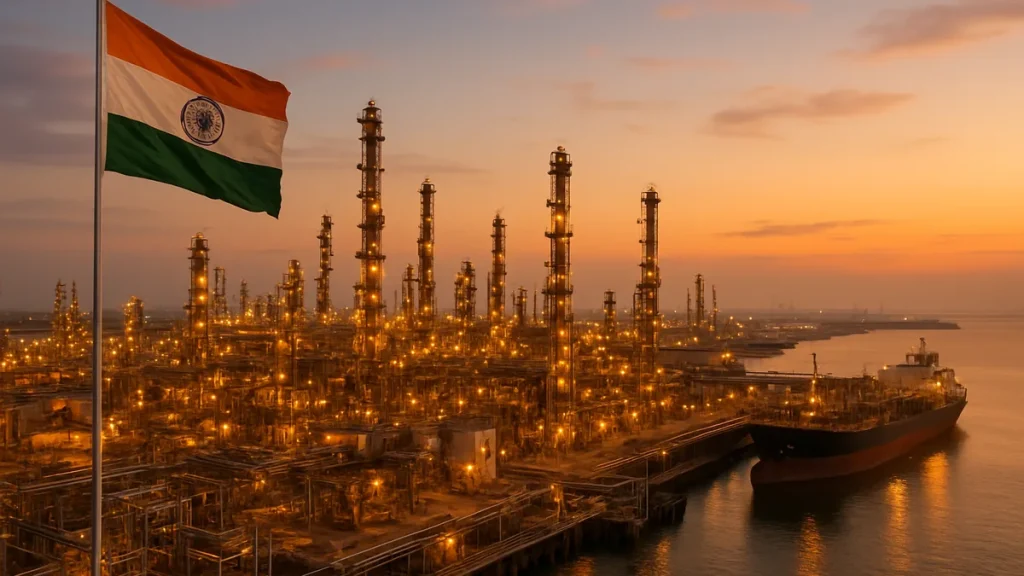
US Secretary of State Marco Rubio visited India this week, and his trip officially ended in Jamnagar, a port town in the western state of Gujarat that is not a common stop for foreign leaders. Rubio did not travel to the Indian capital, Delhi, which drew questions from Indian opposition politicians. Analysts quoted in the reports said the choice of destinations was deliberate and linked to the energy needs of the Trump administration.
Rubio arrived in Mumbai on Tuesday, where he met Foreign Minister S Jaishankar and several of India’s leading business figures. Jamnagar is home to a giant oil refinery owned by Mukesh Ambani, one of Asia’s richest men. The visit was Rubio’s second to India this year, and experts said the timing and the choice of locations were what stood out this time.
Why the Jamnagar refinery became central to the trip
The Trump administration faces pressure to keep fuel prices under control before the US midterm elections in November, while rising tensions in the Middle East threaten global energy supplies. Little new refining capacity is expected in the US in the near future. India’s ability to process large volumes of crude oil therefore offers Washington a possible way to ease pressure on fuel markets, and Reliance’s Jamnagar plant sits at the centre of that calculation.
Also read: Trump administration offers to loan heating oil reserve
The official line from the US State Department had focused on energy cooperation, commercial investment and economic ties. Talks between the two foreign ministers at a Mumbai hotel covered trade, investment, energy security and defence cooperation, according to official statements. India’s foreign ministry said both sides welcomed progress in trade negotiations and reaffirmed their commitment to concluding a deal.
Once the diplomatic meetings ended, Rubio travelled to Jamnagar, which analysts said came to define the visit. The complex can process about 1.4 million barrels of crude oil a day, roughly 1.5% of global refining capacity, according to the company’s website. It is also a major exporter of diesel and other petroleum products.
Rubio toured the facility on Wednesday during a tightly controlled visit with limited media access, and he met members of the Ambani family, including Mukesh Ambani. The company later issued a statement describing wide-ranging discussions on the global energy landscape and opportunities for commercial partnerships. It did not say whether it had committed to buying crude oil or supplying refined products.
A day before the refinery visit, Rubio had called India a “refining superpower” and said Washington wanted Reliance to process more Venezuelan oil. “They have the capability to refine heavy crude,” he told reporters, adding that as more Venezuelan oil comes online, the company could take on that work. He said such oil “can certainly provide relief” in the short term.
Reliance was once among the largest buyers of Venezuelan crude before US sanctions disrupted trade. After Venezuelan President Nicolás Maduro was captured in a US intervention earlier this year, and Washington eased sanctions on the country’s energy sector, Reliance returned as a major importer.
Russian oil, tariffs and strained India-US ties
The visit comes at a delicate point in relations between the two countries. Trump has imposed tariffs on Indian goods, and sanctions against Delhi for buying Russian energy are currently paused. A trade deal between the two countries has also remained out of reach for around 20 months.
India became one of the biggest buyers of Russian oil after Moscow invaded Ukraine in 2022. Between December 2022 and July 2026, India accounted for 37% of Russia’s crude oil exports, according to the Centre for Research on Energy and Clean Air (CREA). Reliance was among the Indian companies that processed Russian crude.
In August 2025, Trump imposed an additional 25% tariff on Indian goods over its Russian oil purchases, which took total tariffs on many Indian goods to 50%. The United States withdrew that extra penalty in February 2026, but India’s continued imports of Russian oil remain a source of friction in Washington-Delhi ties. India has said that securing affordable and reliable energy for its 1.4 billion people is its priority.
Earlier this month, the United States temporarily lifted sanctions on Russian diesel. Against that backdrop, experts said the Jamnagar visit appeared to serve three aims: reducing India’s dependence on Russian crude, encouraging greater imports of Venezuelan and American oil, and moving a trade deal forward in which energy cooperation could become a key area of agreement.
Trade talks, a proposed Texas refinery and bilateral numbers
Michael Kugelman, a senior fellow at the Atlantic Council, said Rubio had two reasons to meet the Ambani family: to secure greater refining of Venezuelan oil, and to seek assurances that Reliance remained interested in backing a proposed refinery in Texas. In March, Trump announced the plan for a refinery at the Port of Brownsville on his Truth Social platform, saying it would be the first major new US refinery in 50 years. Reliance has not publicly commented on the project, and no details or start date have been released.
Kugelman said the Texas plant may matter less to US interests immediately than the Venezuelan oil arrangement, but he still considered it part of the story. Analysts cautioned, however, that closer cooperation with Reliance and progress on energy security do not mean a trade deal is imminent. Kugelman said he did not think anyone expected an announcement at this stage, but that the trip seemed to have helped bring the relationship back on track, within the limits posed by the remaining tensions.
Rajani Sinha, chief economist at the credit rating agency CareEdge, said greater cooperation could ease energy security concerns in both countries and help push stalled trade talks forward. She said it could also “boost trade and sentiment” in India.
Former Indian ambassador to the US Meera Shankar urged caution about reading too much into the skipped Delhi stop, describing the trip as primarily energy-focused. She said India may be waiting for the US to formalise its tariff positions so that it knows whether Delhi would receive a preferential trade deal. Despite the strained politics, bilateral trade continues to grow.
India’s merchandise exports to the US reached $50.81bn between April and September, up 11.1% from the previous year, according to India’s commerce ministry. Imports rose to $32.33bn from $25.66bn over the same period, while India’s merchandise trade surplus with the US narrowed to $18.48bn from $20.07bn a year earlier. “The economic relationship remains strong, but a long period of uncertainty could eventually affect it,” Shankar said.
For now, the visit may have helped put the relationship back on track. Whether it leads to a trade agreement or a lasting shift in energy ties, however, remains to be seen.