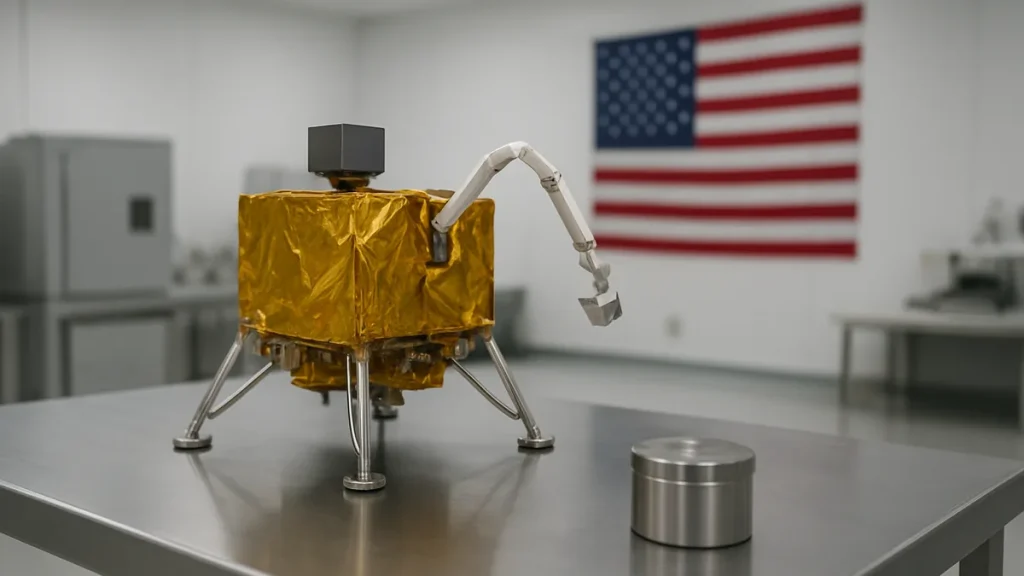

A spacecraft has launched from Japan on a mission to Mars’ moon Phobos, where it will try to collect moondust and bring it back to Earth. If successful, it would be the first time a sample has been returned from Mars or its moons for analysis in laboratories on Earth.
The spacecraft is scheduled to reach Phobos in August 2027. The Mars Moons Exploration (MMX) mission is led by the Japanese Space Agency, which hopes it will help solve the mystery of how Mars’s moons formed.
How the MMX mission plans to reach Phobos
The mission will first study Deimos, the other moon of Mars, as it arrives in the planet’s vicinity. It will then focus its attention on Phobos. Both moons are tiny and irregularly shaped, and Phobos is about 20km (12 miles) across, while Deimos is about 10km (six miles) across.
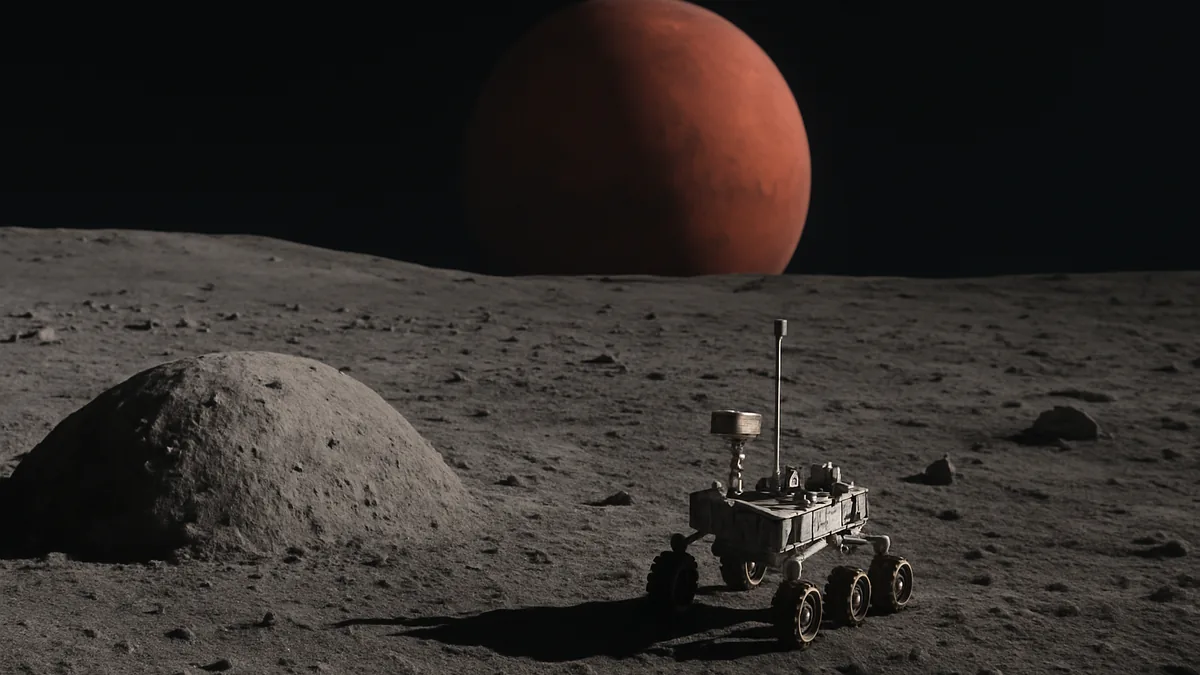
The spacecraft plans to set down a small rover to explore the terrain, a task that will not be simple. Prof Sara Russell, from the Natural History Museum, who serves as the mission’s deputy for sample analysis, explained the difficulty. Phobos has very little gravity of its own, but it sits beside a much larger planet with far stronger gravity, which makes it harder to land a rover on the surface.
Once the rover has scouted a landing site, the MMX spacecraft itself will touch down on Phobos. It will then use a robotic arm and two samplers to gather dust from the surface. The material will be sealed in a small capsule that is due to return to Earth in 2031, landing in the Woomera desert of South Australia. The amount is very small, just 10g.
Dr Chrysa Avdellidou, from Leicester University, who is working with the Japanese mission, acknowledged how little material will come back. She argued that scientists can still carry out several studies on individual grains, and that large quantities are not needed to do useful science.
Two competing theories about the origin of Mars’s moons
Scientists believe the returned sample could settle a long-running question about where the moons came from. Mars received its moons about 4.5 billion years ago, but no one knows how they formed. Researchers have two competing ideas.
One theory holds that a space rock smashed into Mars early in its history, and that Phobos and Deimos formed from the debris. The other suggests that the two moons are wandering asteroids from the outer Solar System that were captured by the Red Planet’s gravity.
Russell said the two hypotheses should produce very different results when the sample is studied. She said that chemistry and mineral composition would show which explanation is correct, and that the answer should be fairly quick to establish.
The team also hopes the sample could contain material from Mars itself. Russell said Phobos lies so close to the Martian surface that grains from impacts on Mars might become embedded in the moon. If that happens, the sample could give direct information about the planet’s composition and history.
Earlier efforts to bring Martian material to Earth
Bringing material from Mars to Earth has long been a goal for space scientists. The Nasa Perseverance rover has been exploring Mars since 2021 and has been collecting samples and storing them in canisters. However, a planned joint Nasa and ESA mission called Mars Sample Return, which would have retrieved those canisters, has effectively been cancelled after the US Congress halted its funding.
China is also planning a sampling mission to Mars, which is set to launch in 2028 and aims to return Martian material to Earth in 2031. Meanwhile, Earth already holds some fragments of Mars in the form of Martian meteorites. These pieces were knocked off the planet’s surface by asteroid strikes and eventually fell towards Earth.
Martian meteorites are extremely rare, and like all space rocks that land on Earth, they become contaminated as soon as they arrive, mixing with air, dust, soil and water. Scientists are eager to study a direct sample from Mars and its moons because it would be pristine, untouched by those influences.