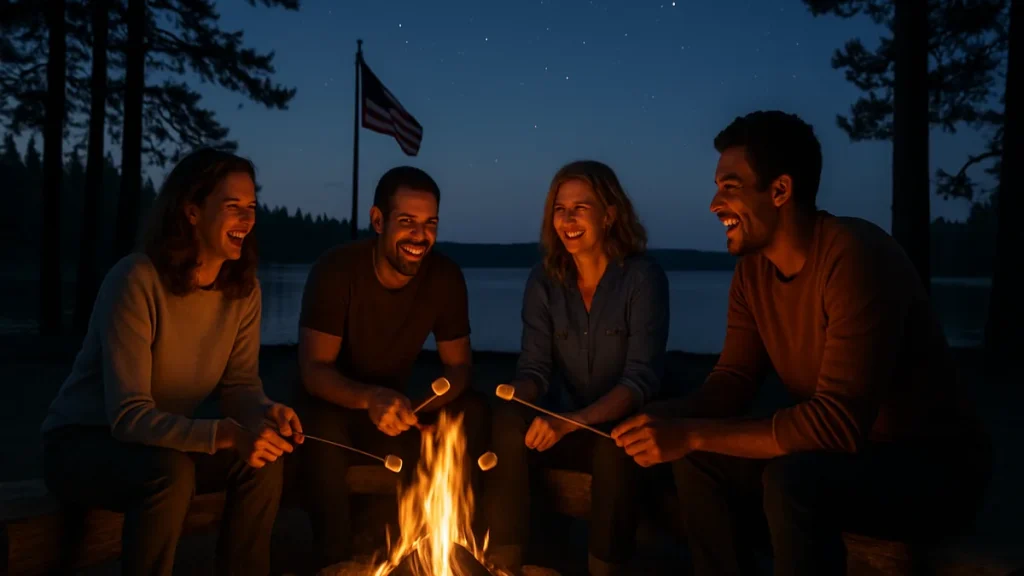

A group of nurses and support staff from a New York City clinic spent an evening around a campfire in upstate New York, swapping stories about their childhoods and how they came to their jobs. For a few hours in July 2026, the job titles and workplace hierarchies that normally shaped their relationships fell away. The group had travelled to Camp No Counselors for a four-day weekend, organised by Aleksey Aronov, chief executive of VIP’s IV, who said he wanted his team to unwind and bond.
Aronov said many of his staff were new to the company and some were shy. “But after the camp experience, everyone felt comfortable around one another, got to know each other better and bonded seamlessly,” he said. Adult camps, once a niche choice for nostalgic former campers, are drawing a wider range of people who want to network, ease burnout or simply make friends.
Adult camps move from niche getaway to mainstream trend
Demand has grown quickly. Yelp’s 2025 Trend Forecast found that searches for “adult camps” rose 347 percent between September 2023 and August 2024, compared with the previous 12-month period. The American Camp Association lists 85 adult camp programmes in the United States. It does not track the number of adult camps from year to year, but it confirmed that adult camp programming has grown steadily over the last decade.
Today’s adult camps look different from children’s programmes. Alongside campfires, sports, arts and crafts and bunk beds, many offer open bars, wine tastings, chef-prepared meals and wellness programmes. The concept has also spread beyond North America, with camps launching in places ranging from the Swiss Alps to the United Arab Emirates as of 2026.
Yelp’s trend expert, Tara Lewis, linked the trend to a wider appetite for in-person activity. “The rising popularity of adult camps reflects a larger movement toward meaningful, in-person experiences we’ve been seeing through Yelp,” she said. Demand is strong enough that all Camp No Counselors dates through 2027 have waitlists, a striking change from 2016, when founder Adam Tichauer pitched the camp on the reality TV show Shark Tank and none of the investors bit.
Loneliness and burnout push adults toward camp life
Adults across generations, from Gen X to Millennials and Gen Z, are turning to camp as a response to loneliness and burnout. Adam “Smiley” Poswolsky, a keynote speaker and author who focuses on human connection and workplace culture, said many people feel a gap between the connection they have and the connection they want. He cited social media and AI, remote work, distance from family and neighbourhoods that lack close ties as possible causes.
Poswolsky, who worked as an adult camp counsellor at Camp Grounded from 2013 to 2017, acknowledged that the idea can seem strange at first. “I think the idea of adult camp might initially produce an eyeroll,” he said. “But it’s the exact opposite.” He said adults often miss “this chance to play and opportunity to connect with people that’s not related to networking, your career, your title.”
Work is a major factor. According to the US Bureau of Labor Statistics, 22.6 percent of American workers teleworked in March 2026, up from 17.9 percent in 2022. The agency did not measure telework rates before the coronavirus pandemic because it was so rare. Matthew Leahy, a licensed clinical psychologist who designs and runs camp programmes, said many adults are now expected to produce, multitask and stay connected at all times.
Leahy said camp can interrupt that cycle. “Instead of focusing on productivity, at camp we encourage presence,” he said. Sarah Boss, a psychiatrist and clinical director of The Balance clinic in Mallorca, Spain, described adult camps as offering “a container” in which “normal rules are suspended.” She said that “permission is given to be silly, to be bad at things and to talk to strangers,” which, in her view, does much of the therapeutic work.
Alyx van der Vorm, 25, a John Harvard Scholar who studied neuroscience and founded the social connection platform Clyx, linked rising loneliness to how easy it has become to avoid leaving home. “So many things have been made frictionless, from laundry to ordering food, that when it actually comes to making plans, it seems like a bit of a mountain,” she said. A 2024 study found that the average time Americans spend at home on a typical day rose by one hour and 39 minutes between 2003 and 2022.
Hobbies, solo campers and costs shape who attends
Some adults go to camp to pick up an interest they set aside as children, often because of money. Stephanie Hamilton, an elementary school librarian in Tuscaloosa, Alabama, wanted to attend Space Camp as a child but her family could not afford it. Through a state programme that funds librarians’ attendance, she was selected to go in 2022. There she met an archivist who works in curation at the US Space & Rocket Center, and Hamilton has since started a museum studies certification programme.
Melanie Kelly, 44, a former painting major, took a weeklong art camp at Anderson Ranch Arts Center in Snowmass Village, Colorado, in 2023 after feeling burnt out from her job running marketing and communications for a solar company. She said she had long sought professional development tied to her work, and the camp helped her return to the “flow state” she remembered from painting. “Rest isn’t sleep,” she said. “The opposite of work isn’t sleep; it’s play.”
Many camps are attended by couples, groups of friends or colleagues, but they also welcome people who come alone. Joel Reisig, a movie producer who founded Michigan’s Camp Forever Fun, said he wanted to create a place for adults to take a summer break. “It is very hard to make new friends after college,” he said, adding that a weekend at the camp offers a chance for real conversations with other stressed-out adults.
Robin Soprano, vice president of Space Camp, said many adult campers are “almost brought to tears at the end of the weekend” because they pushed themselves beyond their comfort zones. Sarah El Nabulsi, a licensed clinical psychologist in Dubai, said she sees the same burnout among her patients and described adults as lacking the low-stakes social contact that once came naturally through school, shared schedules and seeing the same faces.