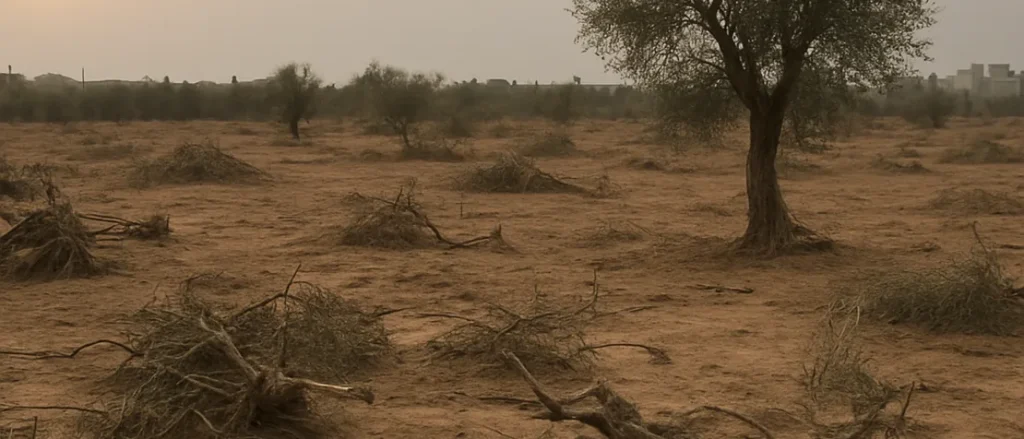

Olive groves in central Gaza that were once among the most prosperous have been largely destroyed, leaving farmers with a small fraction of their usual yield. Haidar Abu Middain, 60, said the family orchard he owned with his brothers and uncles once spanned 900 dunums, or 220 acres, of trees that would be heavy with ripe fruit at this time of year.
Today, nearly half of that orchard lies beyond the “yellow line”, which Israeli troops guard. Palestinians are barred from entering two-thirds of the Gaza Strip behind that line. The other half of the grove is still accessible, but it has mostly been bulldozed.
Family orchard shrinks to a few surviving trees
Before the war, the whole extended family would gather the harvest, which amounted to between 1,100 and 1,500 tons of olives. Some were sold as fruit, while the rest were pressed into enough oil to fill as many as 900 drums of 16 litres each.
Only around 20 or 30 trees are still standing. Abu Middain estimates they will produce just two drums of oil, not even enough for his own family. “The produce before the war was blessed, it was enough to earn a livelihood for our families,” he said.
In Deir al-Balah, a small area of central Gaza that Israeli forces declared a safe zone and did not storm during the war, one of the few remaining olive groves still serves as a refuge at harvest time. Khalil Mansi and his family gather there, with children climbing ladders and girls sorting olives from leaves and twigs before sitting down to a picnic in the shade.
Harvest and oil output fall far below pre-war levels
Gaza’s agriculture authorities estimate that of 2 million olive trees, barely 150,000 are still standing. The figures they give for this season compare with normal years as follows:
- Expected olive harvest: about 5,000 tons, instead of the usual 40,000
- Expected oil production: 700 tons, instead of the usual 5,000
- Olive oil presses still operating: seven, down from about 40 before the war
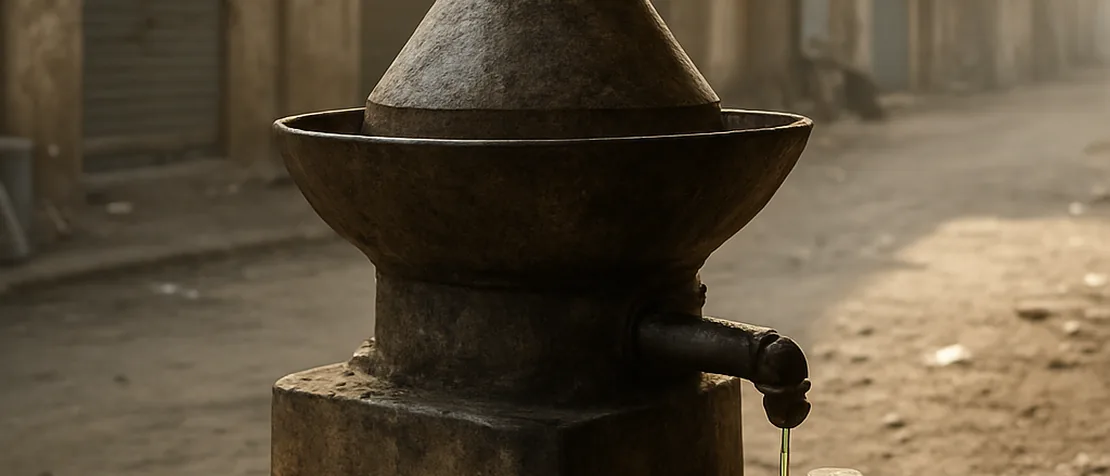
Fawaz Zidan, who has kept his press open in Deir al-Balah, said the presses are barely functioning. “Compared to years before the war, there’s zero. Because there are no olives, all of it has been bulldozed, the olives are gone,” he said, as a handful of residents queued with plastic jerrycans to collect fresh oil from the spigot.
Prices and wages leave Gazan families struggling
Bushels of olives and drums of freshly pressed oil would normally be stacked high in Gaza’s markets at this time of year. Now there is barely any, and what does reach the market sells for around triple the pre-war price, nearly $500 a drum. Imad al-Ajrami, 33, a shopper in the Deir al-Balah market, said that price is well beyond what Gazan families can afford.
Work during the harvest has also dwindled. Ahmed Khader, 38, had come out for a rare day of harvest labour. In the past, he said, the season would have kept a labourer like him employed for two or three months. Now he was grateful for a single day’s pay.
“But we still have to provide for our children with a bite to eat, and we want to try to get our daily bread,” Khader said.