

About 300 residents of Batam, an Indonesian island, stormed a compound housing data centres carrying empty plastic bottles and jerry cans. They were protesting that their home taps had run dry, while the data centres in the new Nongsa Digital Park appeared to have enough water to keep their machines cool.
One protester, Dewi Susanti, said no water had reached her taps for three months. “Our water supply had been reliable until the data centres came,” she said. Residents of her village, Bakau Serip, now rely on tanker trucks, which she described as dispensing “dirty, cloudy and smelly” water.
Authorities blame dry spell as residents allege diversion
Batam’s water utility said it was working to improve supply but did not say whether the disruption was linked to demand from the data centres. BP Batam, the agency that oversees trade and industry on the island, blamed the shortage on a prolonged dry spell. It also denied claims from locals that water intended for homes was being channelled to data centres.
The protest is not the first of its kind on the island, whose shrinking reservoirs are under growing strain as Batam seeks to become a digital hub. After protests in August and September, authorities told companies opening data centres in Batam that they must build their own desalination plants rather than draw freshwater from reservoirs. Locals say they are increasingly worried that they must now compete with servers for water.
Batam has no natural freshwater sources, so its 1.3 million people depend on rainwater collected in six artificial reservoirs. Simulations by a local environmental non-profit, Akar Bhumi Indonesia, suggest the Nongsa reservoir, which supplies Bakau Serip, could dry up within a month without rainfall. The shortages are worse this year, possibly because of a historic “super” El Niño, according to the report.
Residents describe the strain on daily life. One resident, Dewi, said money that should go on rice was now being spent on water drums, and her husband had to wait up overnight to collect water before going straight to work. Batam’s utility had earlier said it would consider measures such as cloud seeding if the shortage continued. When asked about the recent protests, it referred reporters to its earlier statements.
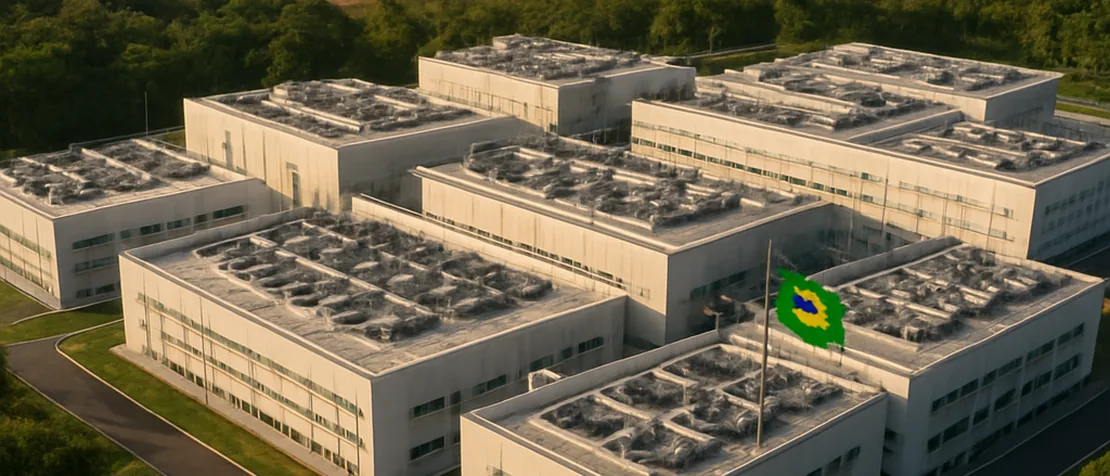
Data centre expansion and its water footprint in Batam
Authorities in Batam have approved 10 data centres, six of them in Nongsa Digital Park. Two are operating and a third is under construction, while at least six more are under review, according to BP Batam. Official figures put investment in data centres on the island at more than $6.7bn (£5.1bn) as of mid-2026, partly driven by demand from Singapore, which is an hour away by ferry.
It remains unclear how much water or electricity the Batam facilities consume. Reliable data on data centre water use in Indonesia is scarce, partly because companies treat it as proprietary information, according to Agus Hasan, a professor at the Norwegian University of Science and Technology. He argued that data centres should be built “rationally, transparently, and responsibly,” and that officials should insist on seeing the numbers.
Research in the United States suggests a typical data centre uses around 300,000 gallons of water a day, roughly the amount used by 1,000 American households. Malaysia’s central bank has estimated that a larger, 50MW facility could use as much water as 2,200 households a day. Official estimates also project that power demand from Batam’s data centres will exceed 1,100MW by 2030, enough for nearly a million homes.
Singapore paused construction of data centres in 2019, citing land and energy constraints, and lifted the ban in 2022 after introducing new efficiency standards. Investors subsequently looked to neighbouring areas. Singapore has long promoted the Riau Islands, which include Batam, and the Malaysian state of Johor as “complementary” regions. Johor drew large data centre projects but faced complaints from residents about noise, dust and water shortages, and has since tried to regulate water and electricity use.
Nongsa already hosts a 13,000-square-metre data centre developed by Hong Kong-based private equity firm Gaw Capital and Indonesian developer Sinar Primera. In April, Singapore’s DayOne signed a deal with an Indonesian state utility to build one of the country’s largest data centres, with around 450MW of capacity. In June, DayOne, chipmaker Nvidia and Australian AI start-up Firmus Technologies announced a 360MW “AI factory”. The has contacted DayOne, Sinar Primera and Gaw Capital for comment.
Residents urge officials to restore water supply
Residents say the construction boom has left them feeling ignored. Marlinda, who lives in the Sei Beduk district, which is also facing water shortages, urged officials to visit the area. “Don’t just sit at the top and keep approving these projects. Come down here and see for yourselves what we are wrestling with,” she said.
Another resident said the community wanted the government to pay attention to ordinary people. “Don’t make billion-rupiah investments while ordinary people are made to suffer,” the resident said. “We are not asking for anything extravagant. We just want our water supply restored.”