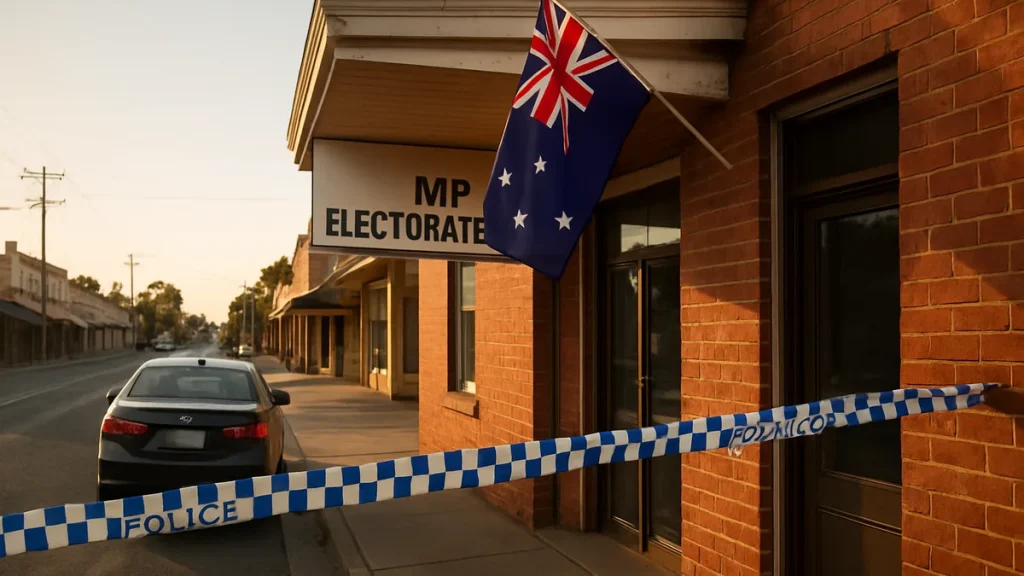

Independent MP Helen Haines was severely injured when she was struck by a car outside her office in the regional Victorian town of Wangaratta on Monday. Police said a 43-year-old man was arrested at the scene and a knife was seized, but they have not said the MP was hit deliberately. She is being treated at a hospital in Melbourne, which police are guarding.
Prime Minister Anthony Albanese quickly described the incident as an apparent attack. The case has also intensified long-running warnings from MPs and experts that threats against politicians are rising, a danger many Australians had assumed was unlikely to reach their own country.
Prime minister says Haines was deliberately targeted
Albanese said he had been briefed by federal police, whose counter terror squad is helping state officers with the investigation. He told the national broadcaster: “This wasn’t an accident. There was a deliberate act, it would appear.”
Albanese stressed that no motive had been confirmed. He became emotional while speaking about the growing fear among MPs that they could end up as targets.
Albanese himself was evacuated from his official residence earlier this year over a bomb threat. As of August, about 20 cases in which people were accused of making violent threats against him were moving through courts around the country.
Rising threats against Australian politicians in recent years
In recent years, politicians have been sent bullets through the mail. Female MPs, and in some cases their children, have been threatened with sexual violence. A Jewish MP’s office has been firebombed, a Sydney mayor’s car was torched, and many other politicians have had their workplaces vandalised.
Last week, Small Business Minister Anne Aly said she had received a wave of death threats. They followed a remark by an opposition politician, who said Aly should be “shamed and stoned in the square” over a tax policy.
Government statistics show 1,067 reports of “harassing and threatening behaviour” against “high office holders” in the year to June. That was an increase on the previous year.
Experts point to social strain and online anger
Josh Roose, a Deakin University professor who studies violent extremism, said Australians have tended to assume such violence could not happen here. He said the problem has been building for well over a decade and has escalated sharply since the pandemic.
Roose pointed to socioeconomic strain, growing mental health problems in the community and “grifters” who gain politically or financially from stoking discontent. He also cited a “carcinogenic” online environment as a driver of the trend. He added that the political class must also take responsibility for its role.
He said there had been “a willingness to cross previously sacred terrain”, including targeting individuals and their families, and that this was now happening “at both ends of the political spectrum”. Experts warn that the threat extends beyond politicians to members of the media, academics, court officials and other public figures.
Spy chief and federal police warn of grievance-driven radicalisation
Mike Burgess, the head of Australia’s spy agency, has warned for years that political violence is a growing concern. In his annual threat assessment for 2026, he wrote that politically motivated violence, including terrorism, is more likely even though a specific attack cannot be predicted.
Federal Police Commissioner Krissy Barrett said ideology is not the only force behind recent cases, and that “grievance” is radicalising people. She told a broadcaster earlier this month that such people feel “distanced” and “alone” and are “looking for something to attach to”.
Some MPs in Canberra have voiced frustration that security arrangements have not kept pace with the changing climate. They warn that if a political motive for the Haines incident is confirmed, one of the core features of the nation’s political culture could be at risk.
Albanese said Haines is particularly renowned and respected for engaging with her constituents. “Here in Australia, it is a good thing that politicians are able to go about their community and engage with people,” he said. He added: “I don’t want to see a political system in which you can’t have conversations with people at the supermarket, in the street, at street meetings, public forums – that’s an important part of our democracy.”