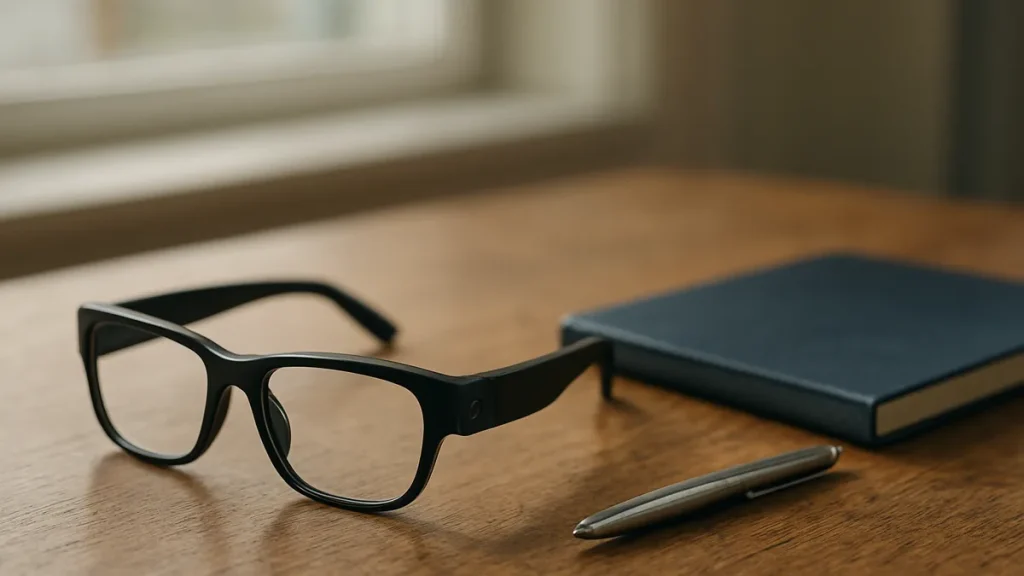

The Punjab government has decided to impose Section 144 to prohibit spy glasses, camera-equipped pens, key chains and button cameras. Information Minister Azma Bukhari announced the decision on Monday and said the Home Department had been instructed to start a crackdown on these devices.
Speaking at a press conference at the Directorate General Public Relations in Lahore, held after a provincial cabinet meeting, Bukhari said Chief Minister Maryam Nawaz had approved the move to protect citizens’ privacy and personal information. The restrictions apply to gadgets that can secretly record or watch people. Officials cited concerns that such equipment is being misused for harassment, illegal monitoring and blackmail, and the minister said the government intends to pursue strict legal action against both misuse and the trade in these products.
Lahore High Court hears petitions on smart glasses
The announcement comes as scrutiny of camera-equipped smart glasses grows in Pakistan. The Lahore High Court is hearing petitions that ask for regulatory action over the sale and use of eyewear able to take photographs, capture audio and record video. Petitioners have raised worries about privacy and security.
Industrial programme, exports and tractor subsidies
At the same press conference, Bukhari outlined other decisions from the cabinet meeting. These included approval of a three-year industrial development programme that is expected to bring in Rs3 trillion in investment. She said 46 private-sector investors were prepared to put money into the scheme, which also covers agriculture and livestock, and that it is expected to create more than 150,000 jobs.
Bukhari said the government wants Pakistani-made goods to be exported under the country’s own name, citing pink salt as an example that would be sold abroad as a Pakistani product. Testing facilities for locally manufactured fans will also be set up. She added that more than 30,000 tractors had been provided during the chief minister’s first two years in office, and that Rs9.5 billion in subsidies would be paid.
She also said the government planned to set up Parks and Horticulture Authorities in every district. Punjab will provide six Clinics on Wheels vehicles to Gilgit-Baltistan, Bukhari said, and she noted that young people had been helped to find jobs in Saudi Arabia through a skills and employment initiative.
Transport plans and emission testing in Punjab
Punjab Transport Minister Bilal Akbar Khan, also speaking at the press conference, said transport accounts for 30 per cent of air pollution. He outlined steps to improve public transport and cut emissions. According to Khan, the chief minister will inaugurate a metro system in Gujranwala in March 2027, and Punjab already operates three metro systems.
Khan said 25,000 people had applied to join the province’s electric taxi scheme, and loans had been approved for 743 applicants. Women make up 30 per cent of the electric taxis, he added. He also said 44 vehicle emission testing centres had been set up across Punjab, 18 of them in Lahore, and that the Lahore figure was expected to rise to 35. The government is also working with the Ravi Urban Development Authority (RUDA) to move two or three bus and transport terminals out of Lahore.
Bukhari’s remarks on Khyber Pakhtunkhwa security and mining licences
Bukhari also turned to security in Khyber Pakhtunkhwa. She criticised Jamiat Ulema-i-Islam-Fazl chief Maulana Fazlur Rehman over his position on the Pakistan Taliban, saying he did not describe the Tehreek-i-Taliban Pakistan (TTP) as a terrorist organisation.
Bukhari further alleged that successive provincial governments had issued thousands of mineral exploration and mining licences in Khyber Pakhtunkhwa. She said 4,200 licences had been granted between 2013 and 2026, compared with 422 from Pakistan’s independence until 2010. She alleged that around 1,000 were issued during the tenures of Chief Ministers Sohail Afridi and Ali Amin Gandapur. These figures and allegations have not been independently verified.