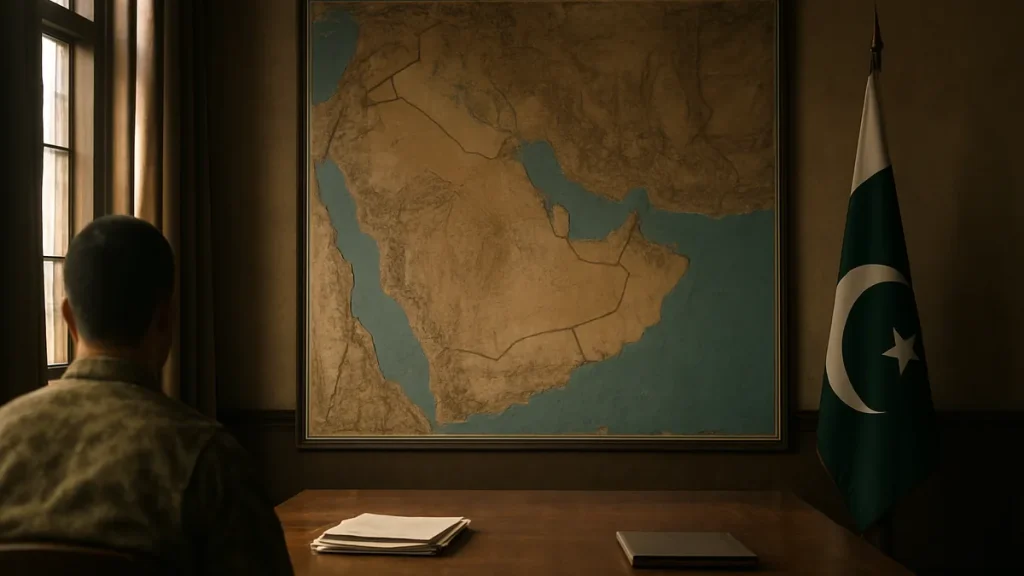

Pakistan’s military spokesperson, Lt Gen Ahmed Sharif Chaudhry, Director General of the Inter-Services Public Relations (ISPR), has said Islamabad may “evaluate” any request for direct military support from Yemen’s internationally recognised government. He made the remarks as Houthi attacks on Saudi Arabia continue. Speaking in an interview on Sunday, he was asked whether Yemen’s government had approached Pakistan for help.
Lt Gen Chaudhry said he was not aware of any formal request so far. If one were made, he added, it would be for the government of Pakistan to assess and respond. He also warned that the Makkah Joint Defence Agreement (MJDA) could come into play if diplomacy fails and military confrontation spreads across the Middle East.
Makkah Joint Defence Agreement and its terms
Lt Gen Chaudhry said the MJDA, which links Pakistan, Saudi Arabia and Turkiye, had moved forward rapidly in a short time. He described the pact as reflecting the shared thinking of the three countries. The agreement was signed on August 7 at the Makkah Al-Mukarramah Summit for Joint Defence.
Under its terms, an armed attack on any one of the three states would be treated as an attack on all of them. Lt Gen Chaudhry said the partners share a commitment to peace, stability and prosperity in the region.

Saudi sovereignty and attacks on holy sites
According to Lt Gen Chaudhry, protecting Saudi Arabia’s sovereignty and territorial integrity remains a top priority for Pakistan. He said the protection of Islam’s two holiest sites matters just as much. He stressed that Pakistan’s position is clear and unequivocal, and said Islamabad had already conveyed its message through the country’s political and military leadership.
The fighting between the Saudi-led coalition and the Houthis, who control the capital Sanaa and much of the north, has escalated in recent weeks. The conflict has been described as another front in the US-Israeli war on Iran. The Houthis have recently attacked Riyadh’s international airport, Makkah and Madina, and their advances threaten the Bab el-Mandeb oil shipping route following the collapse of a truce.
Lt Gen Chaudhry said the Houthi strikes on Islam’s holiest sites had caused deep grief and anger among the public, as well as within the political and military leadership.
Call for a negotiated settlement and Muslim unity
On the wider security situation, Lt Gen Chaudhry warned that rising military tensions would benefit no country. He said expanding the conflict in the Middle East was in no one’s interest and called for a negotiated settlement.
He said the MJDA’s leadership and course of action were clear, and that the alliance had no aggressive intentions and was not aimed at any particular country. He also urged Muslim nations to unite, saying countries in the region should resolve their differences rather than fight one another. Disputes, he said, should be settled through negotiations rather than military escalation.