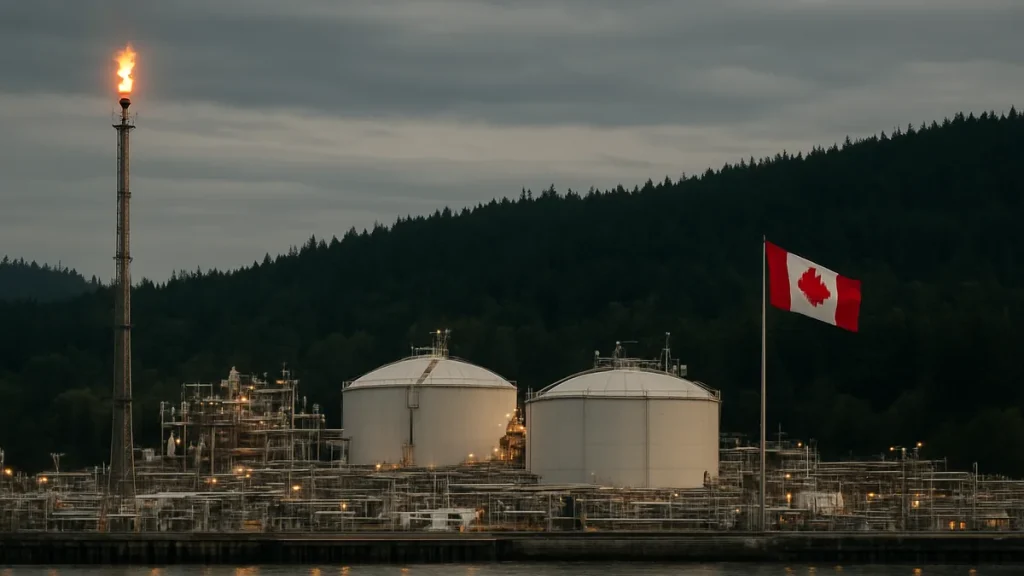

Canada is seeking to become a leading supplier in global liquefied natural gas (LNG) markets, but critics warn that its push could lock the country into decades-long, multibillion-dollar contracts with companies whose past and present projects include alleged human rights abuses and environmental damage. The concerns centre on Kitimat, a community on the west coast of British Columbia where LNG Canada began operations in mid-2025.
LNG Canada is the country’s first major export facility. In late September, its owners gave the go-ahead to a $33bn expansion that is expected to double production at Kitimat in the coming years.
Flaring problems and concerns from residents
The Kitimat plant has had trouble with its flaring equipment since it began commissioning in late 2024. In 2025, the new liquefaction facility burned 350 million cubic metres of gas because of a problem with its main flare stack.
One resident, who asked not to be named, described the noise from the flaring as far louder than expected when the plant first started up. Another said the changes to the area had left them deeply upset and that a friend’s asthma had worsened after returning to the town. Residents spoke anonymously because Kitimat is small and the project is a major local employer and donor to community groups.
Local people were unaware of the scale or nature of the flaring until investigative reporting revealed that the plant had started operating despite identifying an “integrity issue” with its equipment. The facility has since been counted among the world’s highest sources of flaring emissions, according to the article.
Government backing as trade pressures mount
The expansion has political support, particularly as Canada faces economic pressure from the administration of United States President Donald Trump. Washington has imposed a series of tariffs on Canadian goods, including steel, lumber and aluminium in 2025, and added further duties worth $20bn in August, covering products such as wine, dairy and textiles.
Since the tariff campaign began, the Canadian government has announced a string of deals aimed at diversifying its trade partners and expanding domestic infrastructure. Prime Minister Mark Carney’s government recently added two LNG developments, LNG Canada and Ksi Lisims LNG, to its major projects list and pledged strong federal support. A dedicated body, the Major Projects Office, was set up to speed up infrastructure considered to be in the national interest.
Speaking at a news conference in Vancouver after the announcement, Carney said: “Canada is building big again.” He added that the federal government had referred LNG Canada Phase 2 to the office a year earlier, and said the aim was to reach the right decision quickly and efficiently.
Marc Lee, a senior economist with the Canadian Centre for Policy Alternatives, said the long-term economics of oil and gas markets over the next 10 to 20 years are the main force behind these decisions. He argued that the government is not concerned with companies’ conduct in other countries. “None of that matters to the federal government,” he said. “It’s all about investment.”
Lee also said the ongoing trade dispute with the United States was being used as an excuse to fast-track major projects, at the expense of environmental protection and local communities. He noted that the Canadian LNG projects predate Trump’s first term in office. Calling the approach “pure growth and extraction”, he warned of long-term costs to British Columbians.
Carney’s office declined an interview request and referred questions to the federal Privy Council Office, which did not respond before publication. Construction on the expansion, which includes five new compressor stations on the Coastal GasLink pipeline that supplies the export plant, is set to begin immediately.
Corporate links to alleged abuses and pollution
Several companies involved in the two projects, either directly or through financing arrangements, have what the article describes as murky histories and troubling portfolios. Accusations of environmental pollution and potential human rights violations have also been levelled at them.
LNG Canada is owned by a consortium of five foreign companies: Shell, Petronas, Korea Gas, PetroChina and Mitsubishi. Shell holds the majority stake. Shell signed a deal in 2024 to buy two million tonnes of LNG from Ksi Lisims, and recently acquired Arc Resources, a Canadian oil and gas company with assets in northeast British Columbia and Alberta.
Shell’s operations in Nigeria are among the most controversial. The United Nations estimates that the company spilled more than 13 million barrels of crude oil in at least 7,000 incidents in the Niger Delta since it began working there in 1958. Those spills, and the company’s later efforts to avoid responsibility, have allegedly devastated the lives and livelihoods of local residents.
Anna Zalik, a professor at York University in Toronto who has studied Shell’s conduct in Nigeria for more than 20 years, said the company’s description of itself as a responsible actor in Canada was disingenuous. She said the firm had been linked to serious human rights violations and legal cases in Nigeria, and that its track record showed an attempt to avoid liability for pollution.
Shell declined an interview request and said the characterisation of its operations was “not one we recognise”. In an emailed statement, a spokesperson said the company was committed to honesty, integrity and respect for people. The spokesperson also said its Nigerian operations involved “complex and contested issues” and that the allegations did not reflect the difficult conditions in the Niger Delta, including large-scale oil theft, sabotage and illegal refining by organised criminal gangs.
The Coastal GasLink pipeline, which supplies Shell’s facility, was built by TC Energy between 2019 and 2024 across Wet’suwet’en territories. Critics say the pipeline was constructed without the consent of the nation’s Indigenous leaders, the Hereditary Chiefs. Construction of the 670-kilometre pipeline became the focus of Indigenous-led protests, arrests and nationwide outrage in 2020.
KKR, a New York investment firm, is a majority owner of the pipeline. The firm faced controversy last year over its acquisition of Superstruct Entertainment, whose holdings include music festivals and the electronic music brand Boiler Room. Dozens of artists also accused KKR of promoting the illegal occupation of Palestinian territory. KKR has said it has no real estate interests in the West Bank and no longer invests in the German media company Axel Springer. It has not made clear whether it retains financial interests in companies linked to the Israeli military.
TotalEnergies, which agreed in 2025 to buy two million tonnes of liquefied gas a year from Ksi Lisims LNG, has been accused of “complicity in war crimes, torture and enforced disappearance” at its LNG facility in Mozambique. Those claims are contained in a criminal complaint filed in late 2025 by the European Center for Constitutional and Human Rights with France’s national antiterrorism prosecutor. There is no update on the investigation, and TotalEnergies did not respond to requests for comment.
Aidan Gilchrist-Blackwood, a coordinator with the Canadian Network for Corporate Accountability, said the public is largely unaware of how companies in major Canadian projects are linked to alleged abuses. He blamed part of this on a “power imbalance”, saying affected communities are structurally weaker than the companies involved. He also said Canada lacks the legal tools to ensure businesses operating in the country uphold international human rights obligations, calling the pattern the result of “intentional policy decisions”.