Al-Jawf has emerged as a new focal point in the conflict between forces aligned with Yemen’s internationally recognised government and the Houthis. The northern governorate’s strategic importance has drawn both sides into intensified fighting there.
The Yemeni government army and forces loyal to it have launched a major counteroffensive to take strategic heights east of the provincial capital, al-Hazm, from the Houthis. The push is part of Operation Dawn of Yemen, which the government launched last month to reverse Houthi territorial gains and restore state control across the country.
Control of al-Hazm and the strategic heights
Al-Hazm has become a central part of the operation, as the city could serve as a launchpad for government forces moving against the Houthis. The Houthis have held the capital, Sanaa, and most of northern Yemen since the war broke out in September 2014. Control of al-Hazm has changed hands several times over the twelve years of conflict, and the Houthis seized the city in March 2020.
Also read: Saudi strike kills 14 in Yemen as Houthis target Aden airport
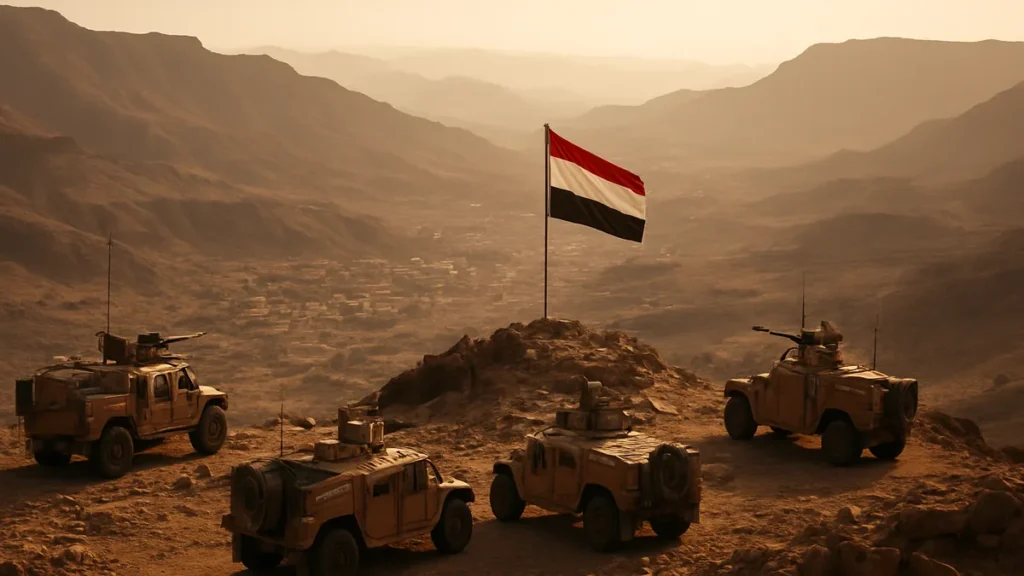
Field Commander Colonel Rabie Al-Qurashi said government forces had won complete control over the Huwaishan mountain range, east of al-Hazm. He described it as the first line of defence for the Houthis on the eastern axis. Control of the rugged area, he said, would let government forces disrupt rebel supply routes.
Al-Qurashi said government forces had broken through that defensive line and now held part of the Al-Alam front road. “The government advance represents a beginning to tighten the noose on the Houthis in the upper al-Labanat camp,” he said, describing the camp as a vital eastern gateway to Sanaa.

Analysts weigh the military value of Al-Jawf
Ali Al-Dahab, a military and strategic affairs researcher, said holding the elevated terrain offered considerable tactical benefits. He told that the recent gains were a military shift that would support future operations towards al-Hazm city. He also said the advances gave government forces a morale boost and allowed them to monitor and observe Houthi supply lines while securing their own.
Military spokesman Majed Abdullah Al-Nuzaili said on X that recent operations against Houthi positions in al-Jawf were “inflicting losses on the militia’s capabilities”. The government dominates the vast eastern desert district of Khabb wa ash Sha’af, which accounts for 82 percent of the governorate’s total area. The Houthis control the provincial capital, al-Hazm, and ten other districts.
Security and political affairs researcher Brigadier General Ahmed Al-Awadhi stressed the importance of “continuous but not rapid” government advances. He said control of heights and mountain ranges in the desert governorate gave military strength, whether they sat near the capital or far from it. Al-Awadhi added that the advances highlighted a historical weakness for the Houthis, who he said had suffered repeated defeats in desert and open areas.
The developments coincide with the Presidential Council’s appointment of Major General Amin Ali Al-Akimi as governor and military commander of al-Jawf. Ibrahim Jalal, a Yemen-focused analyst, said the move was linked to restructuring the theatre of operations and unifying the front. He noted that Al-Akimi, who comes from Dhu Hussein, a branch of the Daham Bakil tribe, has tribal and military influence that could help mobilise tribes and bolster momentum on the ground.
Jalal cautioned that turning that influence into lasting gains depends on unifying command and control, coordinating operations across all fronts, securing military and logistical support, and strengthening anti-corruption efforts. The Houthis, for their part, say they have thwarted government advances in al-Jawf and Marib.
Fighting spreads to Taiz, Hodeidah and Lahij
Fighting has continued in other parts of Yemen. Houthi-affiliated media reported air strikes on an oil company facility in the Bajil district of Hodeidah, which coincided with fierce fighting further south. Government forces said they had repelled Houthi attacks in al-Aqroudh and on the Tur al-Baha front in Lahij governorate, while intense fighting continues in Taiz governorate.
The siege of Taiz City continues to strain medical infrastructure, with deliveries of food and fuel severely restricted. Authorities have warned that civilians remain at risk from sniper fire from the surrounding hillsides. Governor Nabil Shamsan said hospitals are working at only 20 percent capacity, and 120 health centres are completely shut because of the siege.
Shamsan made an appeal to the international community. “We urge the international community to secure at least one safe route between Taiz and Aden to enable citizen movement and the smooth entry of services, essential materials and goods,” he said. Meanwhile, more than 300,000 people have fled their homes in western Yemen because of the escalating fighting, leaving civilians highly vulnerable.