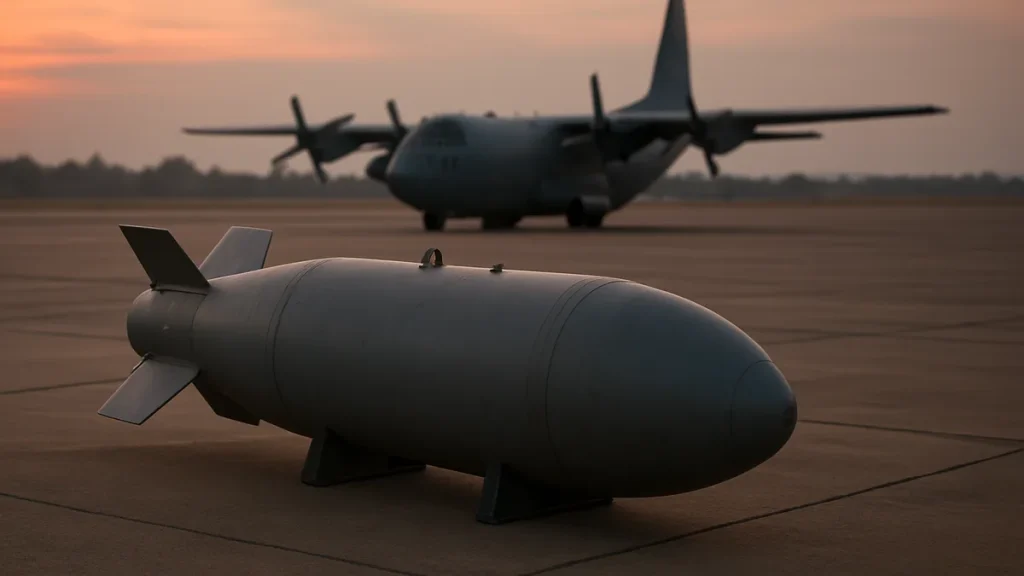

US President Donald Trump has said the ‘mother of all bombs’ is not a nuclear weapon, while discussing the possibility of further American strikes on Iran’s nuclear facilities. Speaking in an interview with Newsmax on Thursday, he described the GBU-43/B Massive Ordnance Air Blast (MOAB) as a conventional weapon and rejected claims that it was a tactical nuclear bomb.
Trump said the bomb was ‘an extremely large bomb’ and likened its destructive force to that of a small nuclear device, while stressing that it carried no nuclear material. He did not rule out nuclear weapons in a wider conflict, and he did not confirm whether he had approved the MOAB’s deployment.
Possible strikes on Pickaxe Mountain and Iranian energy sites
Trump said Washington was weighing further military action against Iran, including a possible strike on a suspected underground nuclear site at Pickaxe Mountain. Separate US media reports said Pentagon planners had drawn up options involving the MOAB that could hit Iranian energy infrastructure and nuclear sites if Trump ordered renewed fighting.
The White House declined to discuss sensitive military planning. It said the president was keeping every option open to prevent Iran from obtaining nuclear weapons.
MOAB’s size, combat history and limits against deep targets
Weighing roughly 21,600 pounds, the MOAB is the biggest of America’s conventional bombs. It was first used in combat in April 2017 against an Islamic State tunnel complex in Afghanistan.
Unlike bunker-busting weapons built to pierce deeply buried targets, the MOAB mainly produces a massive blast at the surface. That raises questions about how effective it would be against facilities buried deep underground.
Trump on damage, negotiations and falling oil prices
Trump said the United States had already caused significant damage to Iran’s nuclear infrastructure, but suggested more strikes could be necessary to stop Tehran acquiring nuclear weapons. He indicated that an operation against Pickaxe Mountain would not require American ground troops.
He predicted the conflict would end soon, saying Iran was negotiating with Washington. He claimed Iranian officials had asked for American and Israeli military operations to stop, and forecast that an end to the war would send oil and petrol prices down sharply.