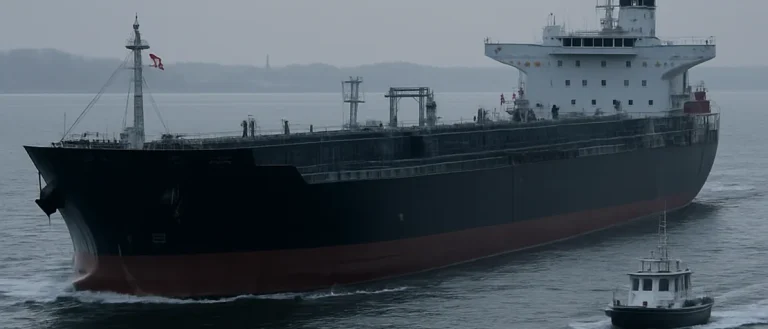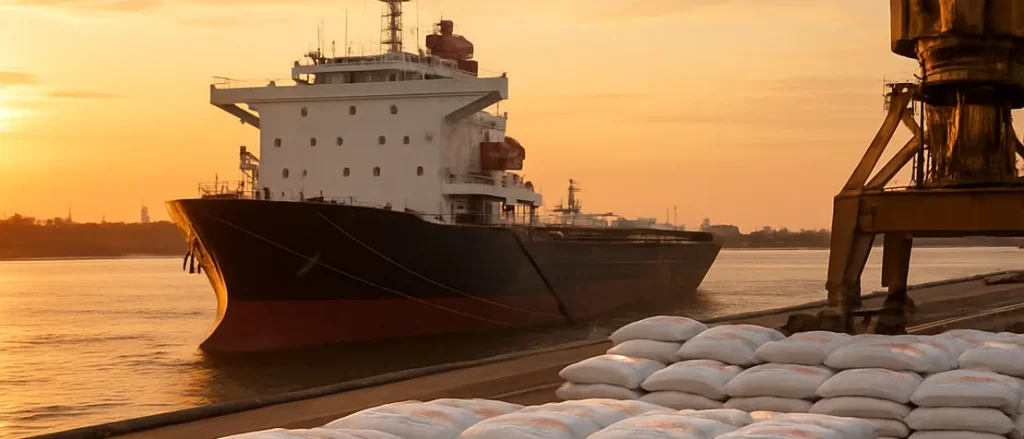

The United States is preparing to take delivery of its first Belarusian potash shipment in four years, as President Donald Trump looks for cheaper fertiliser for American farmers. Rising costs linked to the Iran war and a trade dispute with Canada have added pressure on the sector.
Shipping data from Kpler indicates that a 30,000-tonne cargo of potash is due at the Port of New Orleans on Wednesday. The delivery follows a decision by Washington in March to lift sanctions on major Belarusian potash producers, which cleared the way for trade to restart.
A small cargo with a larger political signal
The incoming shipment is a small part of the market. The US imported 5.6 million tonnes of potash last year, so the Belarusian cargo covers only a fraction of that volume. Even so, it suggests that relations between Washington and Minsk are beginning to thaw.
Trump has said Washington is negotiating a bigger agreement to buy Belarusian fertiliser at prices well below what it pays Canada, the country’s largest supplier. Analysts, however, have doubted whether Belarus can undercut Canadian producers on price and increase exports enough to shift the American market in a meaningful way.
Heavy reliance on Canada and pressure on farmers
Potash is a potassium-rich mineral and a key ingredient in fertiliser. Potassium is essential for plant growth and has no substitute, and the mineral is widely used in farming, including for corn and soybeans.
According to the US Geological Survey’s 2026 Mineral Commodity Summaries, Canada supplies almost 80 percent of American potash imports. Russia is the second-largest source, accounting for 12 percent. That dependence has turned fertiliser supply into a matter of both economic and political concern, particularly as farmers struggle with higher production costs.
US farmers have reported higher fuel and fertiliser bills in recent months, squeezing margins that were already thin. Trump is reported to be worried that the financial strain could cost Republicans support among farmers in this year’s midterm elections. In 2024, he won 78 percent of the vote in farming-dependent counties.
At an agriculture roundtable in Wisconsin in June, Trump promised that fertiliser prices would “go way down” once the United States emerged from the Iran conflict. Disruption to shipping through the Strait of Hormuz has already strained global fertiliser markets, especially nitrogen-based products. Potash is less directly affected, because the US relies mainly on Canadian supply.
Logistics and doubts over Belarus as a supplier
Trump has argued that Belarusian potash could lower costs and give American buyers another option in a market dominated by Canadian imports. Yet the benefits for farmers are not guaranteed. Fertiliser is only one of several large expenses, alongside diesel and machinery, so cheaper potash would not necessarily offset rises elsewhere.
Belarus has no sea access, and EU restrictions are affecting its export routes. As a result, potash must travel a longer route through Russia. One report, citing the Financial Times, said the incoming cargo was loaded at the Russian port of Bronka, near St Petersburg.
Those logistical hurdles could raise transport costs and reduce Belarus’s competitiveness, even if the product itself is cheaper. The scale of exports is another limit. One cargo shows that trade has resumed, but it does not prove that Belarus can replace a significant share of Canadian potash or push prices down across the American market.
Lukashenko himself has signalled limits on supply. In September, Belarusian President Alexander Lukashenko said the country could not provide large volumes to the US. “Even if we wanted to supply [potash] to other, Western markets, we simply do not have those volumes – everything is contracted,” Lukashenko said.
Canada’s position in the market is shaped by trade policy. Relations between Washington and Ottawa have been strained since Trump’s second term began and he imposed tariffs on most trading partners, including Canada. His administration first applied a 25 percent tariff to many Canadian imports, including potash, in March 2025, before cutting it to 10 percent after pushback from agricultural groups and lawmakers. Potash that meets the USMCA trade agreement, which covers the US, Mexico and Canada, is exempt, and most Canadian potash qualifies and remains duty-free.
Rebuilding ties between Washington and Minsk
The planned delivery marks a notable step in restoring trade between Washington and Minsk, which have been at odds for years over Belarus’s human rights record and its support for Russia’s war against Ukraine. The Biden administration imposed tougher sanctions on Belarus in 2021 after Lukashenko’s government cracked down on mass protests against the disputed 2020 presidential election. Belarus also faced Western sanctions for allowing Russian forces to use its territory during the 2022 invasion of Ukraine.
Since returning to the White House in 2025, Trump has pursued direct talks with Lukashenko. Those discussions have led to the release of political prisoners in return for relief from US sanctions. In March, Belarus freed 250 political prisoners under a US-brokered deal, after which Washington lifted sanctions on major potash producers and eased restrictions on several financial institutions. In September, US special envoy John Coale announced a further agreement, under which Belarus would release 25 prisoners in exchange for sanctions relief.
The thaw has also opened the door to wider business proposals. On September 29, Lukashenko said he had agreed with Russian President Vladimir Putin that the state-controlled energy company Gazprom would take part in building a nitrogen fertiliser plant in Belarus. He also proposed inviting the US to join using American technology, according to a news agency report.
Opposition figures have voiced caution. Exiled Belarusian opposition leader Sviatlana Tsikhanouskaya said in September that dealing with Lukashenko carries risks. She argued that it was not the time to trade with the regime, because potash income was feeding repression and supporting Russia’s war effort.
The proposed fertiliser plant has not confirmed any US role. Still, alongside Trump’s stated interest in Belarusian potash, it shows how Minsk is trying to convert improving political ties into wider commercial opportunities. Whether the October shipment grows into a much larger arrangement will depend on whether exports can be sustained and whether the diplomatic opening holds.