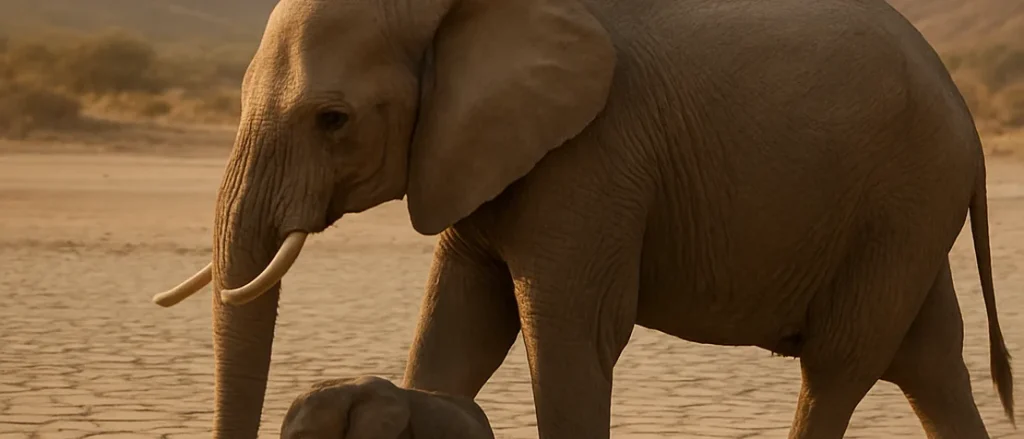

Italian photographer Federico Veronesi has been named Wildlife Photographer of the Year 2026 for an emotional image of an elephant carrying a dead calf. The picture was taken in Namibia’s Huab River Valley. The competition’s annual exhibition opens at the Natural History Museum on Friday 16 October 2026.
Veronesi was tracking elephants in the dry riverbed when he noticed an unusual trail of drag marks in the sand. Following it, he found a female elephant carrying a dead calf, with one of the calf’s legs wedged between her tusk and trunk.
How the elephant image came to be taken
Veronesi first assumed the elephant was the calf’s mother. After he shared his photographs with an elephant research project working in the area, however, he learned that this was not certain. Researchers recognised the elephant as a female who had lost a calf several years earlier. They said she had previously picked up dead calves belonging to other females.
Veronesi said the encounter had a deep impact on him. “Of all the 20 years I’ve done photographing animals, this is the most heart-wrecking and fascinating and dramatic,” he said. He described it as revealing “the depth and complexity of the emotions, the feelings of the animals.”
He hopes the picture will encourage people to look beyond an animal’s physical appearance. In his view, animals are individuals with their own relationships, memories and emotions. “It’s a small window that opens just a crack into the complexity of their world,” he said.
Other winning entries from across the world
The competition also featured a range of images from many countries and categories. Among the entries highlighted in the gallery are the following:
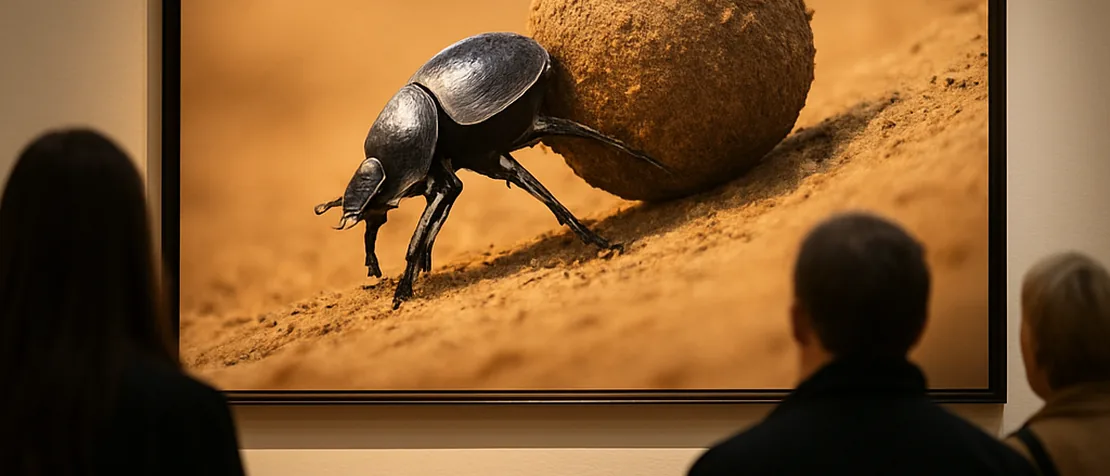
- Oscar Whitfield, from Zimbabwe and the UK, whose picture of a dung beetle pushing a ball of dung uphill was taken in Zambezi National Park, Zimbabwe, in the 11 to 14 Years category.
- Amelie Davis, from the UK, who took a shot of a common carder bumblebee in mid-flight using her father’s smartphone in the garden.
- Aaron Sanders, from the UK, who photographed a common octopus peeking from behind kelp at Porthkerris Beach in Cornwall.
- Isak Pretorius, from South Africa, whose image of two shoebill storks was taken at Mabamba Swamp in Uganda. Fewer than 5,300 mature shoebill storks are estimated to remain in the wild.
- Tony Wu, from the USA and Japan, whose photographs show Abbott’s moray eels in Kagoshima Prefecture, Japan. The Natural History Museum said this is probably the first time the eels’ courtship ritual has been photographed.
Whitfield captured his image while on a family game drive near his home in Victoria Falls. He lay in the dust to shoot the beetle at eye level, which he said was necessary to show how much strength its task required. Davis’s photo freezes a single wingbeat as the bumblebee prepares to land on a flower.
Urban wildlife and conservation themes in the gallery
Several entries focus on animals living close to people. Loren Elliott’s work concerns San Francisco, which is estimated to be home to around 100 coyotes living alongside a large human population. According to the gallery, coyotes can prey on domestic animals but also help control disease-carrying rodents, and residents’ attitudes towards them are mixed.
Other images highlight threats and change. Francisco Negroni photographed a dead puma displayed as a hunting trophy in Santa Cruz Province, Argentina. The gallery notes that Santa Cruz banned puma hunting in 2025, but illegal persecution continues. Photographer Alex Visbal documented the pink colour of Stansbury Bay in Utah’s Great Salt Lake, which the gallery links to microbes thriving in extremely salty water after the area was cut off from fresh water.