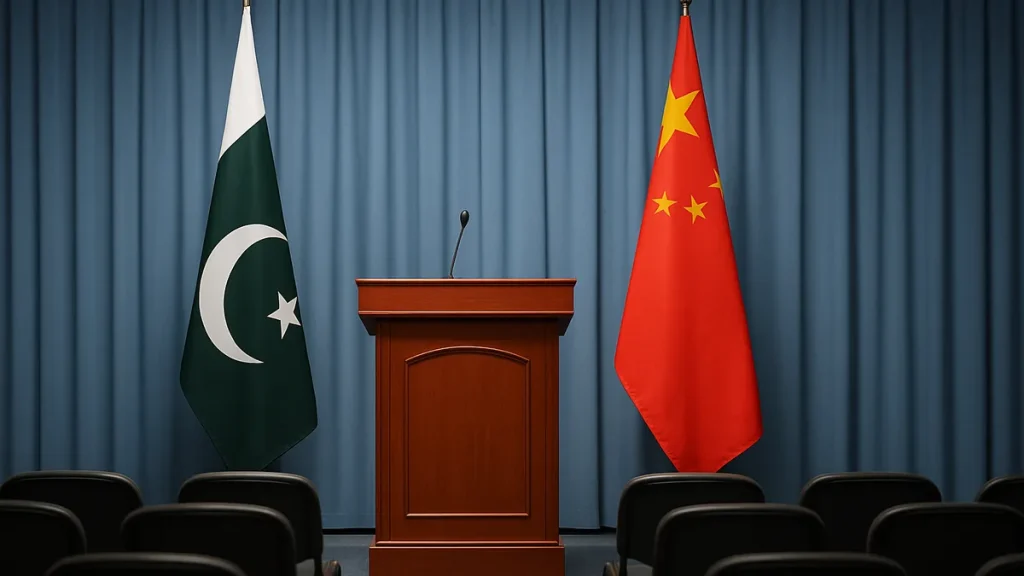
Pakistan has unveiled the China-Pakistan Information Corridor (CPIC), a new initiative designed to expand media collaboration with China, push back against false narratives and build closer bonds between the two peoples. Information Minister Attaullah Tarar presented the project at a ceremony in Islamabad, calling it a central part of the two countries’ developing partnership.
Tarar said the corridor would draw in media outlets, companies, think tanks, and cultural and youth groups. Its purpose, he said, is to encourage the sharing of information, fact-checking, trade and investment. He framed the project as a companion to the China-Pakistan Economic Corridor (CPEC), which was launched in 2015, with its emphasis placed on public understanding between the two nations.
Four pillars cover media, business, think tanks and youth
The minister said the corridor will operate through four pillars: media; business and enterprise; think tanks; and culture, tourism and youth. Under the media pillar, a news exchange working group has been set up with 18 Pakistani and Chinese media organisations to circulate verified material on bilateral cooperation. A separate fact-checking mechanism will monitor misleading claims and answer them with accurate information, Tarar said.
The business and enterprise pillar has opened its first regional office in Karachi and is building a trade portal that will follow trade, investment and foreign direct investment. A planned podcast series will spotlight Chinese companies working in Pakistan and Pakistani entrepreneurs operating in China. The think-tank pillar, led by the Pakistan-China Institute, will bring together research bodies from both countries to hold joint discussions, carry out research and produce publications.
- A tourism corridor linking China’s Xinjiang region with Pakistan’s Gilgit-Baltistan is under development.
- A Pakistan-China friendship rally is planned.
- A youth ambassador programme is also in the pipeline.
- The first cohort of CPEC Youth Ambassadors has been nominated from 13 universities across Pakistan.

Digital skills and the push for a stronger national narrative
Tarar argued that the initiative comes at a time when digital reach and control over a nation’s story have become increasingly important. “In the digital age connectivity is power and narrative is sovereignty,” he said. He warned that a country unable to tell its own story in digital spaces risks having others tell it instead.
He also pointed to cooperation in digital technology, including artificial intelligence and e-commerce, and invited Chinese media organisations, universities, think tanks, businesses and young people to take part. Prime Minister Shehbaz Sharif, according to Tarar, had encouraged cooperation in information technology education, including scholarships for Pakistani students to study emerging trends. An agreement with Alibaba Group, which was drafted using artificial intelligence and signed during the prime minister’s visit, is now being carried out, the minister added.
Tarar said more than 68 per cent of Pakistan’s population is under 30, which he described as making youth development and digital skills central to the country’s economic future. He called the Pakistan-China relationship an enduring partnership rooted in shared history, and said the corridor would pass that legacy on to younger generations.
Building on the second phase of CPEC
Tarar said the first phase of CPEC focused on physical links, including energy projects, motorways, the Gwadar port and a fibre-optic connection between the two countries. The next phase, he said, would aim to connect people and ideas as well as economies. The initiative, he added, is linked to the broader second phase, which emphasises economic growth, innovation, green development and wider cooperation.
He invited Chinese partners to work with Pakistani institutions across all four pillars. The aim, Tarar said, is to build understanding and trust through sustained exchange of information.