At Karachi Zoo, activist Jude Allen once sang “You Are My Sunshine” to an elephant he could not save. That elephant, Noor Jehan, died in April 2023 after a long decline, and her death has since become the starting point for a wider campaign to protect her sister, Madhubala.
Madhubala, now 22, is recovering from serious health problems, according to her carers. Pakistani and international activists and doctors are working to save her, and they say her condition reflects more than medical illness. In their view, the system that holds captive animals is unable to give them the care and facilities they need.
Noor Jehan’s death and the campaign that followed
Allen, 45, had worked a series of corporate jobs while volunteering as an animal caregiver since he was young. He said his bond with Noor Jehan changed the direction of his life. After she rested her forehead against his and he hugged her for the first time, he said, “it all made sense”, and he quit his job without a fallback plan.
Allen said he massaged Noor Jehan’s legs, treated her bedsores and stayed with her in her final days. She died on April 22, 2023, surrounded by a small group of activists. By 2021, her tusk was infected, and she was suffering from malnutrition and stress.
The four African elephant calves at the centre of the story were brought to Pakistan in 2009 from Tanzania, allegedly through an animal trader. Two, Noor Jehan and Madhubala, were kept at Karachi Zoo. Their sisters, Sonia and Malika, were taken to Safari Park, a larger facility in the same city with a zoo and viewing areas where visitors can watch animals up close.
The case drew wider attention in 2020, when Pakistan followed the story of Kaavan, an Asian elephant who had spent 35 years in Islamabad. Four Paws, an international animal welfare organisation, helped move him to a sanctuary in Cambodia. Allen said that episode led him to Four Paws, which then introduced him to the Karachi sisters.
Allen and other activists could not save Noor Jehan, but her death turned into a broader call for care and justice for captive animals in Karachi, a coastal city of 20 million people. Allen leads the “I Am Noor Jehan” movement, and the Pakistan Animal Welfare Society held a memorial for her with artists, filmmakers and animal activists.
Madhubala’s reunion with her sisters at Safari Park
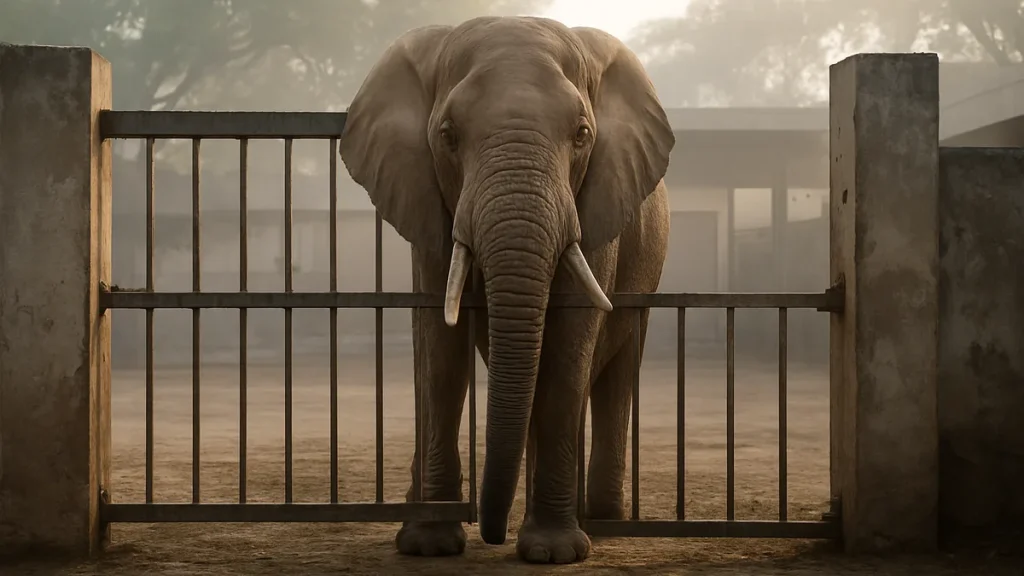
Madhubala was by then the only African elephant left at the Karachi Metropolitan Corporation-run zoo. Allen said she was alone and banged her head against the gate of her enclosure. “She didn’t have a friend,” he said, adding that she needed company.
Four Paws assessed the elephants at Safari Park and concluded that they needed better diets, enrichment and medical treatment. The organisation recommended reuniting the siblings, and Allen helped prepare Madhubala for the move. Preparing her to enter a transport crate took patience, he said, because she could be aggressive and hard to approach.
The reunion took place in November 2024, and Four Paws documented the meeting. Sonia approached Madhubala first, followed by Malika, and the three touched each other with their trunks and drank together. Days later, on December 8, Sonia collapsed in her enclosure and died. She was about 19.
The park’s director initially described an apparent heart failure. Later findings, reported by Four Paws, identified a severe bacterial infection linked to an advanced abscess on her foot. Amir Khalil, a Four Paws wildlife vet involved in the elephants’ care, told a news agency at the time that “such infections don’t spread in one day”. Four Paws linked her death to long-term unsuitable living conditions and malnutrition.
Madhubala and Malika were both diagnosed with tuberculosis. Recent examinations, reported by Madhubala’s veterinarian, indicate that she is no longer testing positive. She had lost more than 200kg (440 pounds) and became too weak to get up safely after lying down.
Disputed care and the limits of the response
Khalil, who has also rescued wild animals from conflict zones, is now among the carers leading Madhubala’s recovery. He said she had regained 85 percent of her ability to walk and was a cooperative patient. Her treatment includes a “water massage for the leg with high-pressure water”, and he said her wounds were improving when he left Pakistan a few days earlier.
Allen said he had raised concerns with local authorities about Sonia’s weight loss and a swelling beneath her body before her death. He said those warnings were not adequately acted upon. Experts quoted in the reporting said the deaths of two of the four African elephants raise questions about the resources, expertise and accountability involved in keeping wild animals in public institutions.
Karachi Mayor Murtaza Wahab said the Karachi Municipal Corporation had not acquired any animals in the past 20 years, and that the elephants had arrived long before his time. He said animal welfare should come first and that his team had done what it could for Madhubala alongside Khalil and other doctors. He also said Khalil’s assessment showed that her treatment was moving in the right direction.
Allen, however, described Safari Park as a disappointment. He said he helped design Madhubala’s new enclosure there, but visitors come close to the elephants, feed them and treat the facility like a zoo. “What was meant to be a sanctuary became a zoo,” he said.
Javed Maher, the top wildlife official in Sindh province, said elephants need to live in their own habitat and that their carers need proper knowledge of animals. According to Four Paws, the Safari Park elephant enclosure covers about 14 hectares, or roughly 35 acres. Maher said he had offered hundreds of acres of rural land so the elephants could live more freely, and he said Karachi Zoo, like most zoos in the country, was not capable of meeting their needs. The elephants, however, remain at Safari Park.
Former Islamabad High Court Chief Justice Athar Minallah, in a 2020 judgment, declared that animals have rights. He said that ruling remains the law because no appeal was filed against it. “Under this jurisprudence, Madhubala has the right to live in an environment where her social, behavioural, and psychological needs can be met,” he said.
Officials face real constraints, and the reporting noted that Pakistan already faces serious hardship. A United Nations account published in March said more than 60 percent of people in the country cannot afford a healthy diet. Analysts say acquiring animals that need specialist care creates obligations lasting decades, and that captive animals depend on people for food, movement, companionship and treatment. Allen argues that this is a reason to “stop keeping them in our custody”.
Allen last saw Madhubala on October 8, while assisting the Four Paws team. He said she is easily distracted when many people are around, and that she can become jealous of his attention. “She will literally throw rocks if she can at anyone talking to me,” he said.