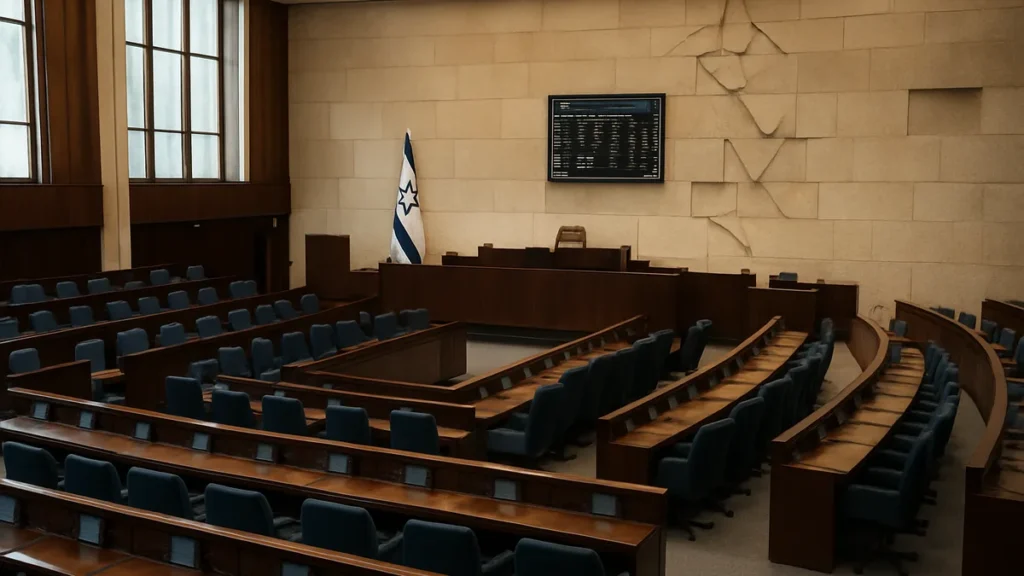
Israeli President Isaac Herzog must now decide which politician receives the first attempt at assembling a governing coalition. The election produced no clear result, leaving neither Prime Minister Benjamin Netanyahu nor his main challenger, former army chief Gadi Eisenkot, with a parliamentary majority.
Herzog has said he will name a candidate on Sunday. Eisenkot did win the backing of most lawmakers, but that support relies on parties representing Palestinian citizens of Israel, which took a record 19 seats in October. Eisenkot has said he will not bring those parties into his government.
Consultations leave Eisenkot ahead on paper
Consultations between party leaders and the president ended on Thursday. Of the 120 Knesset members, 67 endorsed Eisenkot, while 46 backed Netanyahu.
Netanyahu’s endorsements fell seven short of the 53 seats held by his bloc. United Torah Judaism, one of his long-standing allies, withheld its backing over the coalition’s failure to exempt ultra-Orthodox Israelis from military service. Shas, the other ultra-Orthodox party, endorsed Netanyahu on Wednesday.
Herzog has not publicly committed to either side. He said that although the numbers might look clear, “mutual vetoes between the blocs and within the blocs themselves” made it hard to judge who could build a coalition. Before the October 27 vote, reports suggested he had wanted to push for a national unity government including Netanyahu and Eisenkot’s rival parties, in order to avoid another election.

Seat counts and paths to 61
No bloc has reached the 61 seats needed for a majority. The current breakdown is as follows:
- Netanyahu’s right-wing and religious alliance: 53 seats
- Four Jewish-led parties backing Eisenkot: 48 seats
- Arab-led parties: 19 seats
Eisenkot would reach 67 seats by including the Arab-led parties, but he has ruled that out. Winning over United Torah Judaism and Shas would give him exactly 61. United Torah Judaism has signalled that its support is available for the right price.
Netanyahu would need to lure an opposition party to his side. A unity government in which the two men alternate as prime minister, with Arab-led parties excluded, is another possibility, but many of Netanyahu’s rivals have ruled out serving under him. For now, that looks improbable.
Israeli law allows a prime minister to take office with fewer than 61 seats if the proposed government wins a parliamentary confidence vote, and the Arab-led parties could help secure that. Eisenkot could also form a minority government first and later try to win over the ultra-Orthodox parties by offering concessions on conscription.
Arab-led parties set conditions for support
The Arab-led bloc consists of the Joint List, an alliance of three parties with 11 seats, and the United Arab List, known as Ra’am, with eight. Ra’am says it is willing to join an Eisenkot-led government. The Joint List has ruled out joining but offered to help put him in office from outside.
Both endorsed Eisenkot during consultations, but he has refused to bring either into government unless they meet certain conditions, including recognising Hamas as a “terrorist organisation”. Ra’am leader Mansour Abbas, whose party joined an anti-Netanyahu coalition in 2021 and became the first Palestinian-representing party to enter an Israeli government, supports disarming Hamas but has declined to label it a “terror” group.
Some of Eisenkot’s allies have opposed relying on Palestinian lawmakers, a stance many observers see as highlighting the second-class position of Palestinian citizens. Netanyahu’s Likud has warned that cooperating with the Arab-led parties would be “dangerous to Israel”.
Joint List member Ahmad Tibi said that rejecting a partnership would prove Israel is “an ethnocracy, not an absolute democracy for all citizens”. The Joint List said its unanimous backing for Eisenkot answered a “public demand” to stop Netanyahu and his government from returning to power. It added that its support did not mean dropping its reservations about an opposition that had not shown readiness to confront Netanyahu’s approach or incitement against Palestinian citizens.
In return for outside support, the Arab-led parties want guarantees for Palestinian citizens, including an end to house demolitions and incitement, action against crime, and a political horizon for Palestinians. Tibi said he had no illusions that this would end Israel’s wars or bring a Palestinian state, but argued that a “repair government” could improve Palestinian citizens’ lives, potentially including by tackling violent crime in their communities. Abbas has also named ending Netanyahu’s government, and removing far-right figures such as Finance Minister Bezalel Smotrich and National Security Minister Itamar Ben-Gvir, as a priority.
Timeline if coalition talks fail
The nominee chosen by Herzog will have 28 days to form a coalition, extendable by 14 more. If that fails, another nominee will receive 28 days. If the second nominee also fails, a parliamentary majority can back a third candidate, who will be granted a final 14 days.
If no government is formed after that, the Knesset will be dissolved and a new election called within 90 days. Netanyahu would remain as caretaker prime minister in the meantime.
Analyst Nehru Jamhour, who follows Israeli affairs, said this drawn-out impasse was the likeliest outcome and was Netanyahu’s preferred one. He argued that Netanyahu hopes a repeat election could weaken his rivals and depress turnout among Palestinian citizens of Israel.