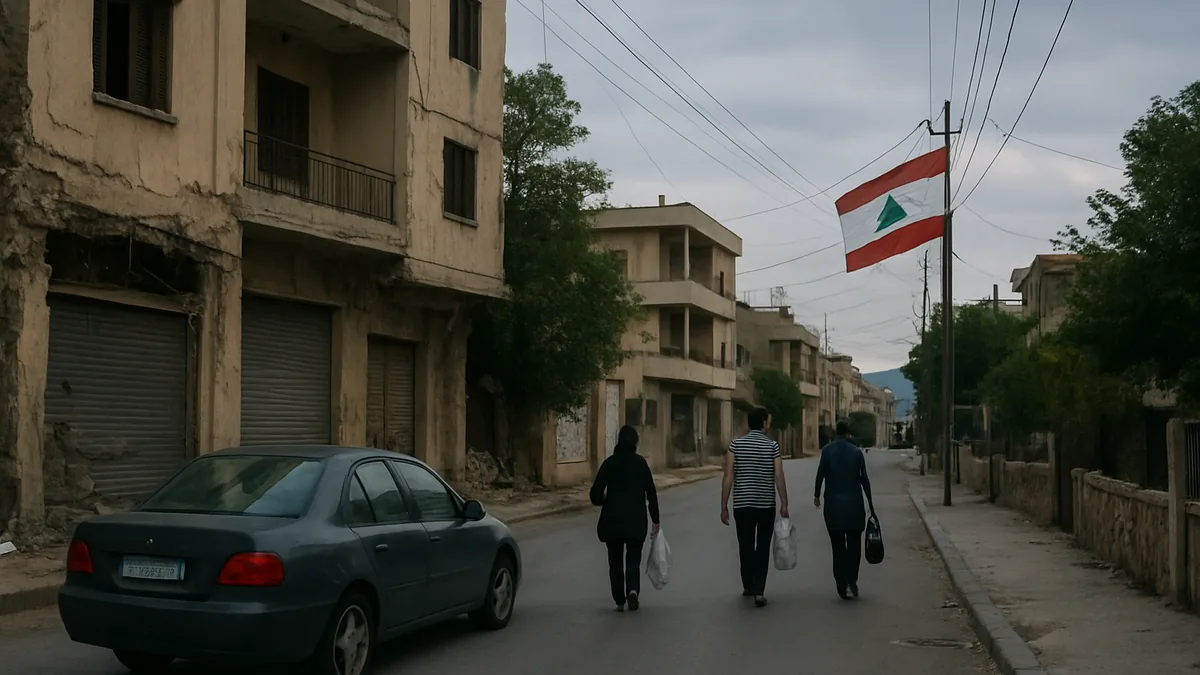
Lebanese residents are packing emergency bags, stocking up on medicine and keeping their electronics charged as fears grow of another large-scale Israeli offensive. Accounts gathered from people in southern Lebanon and Beirut describe a population that has lived through repeated rounds of fighting and is now bracing for a possible third escalation since 2024.
Aya stayed in her home in Abbasiyeh, in southern Lebanon, during Israel’s intensified campaign in March, despite the danger. She said a neighbour’s house was hit by an Israeli attack at one point. Since then, the strikes have largely subsided following a ceasefire announced in April, but the noise of war has not fully gone away.
Families prepare bags, medicine and escape plans
Aya said drones and explosions are a constant presence in her area. “There’s always drones around and sounds of detonations, but we’ve grown thick skin,” she said. Yet she has changed her plans. This time, she said, she would leave her home if attacks resumed rather than stay put as she had before.
Also read: Iranian envoys meet Qatari mediators ahead of possible US strikes
Her family has set aside extra medication for her grandparents, in case a new round of conflict makes it hard to get supplies. Others are packing bags and extra food, and making sure phones and other electronic devices stay charged in case strikes begin again.
Ramez, who did not want to use his real name for security reasons, has been living away from his home since July 2024. That month, he was in his bedroom in Haret Hreik, in Beirut’s southern suburb, when he heard loud explosions, and the neighbouring building then collapsed onto his apartment. His family now uses a second home about a half-hour drive southeast of Beirut.
Ramez said his family has delayed returning to their home in Dahiyeh because of concerns that attacks could restart. He said he keeps his batteries and power banks charged, has a steady water supply for months, and keeps his car’s petrol tank full. Other people from Dahiyeh and the south told the same outlet that they keep go-bags ready.
Karim Safieddine, a non-resident fellow with the Tahrir Institute for Middle East Policy, said people have been planning for months. He noted that Dahiyeh has not been full of residents in recent months, and that many people leave a little each night along quick escape routes.
Ceasefire, framework deal and the Yellow Line
The Lebanese Shia group Hezbollah and Israel have been at war since October 2023. According to the Lebanese health ministry, Israel has killed around 9,000 people in Lebanon, mostly during escalations in the autumn of 2024 and in March and April 2026. Israel has invaded Lebanon during each offensive and has since occupied up to 10 kilometres of territory, where it has established what it calls a “Yellow Line”.
Israel continues to destroy towns and villages below that line, and has made border areas uninhabitable, possibly for years. A ceasefire was announced in April, just over a week after Israel launched more than 100 attacks on Lebanon in less than 10 minutes, killing more than 350 people. In June, Beirut and Tel Aviv signed a framework agreement brokered by the United States to set up “pilot zones”. Under that arrangement, the Israeli military would withdraw from those areas and the Lebanese army would deploy to disarm Hezbollah.
Active fighting between Hezbollah and Israel has eased since the ceasefire and the framework deal, although Israeli attacks and the destruction of homes and infrastructure in the far south have continued. People living above the Yellow Line are mostly out of the line of fire, but they hear constant explosions and drones, and at times have struggled to reach their land.
US President Donald Trump has reportedly considered another round of attacks on Iran, in coordination with Israel. Iran has warned that it would retaliate against targets in the region if such an attack happens. That has raised questions about whether Hezbollah, which is backed by Iran, would resume its own attacks on Israel.
Israeli officials have accused the Lebanese army of failing to meet its side of the framework deal, something the Lebanese army denies. Analysts say the accusations might be an effort to build justification for another bombing campaign in Lebanon.
Mohamad Bazzi, a Lebanese political analyst, said Israel does not need a pretext. “When it comes to Lebanon, Israel doesn’t need that instigation,” he said. He argued that Israel had destroyed more of the south under the April 17 ceasefire than before it, and that there was no reason it would not do more if the United States and Israel restarted the war with Iran on a large scale.
Economic strain and fears of sectarian unrest
Many Lebanese are also struggling financially while living with the threat of renewed fighting. The World Bank said in August that it expects inflation in Lebanon to rise to 17.5 percent this year. Analysts warn that the economic pressure could have serious security consequences.
Bazzi warned that people are being worn down by each cycle of violence, exhausting their savings and goodwill. “As this cycle repeats itself, people get worn down, exhaust their savings and their goodwill, and I think that adds to the possibility of social explosion,” he said. He added that Lebanese society could blame Hezbollah for provoking Israel, and by extension the wider Shia community.
Jad Dilati, a Lebanese analyst from Nabatieh, in southern Lebanon, said some families have kept paying rent on apartments elsewhere in Lebanon so they have a backup place to stay if another war breaks out. After three years of conflict, however, he said this is “a privilege that not everyone can afford”.
Analysts also warned that another round of fighting could deepen sectarian tensions. They said Israel has previously tried to stir internal strife, including by warning non-Shia communities in the south against hosting displaced people. With many already barely getting by, they said, another war could ignite sectarian conflict.
“It is a combustible mix that could explode through something unexpected,” Bazzi said.