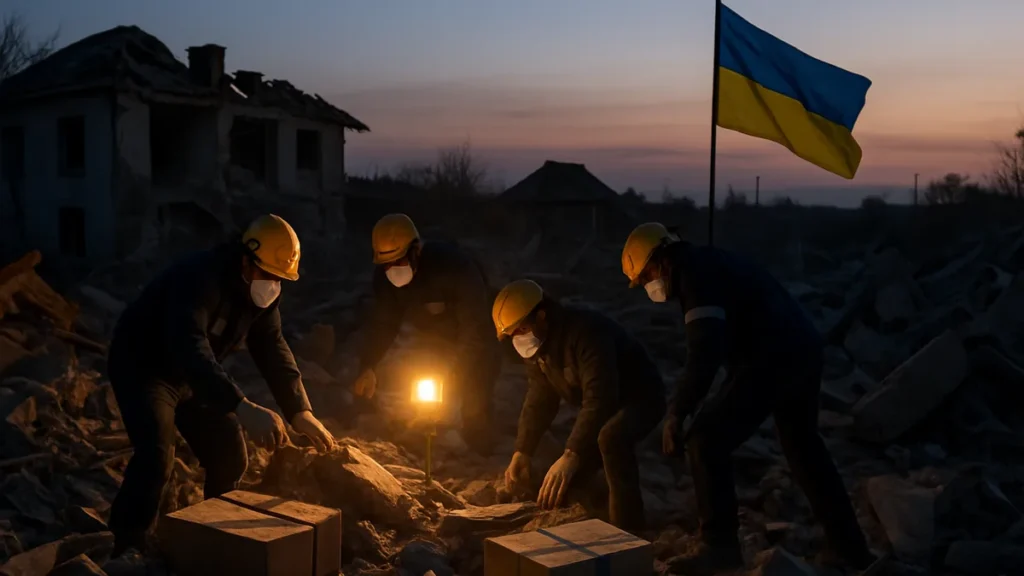
The death toll from a Russian attack on an aid centre in the Zaporizhia region, in southeastern Ukraine, has climbed to 40, according to President Volodymyr Zelenskyy. He announced the updated figure on Wednesday and said some bodies had not yet been accounted for, with more than 30 people possibly still trapped under the rubble.
The strike, carried out on Monday, is among the deadliest attacks on civilians during Russia’s war against its neighbour, which is now in its fifth year. It came as Kyiv prepares for ceasefire talks with Moscow next week, which have been brokered by the United States.
School used for aid distribution hit in Komyshuvakha
The attack targeted a school building in the village of Komyshuvakha, close to the front line, which was being used to hand out aid. Local officials had earlier confirmed 37 deaths and estimated that about 38 people could remain trapped.
Also read: Russian bombing kills 18 at Ukraine aid site, Kyiv says
Ukraine said a second strike then hit an underground shelter that was packed with people. Four police officers and two members of a rescue crew were among those killed.
Ukrainian police released body-camera footage from one of the officers who died. It shows people being guided into the shelter as the officer receives a radio warning about incoming guided aerial bombs. The footage then shows people inside the shelter before it cuts to black and silence.

Zelenskyy condemns strike and questions Russia’s intentions
Zelenskyy condemned what he called the “vile terrorist strike” and said it showed that Russia did not want the conflict to de-escalate. He added that the attack had undermined an opportunity created by a ceasefire and humanitarian mission in the front-line village of Oleshky last week.
The United Nations human rights mission in Ukraine said on Tuesday that the bombing likely violated international law. Local authorities said Russian drones were hampering the search for victims in Komyshuvakha, but Mykhailo Semikin, acting head of the regional military administration, insisted that operations would continue.
In a social media post, Zelenskyy said the world had reacted weakly. “Unfortunately, there has been very little reaction from the world to this insane attack,” he wrote. “But it, like thousands upon thousands of other war crimes Russia has committed against Ukraine and Ukrainians, demands a strong response. Evil always goes further if it is left unanswered.”
US-brokered talks in Abu Dhabi face deep doubts
US special envoy Steve Witkoff has said delegations from Ukraine and Russia will meet in Abu Dhabi on November 10-11 to discuss post-war security agreements, de-escalation, humanitarian measures and ending the war. Russian President Vladimir Putin agreed to the talks after meeting Witkoff in St Petersburg on October 21.
Previous meetings of this kind have produced little progress, as Moscow has refused to compromise on its hardline demands. These include that Kyiv give up territory, demilitarise and guarantee it will not seek to join NATO.
The Trump administration has appeared to back Russia’s position, which has stoked concern in Kyiv and across Europe. Zelenskyy has previously tried to sway the US president by describing the suffering in his country, and he appeared to attempt the same approach after the Zaporizhia attack.