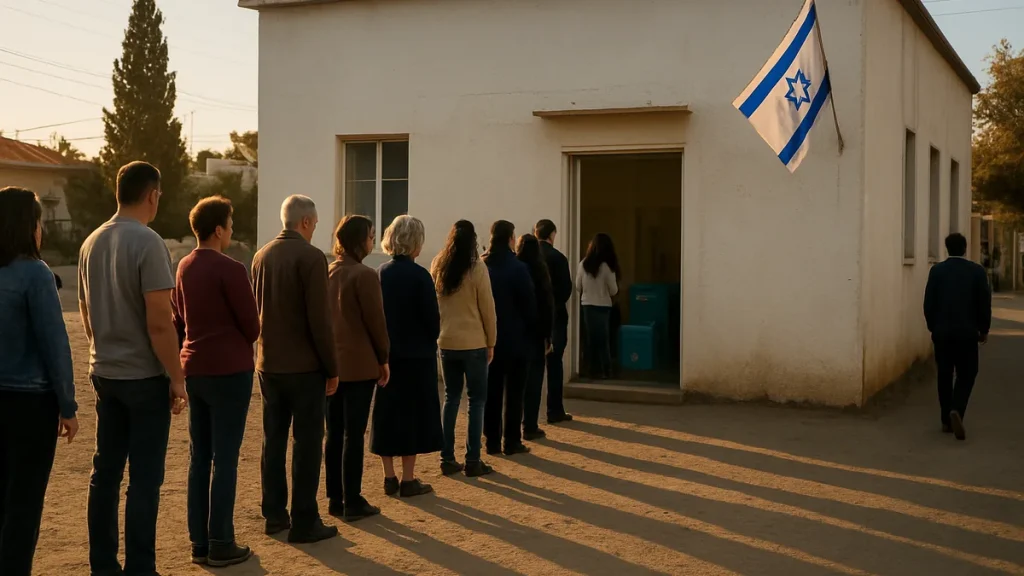
Exit polls indicate that Israel’s Arab parties could win 18 seats in the country’s parliament, after voting among Palestinian citizens of Israel rose to its highest level in decades.
Exit polling from Tuesday’s vote suggested that the Joint List and Ra’am, the two leading Arab-led parties, could hold a record number of seats in the 120-member Knesset. Updated figures showed the opposition bloc led by former military chief of staff Gadi Eisenkot’s Yashar party and the bloc led by Prime Minister Benjamin Netanyahu’s Likud party tied at 51 seats each.
Turnout among Palestinian citizens reaches record levels
Early indications put turnout among Palestinian citizens of Israel at around 80 percent, figures that an Israeli broadcaster said on Tuesday broke records set in 1999. Overall turnout also reached its highest point since 1999, with 77.7 percent of voters casting ballots, the Central Elections Committee reported.
Also read: Israeli election exit polls indicate no clear winner · Israel election turnout highest in 50 years as voting goes on
Palestinian citizens make up about 21 percent of Israel’s population of 10 million and have traditionally voted at lower rates than Jewish Israelis. Mansour Abbas, leader of Ra’am, or the United Arab List, said he hoped the final results would allow the anti-Netanyahu bloc, including his party, to reach the 61 seats needed to form a government.
“With the numbers we have now, there is no government,” Abbas told an Israeli broadcaster. He said both main blocs had approached his party before and after the election. Ra’am currently holds five seats and joined the coalition that governed Israel from 2021 to 2022.
Netanyahu’s final appeal draws accusations of racism
Netanyahu and his far-right coalition made last-ditch efforts on Tuesday to bring their supporters to the polls, warning of surging turnout among Palestinian citizens. Arab politicians denounced the tactic as racist and inflammatory. Witnesses said cars flying Likud flags drove through Jerusalem blaring the Islamic call to prayer and urging people to vote because “Arabs are voting”.
In social media posts, Netanyahu highlighted long queues at polling stations in Arab communities. He also published an image that he said showed Arab voters, including women wearing the niqab, a veil that covers the lower half of the face, waiting to vote. “If we don’t wake up now, we’ll find ourselves with a government of Mansour Abbas and Ahmad Tibi,” he said, referring to two leading Palestinian members of the Knesset.
Coalition math complicates the path to a government
Alon Pinkas, a former Israeli ambassador, said in an interview that forming a government might prove difficult for parties such as Eisenkot’s, which earlier exit polls had put narrowly ahead. He noted that these parties had promised during the campaign not to form coalitions with Arab parties. “There’s a price to pay,” Pinkas said, arguing that Arab citizens cannot be kept outside and only consulted when their votes are needed.
Pinkas added that the Arab-led lists would make demands that a Jewish-led coalition government may not support. Nour Odeh, reporting from Ramallah in the occupied West Bank, called the election “an existential moment for Palestinian-Israelis”. She pointed to record turnout among a bloc that has become a key voting force, including people who would normally boycott elections.
Odeh also said the Knesset has passed more than 100 laws discriminating against Palestinian citizens of Israel, who additionally face discrimination in receiving state funds.