Iran’s authorities are putting more money into a programme that trains and arms civilians to serve in the state security apparatus. The move comes as fears grow that fighting with the United States and Israel could resume soon.
The campaign, known as Janfada, a term meaning “those who sacrifice their life”, was launched in late March at the height of the war with the US and Israel. It has since spread to large parts of the country. Organisers are seeking volunteers of any age, although they say young people are the main focus.
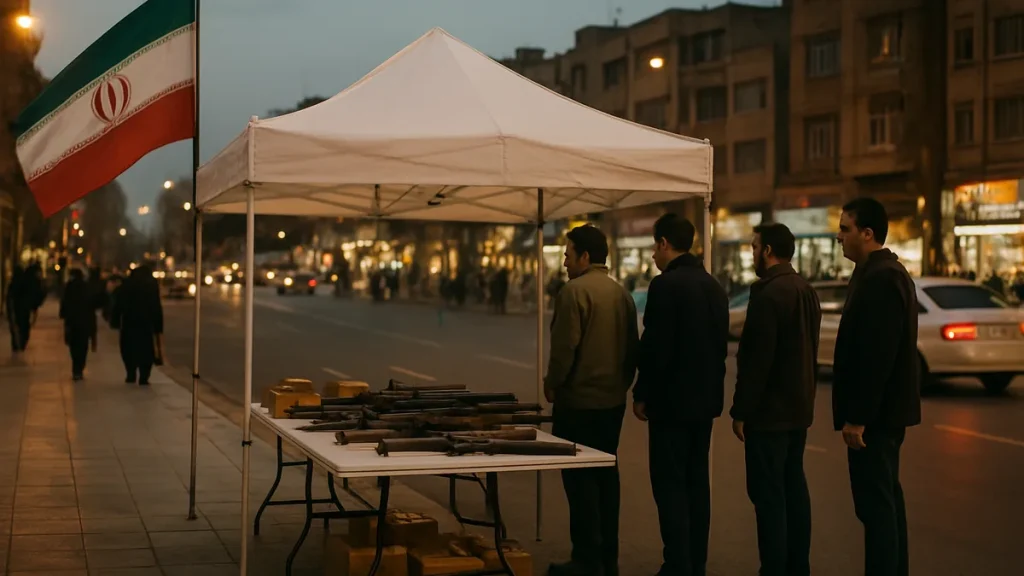
Street booths and armed drills spread across provinces
At street booths and stations, members of the Basij militia of the Islamic Revolutionary Guard Corps (IRGC) and other state bodies teach people how to handle weapons and other equipment. The stated purpose is to protect the government and the “revolutionary” principles it upholds.
Also read: Iran says war resumption would not change its stances · Netanyahu vows Iran regime change: Can Israel topple Tehran?
State-organised events and armed exercises connected to the campaign have taken place in Tehran, Isfahan, Zanjan, Shiraz, Kerman, Mashhad, Bojnord, Ahvaz and many other towns and cities across Iran’s 31 provinces.
Ali Kowsari, the Basij’s deputy for training, told a news conference this month that the IRGC plans to use at least 14 main squares in Tehran as training and equipment points for Janfada volunteers. He said the target is one to three squares in the capital of every province. He did not say how many cities are currently taking part.
A resident of Gilan province in northern Iran said people regularly pass state-run stations on streets in both large and small cities during their daily commutes. Night events are sometimes preceded by daytime rallies and motorcades. The resident, who asked to remain anonymous for security reasons, described small prize competitions in which participants were given live ammunition, shown how to load magazines, and taught to arm and fire pistols and assault rifles.
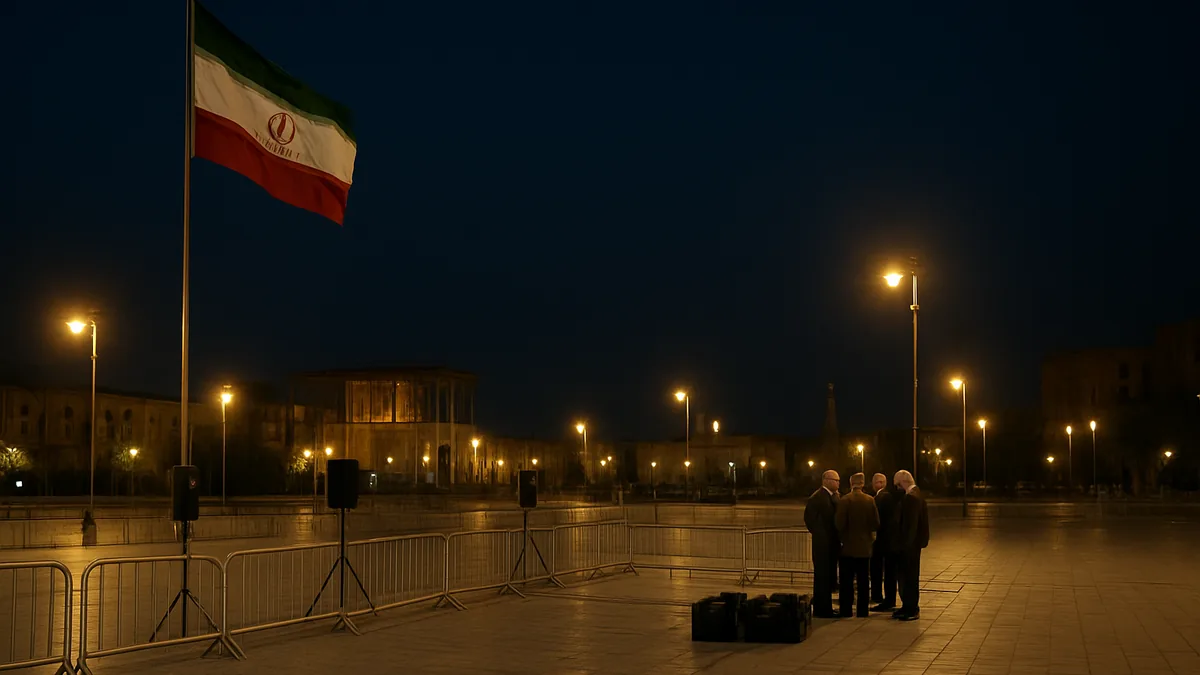
The same resident said the organisers are mostly older men who have gathered around the main square almost every night since the war began. They often play revolutionary music and chant through loudspeakers.
In Rasht, the Gilan city, residents on October 15 objected to the noise and to the closure of a street for a nighttime pro-government gathering. Videos circulating on social media showed the dispute escalating into a brawl. Authorities did not comment on the incident.
On Saturday, authorities warned residents of Karaj, in Alborz province near Tehran, that they could hear explosions and loud noises from one of the Janfada exercises. Last week, a large mobilisation also took place in Kurdistan province in northwestern Iran, which borders Iraq. The IRGC-linked Tasnim News Agency described a procession in the provincial capital, Sanandaj, as an exercise in “unity” between Shia and Sunni Muslims.
Rights groups and analysts question the drive’s purpose
A number of foreign-based Iranian human rights groups have described these armed mobilisation efforts as “intimidation” campaigns. They say the drills are being held months after nationwide protests in January, during which thousands of civilians, including many young people, were killed by gunshots and stab wounds.
The government has acknowledged that protests took place in more than 400 counties across all provinces. However, it describes them as a “coup” attempt wholly orchestrated by the US and Israel to overthrow the establishment. It also rejected findings by an independent United Nations fact-finding mission, which said the authorities committed crimes against humanity while cracking down on the protests.
Mehran Kamrava, a professor of government at Georgetown University in Qatar, said the US-Israeli war on Iran has “presented another opening for the more revolutionary elements of the Iranian body politic”.
He compared revolutions to riding a bicycle, saying that avoiding a bad fall requires pedalling hard. In his view, the Janfadas and their leaders are doing exactly that in order to stay relevant. He also argued that the training gives revolutionary-minded figures in the leadership a chance to stage displays of political and ideological loyalty.
Disputed sign-up figures and the role of schools
The government says 33 million Iranians have signed up through the campaign’s website, but it has provided no evidence to support the figure. That number would be more than a third of the population, or more than half of everyone aged over 12.
Earlier this year, foreign-based activists examined the website’s source code, which they said showed that fewer than four million people had registered. Registration required only a phone number, and no national identification number was needed.
Speaking last week about the campaign’s political aims, Nematollah Bagheri, the IRGC commander for Lorestan province, said: “The aim is to show that, just as the government supports the people, the people support the Islamic Republic and the Islamic revolution.”
Organisers said registrants could be called on for future rescue operations, as well as for social services, media and financial support. The government has also asked people to help ease the pressure of the US war, a naval blockade and sanctions by using less fuel, electricity and other resources.
The push has intensified after nearly eight months of attritional war that has killed thousands of people, made Iranians poorer and destroyed parts of the civilian infrastructure. Children have become a major focus, and schools have increasingly been used for mobilisation. Last week, Education Minister Alireza Kazemi said the Basij was registering “student Janfadas” and had plans for more mobilisation and ceremonies involving children in the coming weeks.
Kamrava said this kind of mobilisation does not necessarily widen the state’s legitimacy across wider society. Instead, he argued, it strengthens the support the state already has among its existing backers and reinforces belief in the revolution’s ideological and political mission.