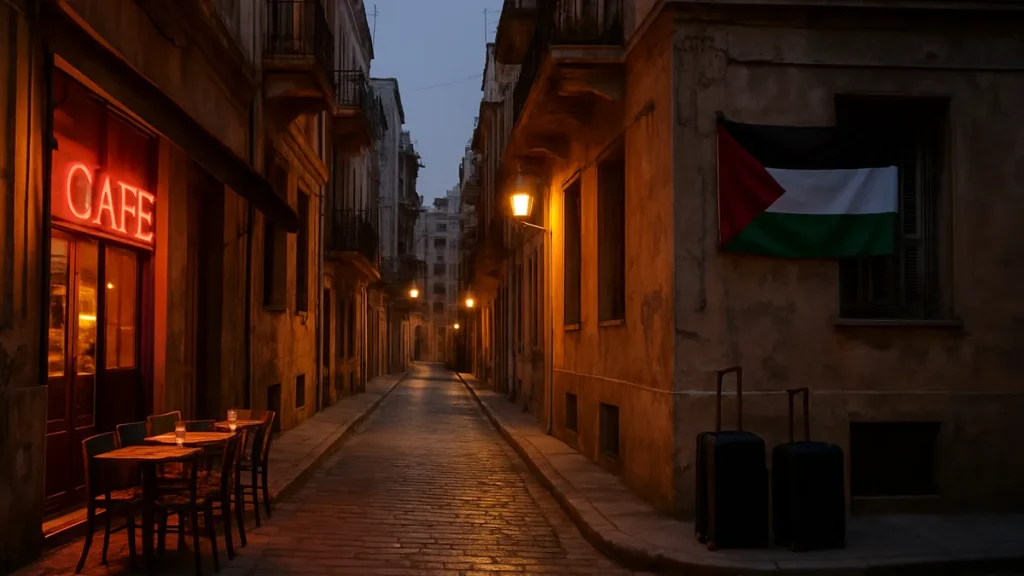

In Exarchia, an Athens district long associated with radical left-wing politics, residents say foreign investors are buying up flats and converting them into short-term rentals, forcing long-time tenants out. Tonia Katerini, a 69-year-old architect, and a group of neighbours have spent months tracking foreign purchases using public records, marking each one with a red dot on a digital map.
Her group says much of the money behind the area’s new company-run hotels and rentals is Israeli, and by its own count more than half of them fall into that category. In a neighbourhood where Palestinian flags hang from balconies and solidarity slogans cover the walls, the claim has created friction.
Short-term rentals reshape streets in Exarchia
Katerini has lived in her flat since 1986, and the noise of tourists dragging suitcases over the cobbles wakes her each morning. On her own street, she said, Israeli investors have bought two buildings, and the flat directly below hers belongs to one of the companies involved. Her verdict on the downstairs neighbours was softer than her concerns about the wider trend: “They are nice guys we have downstairs,” she said. “It’s an Israeli company.”
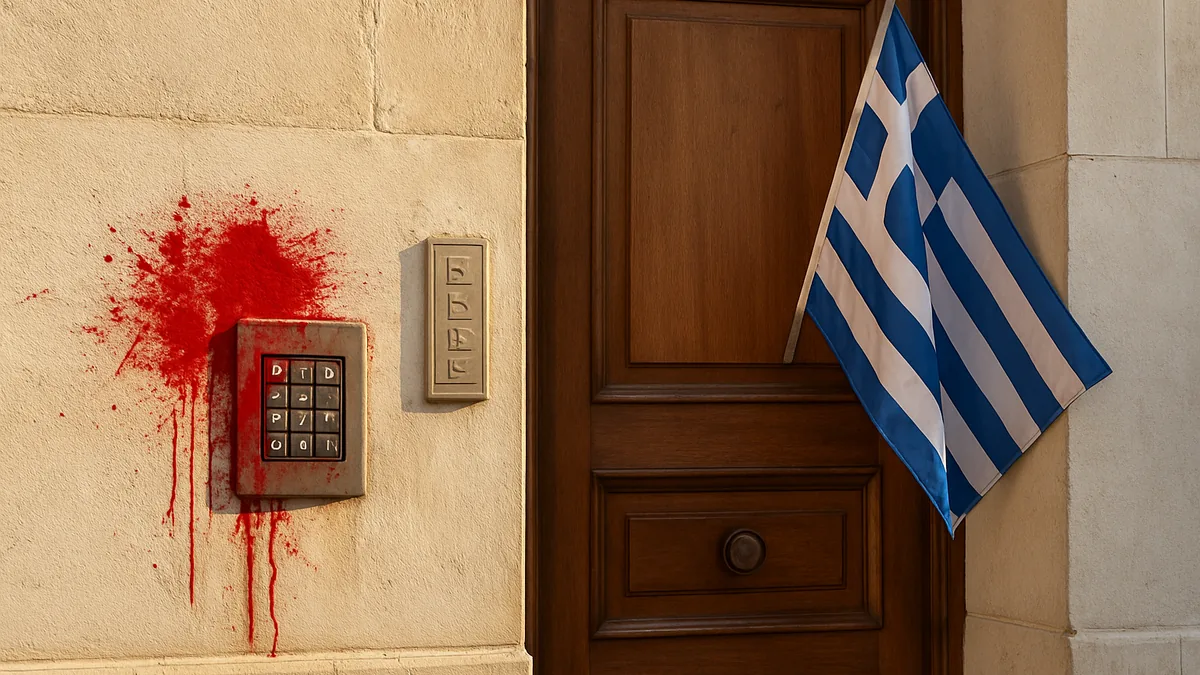
A few streets away, the facade of a residential building is streaked with black paint. One slogan reads “Airbnbs leave us homeless,” while another says “Zionists not welcome.” Such buildings are easy to identify, according to residents, because their buzzer panels list numbers rather than names and a keypad by the entrance hands out keys to guests.
Activists have also splashed red paint over keypads and facades across the neighbourhood. They argue that short-term rentals are driving an aggressive form of gentrification that is pricing locals out and eroding the area’s character.
Political history and the government’s response
Protest has deep roots in Exarchia. In 1973, students at the nearby Athens Polytechnic rose against a military government backed by the United States, and that government fell the following year. In 2008, police shot dead Alexandros Grigoropoulos, a 15-year-old Greek student, in the district, an incident that set off protests across the country. Katerini described the reaction as like “fire on dry land.”
Chrysoulla Papageorgiou, a 46-year-old schoolteacher who has lived in Exarchia for 24 years, recalls it as “a neighbourhood of solidarity.” She described the shift as gradual at first and then rapid. Small owners initially rented out spare rooms, but after the COVID-19 pandemic, companies started purchasing entire blocks. “Overnight, tenants were displaced and apartment blocks emptied,” she said.
Papageorgiou said rents climbed, and migrants and low-income families, many of whom lived in basements and lower floors, were the first to leave. Schools lost pupils, and old bookshops, traditional cafes and grocers shut. She also said that the buildings where residents once sheltered refugees, many of them on prime real estate, were among the first to be emptied by police and then sold. “Half were squats,” she said. “Now we have only one.”
Lazaridis, a real estate agent who heads a branch of the Athens-Attica Real Estate Agents’ Association, described investment in the area in purely practical terms. He said Exarchia “was a run-down area” which made it “a very good opportunity.” Its location near the city centre, the metro and universities with many foreign students, along with fewer building restrictions than neighbourhoods such as Plaka, make it attractive, he said.
The government is now moving to cool the market. Prime Minister Kyriakos Mitsotakis announced last month that the transfer tax paid by homebuyers from outside the European Union would rise from 3 percent to 15 percent from next July. Lazaridis said agents’ associations oppose the plan, which has not yet become law, and that it “may not take effect, or may be postponed.” Agents expect some non-EU buyers to accelerate purchases before the deadline, according to a Greek news site.
Agents and residents disagree on whether the trend is slowing
Not everyone in the sector sees the trend as unstoppable. Iryna Rondyak, who is originally from Ukraine, runs her own estate agency near Exarchia. She said Israeli buyers made up about 60 percent of her foreign clients when they began arriving about a decade ago, and many bought whole office buildings to convert into hotels. Until around 2024, foreigners accounted for roughly 70 percent of her sales.
This year, that share has fallen to about 30 percent, she said, as state-backed mortgages for young Greeks under a scheme called “Spiti mou” (My Home) are drawing local buyers back. She credits new rules for the change. No new short-term rental licences are being issued in central Athens, including Exarchia, and in September the freeze was extended to the end of 2027, according to a Greek weekly. Properties bought under Greece’s “golden visa” residency scheme can now be let only on a long-term basis, although a cheaper route into the scheme, at 250,000 euros ($280,000), rewards investors who convert empty office buildings into flats.
“Anyone living in Greece couldn’t find a home in the centre. Everything was on Airbnb,” Rondyak said. “Now there are far fewer.” She described the situation as “a little better,” but said “the problem still exists.” Rents remain high, at 10 to 15 euros ($12 to $17) per square metre, even in the southern suburbs, she said, and many flats sit empty because owners feel that renting them out is not worth the tax bill.
Residents and campaigners note that the rental freeze is temporary and that investors with sufficient money can still find ways in. It also does not reverse what has already happened, since many of the neighbourhood’s buildings are already operating as short-term rentals. Papageorgiou, for her part, counts herself lucky. Her landlady, whose family has lived in the area for generations, refuses to raise the rent, which Papageorgiou described as an “act of resistance.” She added, half-jokingly, that her landlady’s accountant has told her she is ruining the market.