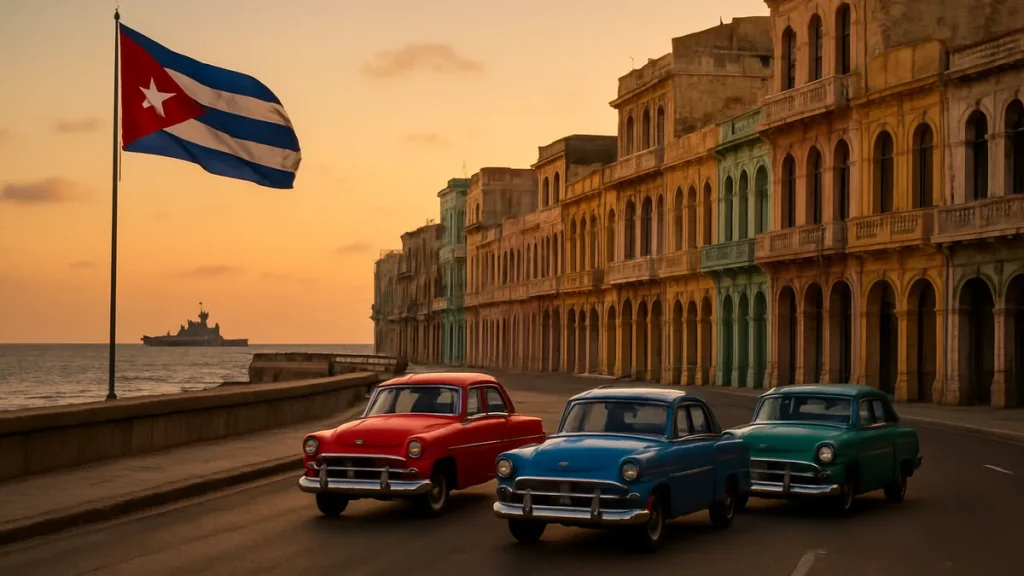

US officials have repeatedly said they want “Cuba to be free”, while recent media reports have pointed to US military activity near the Caribbean island. According to the article, Washington’s operation in Venezuela at the start of the year is widely seen as having paved the way for a similar undertaking against Cuba. It remains unclear when or how the United States may strike.
The author argues that the Cuban Revolution may be nearing its end, and says the island of 10 million has played an outsized role on the world stage. The piece frames Cuba through the figure of Eshu, a trickster from Cuban Santeria, which the author uses as a metaphor for a nation that challenges established power.
Cuba’s challenge to US power since 1960
In September 1960, a year after taking Havana, Cuban leader Fidel Castro travelled to New York to address the United Nations General Assembly. The article says the Cold War-era US government put pressure on several prominent hotels to refuse service to Castro and his entourage. The delegation instead went to Harlem and found rooms at the Hotel Theresa.
Photographers and television crews gathered there, creating a media sensation. Castro used the moment to compare the delegation’s treatment with that of Black Americans refused service in the segregated South. The author says this landed like a bomb in the civil rights movement, because the episode unfolded in a northern city rather than in the Jim Crow South.
The article says Cuba’s revolutionary government later built a programme of internationalism that countered US soft power efforts in the developing world, including through the Peace Corps and USAID. Cuba sent as many as 400,000 doctors, along with engineers, agricultural technicians and other professionals, to 164 countries. The author writes that this support earned Cuba great affection in countries such as Venezuela, South Africa and Vietnam.
Military and solidarity campaigns abroad
The article cites the defeat of the Bay of Pigs invasion as one of Cuba’s most notable military achievements. The invasion was carried out by Cuban exiles, but according to the author, it was supported and funded directly by the CIA. The piece also notes the revolution’s backing for the Palestinian liberation movement and the antiapartheid struggle, at a time when the US gave diplomatic cover and military aid to Israel and to the apartheid regime in South Africa.
Between 1975 and 1991, more than 300,000 Cuban soldiers fought alongside forces in Angola. The article says the operation, known as Operation Carlota, helped liberate Angola and neighbouring Namibia and contributed to the downfall of South African apartheid. Former South African President Nelson Mandela, quoted in the article, said Cuba’s intervention in Angola “destroyed the myth of the invincibility of the white oppressor”.
The author also describes Castro as carrying the spirit of Eshu. The article reports that the Cuban leader survived more than 600 assassination attempts and died of natural causes at the age of 90.
Embargo, repression and the question of freedom
According to the article, the United States has imposed an economic embargo on the island for more than 60 years. The author describes it as the world’s longest, and says it was intensified at various points, especially after the fall of the Soviet Union, when Cuba faced a profound economic crisis. Despite this pressure, the article says the revolution got through the crisis of the 1990s by diversifying and liberalising the economy, and by drawing on its internationalist programme.
The author concedes that the denial of political rights and the repression of freedoms of expression and assembly have been the revolution’s greatest failings. The article states that speech is not free in Cuba, that access to information and the internet is heavily restricted, and that recent popular protests have been violently suppressed.
The author argues that Cuba is not the opposite of the United States on these issues but its peer. Citing corruption, the erosion of democratic institutions, attacks on free speech and the media, and extrajudicial killings of US citizens by masked agents of the state, the author says the US in 2026 faces its own unfreedoms. The piece also points to the Guantanamo Bay detention facility, which it says still holds 15 detainees, and to President Donald Trump’s immigration crackdown. These are the author’s own assessments.
In closing, the author suggests that if the revolution falls, there will be celebrations in Miami, but also grief elsewhere for the alternative the revolution represented, however flawed. The piece says that, had the US listened more or differently, it might have learned the lesson Eshu was trying to teach.