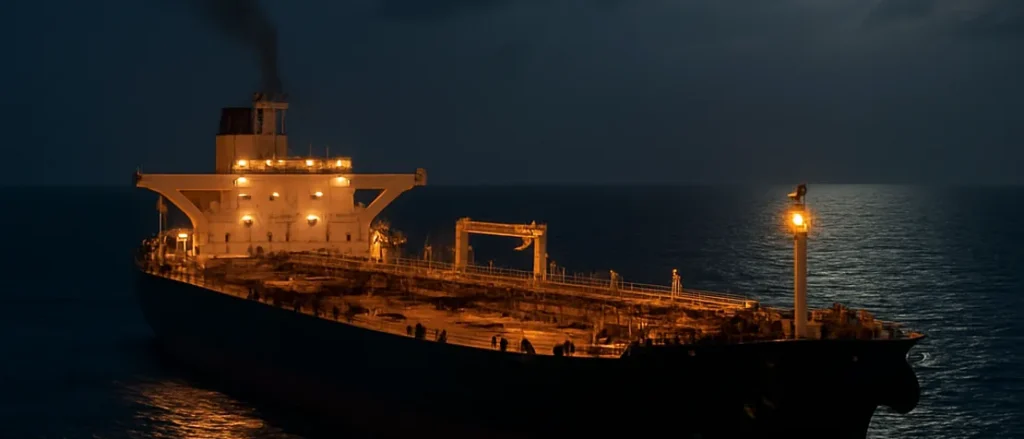

Strikes around the Strait of Hormuz have picked up again, even as mediated attempts to end the US-Israel war on Iran remain stuck. The Islamic Revolutionary Guard Corps navy said on Saturday night that an unnamed crude oil supertanker hit a naval mine and suffered a major fire after entering the waterway by an unauthorised route with its navigation systems switched off.
The IRGC navy warned that any oil tanker choosing to disregard the strait’s security measures and rules could face a similar outcome. The waterway normally carries roughly a fifth of the world’s oil and gas in peacetime, which gives the warning wider weight for global energy markets.
Mine blast and projectile strikes hit tankers near Hormuz
On Sunday, Habibollah Sayyari, chief of staff and joint coordinator of the army, told state television that Iranian forces remain ready for both defensive and offensive operations. He said that Iran had already hit enemy vessels and would strike them again if anything else happened against the country. His remarks came more than seven months after the United States and Israel began the war by attacking Iran on February 28.
The United Kingdom Maritime Trade Operations agency, UKMTO, recorded several incidents in the past day involving military action or warnings against vessels in the Strait of Hormuz and the Gulf of Oman. Ship masters near Ras al-Khaimah in the United Arab Emirates were instructed by radio overnight to leave their anchorages. Later on Sunday, UKMTO said an unidentified projectile had struck a tanker heading out through the strait.
Separately, the UAE said its coastguard rescued 22 crew members after a fire broke out on an unnamed tanker close to its shores. The UAE did not say what caused the blaze.

US blockade enforcement and ship losses since July
Early on Sunday, US Central Command, known as CENTCOM, released footage showing a fighter jet bombing the stern of a Panama-flagged cargo vessel in the Gulf of Oman. The strike disabled the ship’s propulsion as part of efforts to enforce a US naval blockade of Iran’s southern ports.
CENTCOM says that since Washington reimposed the blockade in mid-July, its forces have disabled four commercial vessels, turned around 135 ships and destroyed 10 tankers linked with Iran. Washington also says Tehran has exported no oil through the blockade line.
The violence has escalated sharply. At least a dozen ships were attacked in the week ending on October 5, the highest weekly figure since the war began, and at least one was hit off the north coast of Qatar. That suggests the danger now extends beyond the immediate strait as Iran and the US compete for control of the area.
The attacks appear to have reduced energy flows, which had climbed above pre-war levels at the start of the month. Citing Kpler data, CNBC reported on Friday that average crude passing through the strait in the week ended October 7 stood at 8.5 million barrels per day, roughly 40 percent below normal.
Iran sets conditions as nuclear positions harden
To reopen the strait and reach a settlement, Iran has asked for the return of a memorandum of understanding agreed in June, which has since collapsed. It also wants Washington to back a finalised Iran-Oman arrangement that sets temporary coordinated entry and exit routes for vessels transiting the strait.
Messages continue to pass between the two sides through mediators. However, no breakthrough is expected in the coming weeks, ahead of the US midterm vote on November 3 and Israel’s election on October 27.
Last week, US Vice President JD Vance said Iran must make a meaningful reduction in its nuclear enrichment capacity to end the war. His comment suggested a possible softening of Washington’s repeated demand that zero enrichment take place on Iranian soil. Tehran has said that a nuclear agreement potentially involving the dilution of its highly enriched uranium could form part of the later stages of talks, but it has stressed it will not abandon enrichment altogether.
On Sunday, Iran’s nuclear chief Mohammad Eslami said in a speech that the achievements of the country’s domestic nuclear industry cannot be halted, pointing to electricity generation as a main use. He also renewed his criticism of the International Atomic Energy Agency for not condemning repeated US threats to bomb Iran’s nuclear facilities again.
Behrouz Kamalvandi, spokesman for the Atomic Energy Organization of Iran, told reporters on Sunday that authorities plan to use both military and diplomatic avenues to achieve their aims. He said the Islamic Republic would firmly pursue the country’s interests, preferring diplomacy if those interests can be secured that way, but would secure them on the battlefield if they cannot.