
Pakistan’s economic growth for fiscal year 2025-26 has been revised slightly lower, to 3.65 per cent from an earlier estimate of 3.70 per cent. The Pakistan Bureau of Statistics (PBS) said the size of the economy reached USD 450.4 billion. The figures came from updated national accounts approved by the National Accounts Committee on Monday.
The committee also signed off on revised quarterly growth estimates for the first three quarters of the fiscal year, along with a new estimate for the fourth quarter. In that final quarter the economy expanded by 2.0 per cent, a pace the committee described as markedly slower than earlier in the year. PBS said the economy was worth Rs126.4 trillion in FY26, against Rs114.9 trillion, or USD 408.7 billion, a year earlier. Per capita income stood at Rs531,897, or USD 1,896.
Agriculture revised up as industry and services slip
The 118th meeting of the National Accounts Committee took place at the National Command and Control Centre at the PBS headquarters in Islamabad. It was chaired by the secretary of the Ministry of Planning, Development and Special Initiatives. The committee approved the inclusion of revised import data in national accounts estimates covering FY21 to FY25, as well as new growth rates for the first three quarters of FY26, the fourth-quarter figure, and updated annual rates for FY25 and FY26.
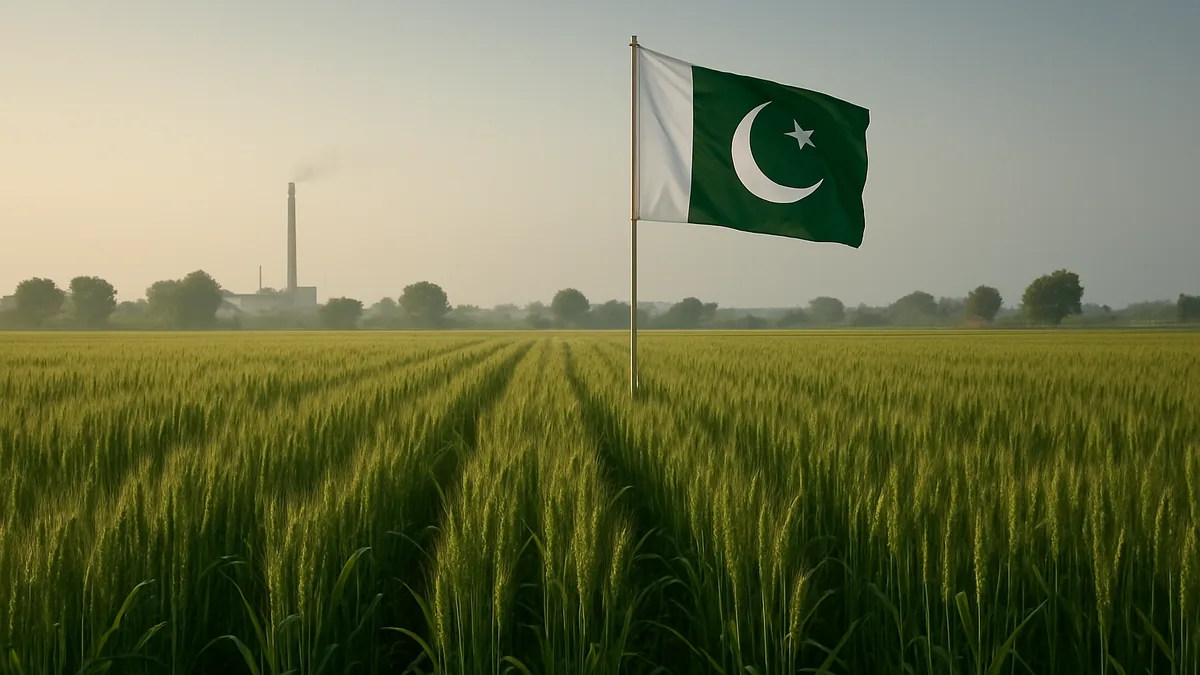
The revisions showed stronger farm output than previously calculated, while industry and services were scaled back. The main sector changes were:
- Agriculture: 3.50 per cent, up from 2.89 per cent
- Industry: 3.34 per cent, down from 3.51 per cent
- Services: 3.81 per cent, down from 4.09 per cent
Higher estimates for important crops lifted their growth to 1.59 per cent from 0.65 per cent. Other crops improved more sharply, rising to 4.28 per cent from 2.43 per cent, helped by bigger harvests of pulses, fruit, tomatoes, oilseeds and green fodder. PBS put the increases in production at 6.3 per cent for pulses, 1.3 per cent for fruit, 44 per cent for tomatoes, 5.4 per cent for oilseeds and 2.4 per cent for green fodder. Livestock was trimmed slightly to 3.71 per cent, which PBS linked to higher fodder inputs.
Mixed picture across manufacturing, mining and utilities
Industry grew 3.34 per cent in FY26, below the previous estimate. Mining and quarrying did better than first thought, with growth revised up to 1.52 per cent from 0.38 per cent. PBS attributed that to higher output of gas, crude oil and coal, which rose by 2.84 per cent, 5.12 per cent and 2.73 per cent, respectively.
Large-scale manufacturing was revised down to 5.01 per cent from 6.11 per cent, yet several categories still posted strong gains. Automobiles rose 57.77 per cent, transport equipment 42.36 per cent and furniture 22.69 per cent. Electrical equipment grew 14.25 per cent, rubber products 14.19 per cent, tobacco 12.61 per cent, petroleum products 9.7 per cent and food 7.03 per cent. Other manufacturing, which includes football production, expanded by 16.62 per cent.
Some large industries continued to shrink over the July-June period. Pharmaceuticals fell 8.87 per cent, iron and steel products 7.84 per cent, chemicals 2.53 per cent and leather products 1.95 per cent. Electricity, gas and water supply contracted by 10.24 per cent, a slightly smaller decline than the 10.63 per cent first estimated. Construction growth was revised up to 6.30 per cent from 5.73 per cent, which PBS linked to higher public-sector construction spending.
Services revisions and a slower fourth quarter
Services, the largest part of the economy, grew 3.81 per cent in FY26, compared with the earlier 4.09 per cent. Wholesale and retail trade was cut sharply to 2.37 per cent from 3.71 per cent, which reflected weaker manufacturing activity and imports. Transport and storage moved up to 3.23 per cent from 2.31 per cent, supported by upward revisions in railways, water transport and air transport.
Information and communication was among the stronger performers, with growth revised up to 9.53 per cent from 7.52 per cent. Finance and insurance improved to 4.23 per cent from 0.32 per cent, mainly because of stronger insurance activity. Public administration and social security grew 5.67 per cent, education 4.17 per cent, human health and social work 5.52 per cent and other private services 4.01 per cent. PBS said every major services component stayed on a positive path, even where estimates were lowered.
The economy grew 2.0 per cent in the fourth quarter, far below the rates of the earlier quarters. PBS said part of the slowdown reflected a high base, since the economy had expanded 6.07 per cent in the same quarter of FY25. Agriculture rose 3.71 per cent, compared with 0.58 per cent a year earlier. Industry, however, contracted 4.70 per cent, after growing 20 per cent in the corresponding quarter of the previous year. The biggest drag came from electricity, gas and water supply, which fell 33.19 per cent. PBS attributed that decline to lower subsidies, a high deflator and an exceptionally strong base effect of 123.03 per cent.
The committee also revised the first three quarters of FY26. First-quarter growth was trimmed to 3.89 per cent from 3.92 per cent, while the second quarter was raised to 4.31 per cent from 4.05 per cent. The third quarter rose more significantly, to 4.42 per cent from 3.99 per cent. Separately, FY25 growth was revised down to 3.11 per cent from 3.18 per cent. The National Accounts Committee said the estimates drew on input from the PBS national accounts team and key stakeholders, including the Ministry of Planning, Development and Special Initiatives, the Ministry of Finance and the State Bank of Pakistan.