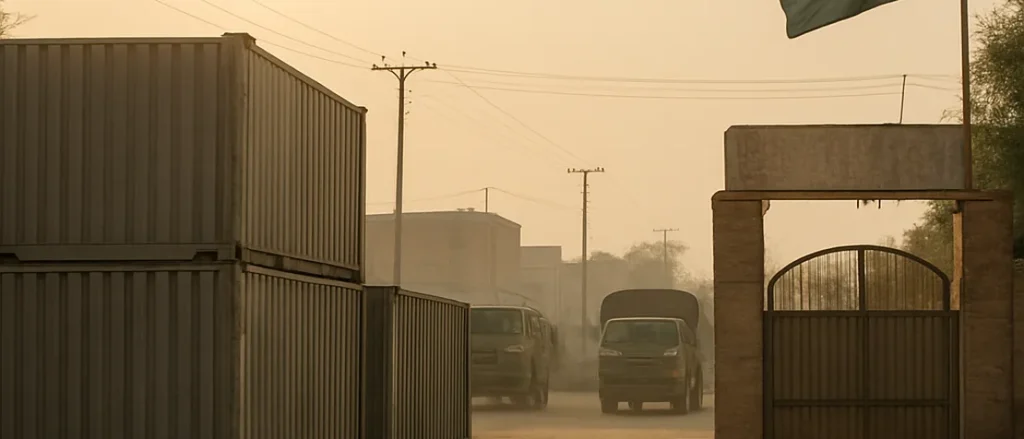

Pakistan has placed Khyber Pakhtunkhwa, the stronghold of former prime minister Imran Khan’s party, under a state of emergency and suspended the provincial government led by his party. Schools were closed, internet services were partially shut down, roads were blocked with shipping containers, and the army was deployed in towns across the province. The move comes amid a standoff between Khan’s supporters and the state, and some fear it could deepen instability rather than reduce it.
The federal government said the step, which it said is permitted by the constitution, was needed to protect the province’s population from the threat of terrorism. On Sunday, federal information minister Attah Tarrar told journalists that “the PTI KPK government was hand in glove with the terrorists.” He did not give details or present evidence, but said he would do so soon.
Schools reopen as crackdown on PTI intensifies
Two days after the announcement, Tarrar had not provided any update. Schools had reopened in Peshawar and most other parts of the province, and internet services had been restored. Police declined to confirm any detentions, but the situation pointed to a crackdown aimed at preventing protests, and most PTI leaders in the province have gone into hiding.
On Tuesday, dozens of PTI supporters took to the streets in Bara, in Khyber district, the hometown of provincial Chief Minister Sohail Afridi. Reports said tear gas had been fired in the area. Afridi, who led the protests, has not been seen publicly. His party says he has been arrested, while the government says he is in protective custody.
The crackdown began before the march. Three of Khan’s sisters were arrested in September and accused, among other things, of mobilising supporters. They have been held since then. Khan has had little contact with his family or lawyers over the past year. Two of his sisters saw him in August, one of them during a hospital visit that followed concerns raised by the Supreme Court about his health. He has been in prison since August 2023 and has been convicted in several corruption cases, which he says are politically motivated.
Observers question the timing and the motive
To many observers, the timing of the emergency announcement is not a coincidence. For about a week, thousands of Khan’s supporters have marched through Khyber Pakhtunkhwa, where the PTI has governed for 13 years, demanding his release. Farzana Sheikh, an associate fellow at Chatham House, said the government’s explanation sounded disingenuous at best.
Arifa Noor, a journalist and commentator, said she did not see a clear link to terrorism. She questioned whether the march itself was the trigger, suggesting it may have been the last straw or simply a reluctance to have an opposition party in charge of a province. Michael Kugelman, senior South Asia fellow at the Atlantic Council, said the PTI rank and file had grown restless in recent months over concerns about Khan’s health, and that the authorities may want to send a strong message to the party.
Tarrar has rejected claims of a political motive. He said, “There was no political agenda. They could have gone on with their march,” and pointed to talks between the two sides before the decision as evidence that dialogue had been attempted. Others see the move as another effort to restrict Khan and his party. Noor said the government has less and less room for dissent and does not want to negotiate its way out of conflict.
Zahid Hussain, an Islamabad-based author and defence analyst, said the balance of power had shifted entirely to the military establishment. Sheikh argued that the military may feel confident because it believes it has a good relationship with the White House, and that its international standing has been strengthened by its role in US-Iran peace talks.
Security pressures and fears of a backlash
Pakistan already faces serious security challenges. Militancy is rising, and the country was ranked first in the Global Terrorism Index 2026 as the nation most affected. It is also in disputes with two neighbours. It has repeatedly carried out air strikes in Afghanistan, accusing the Afghan Taliban government of harbouring militant groups, a claim Kabul denies. Tensions with India have long simmered and could easily reignite. Pakistan has also promised to help Saudi Arabia defend itself against attacks as its conflict with the Houthis grows more dangerous.
Some analysts warn that the emergency could create new problems while solving none of the existing ones. With the provincial government removed, Islamabad now bears direct responsibility for the province, with no elected government left to share the blame. Kugelman said the move could backfire. “You’re playing with fire,” he said, warning that if it adds to anger and discontent, the government will have a serious problem. Hussain called it reckless given the country’s many challenges, and said he feared such powers could be used more widely across Pakistan.
Sheikh said that any large army operation against militants would bring casualties among the armed forces, and that significant losses could prompt questions within the military itself. Pakistan has a history of military coups, and Noor noted that removing elected governments, whether at provincial or national level, has turned out badly before. She said senior figures in the PML-N, which leads the federal government, must realise these actions could return to haunt them. She also said the PTI appeared to accept that protest alone would not secure Khan’s release. “Everybody realises that this is a train crash but somehow you can’t stop it,” she said.