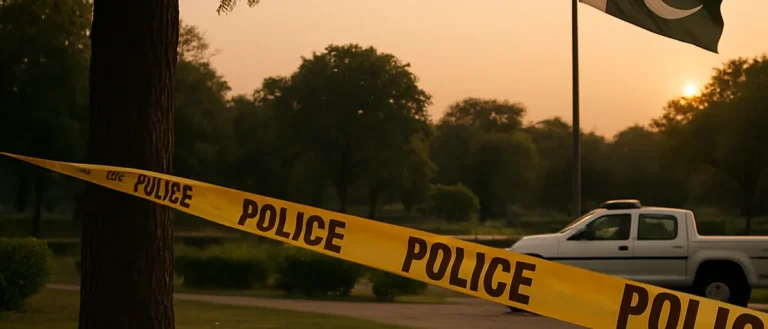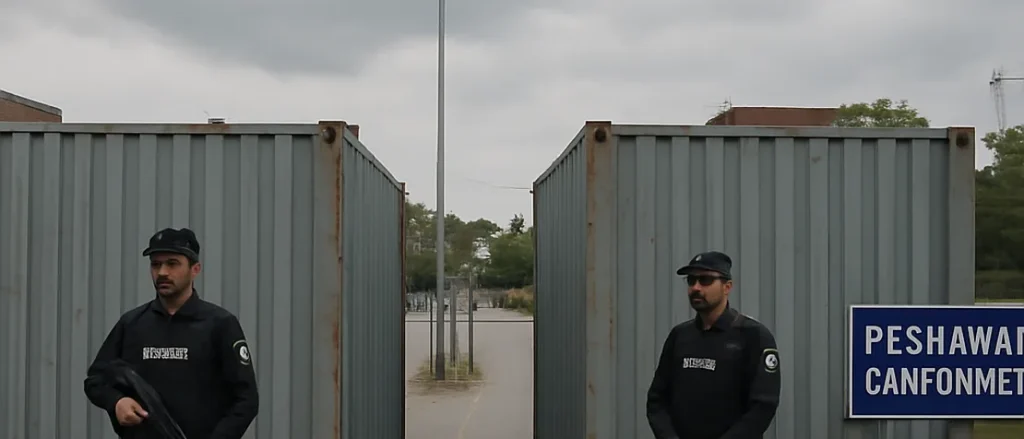

Security measures in Peshawar have been significantly increased ahead of a planned protest by the Pakistan Tehreek-e-Insaf (PTI) scheduled for noon. Key routes, especially across Peshawar Cantonment, have been blocked with containers, movement in sensitive zones is limited, and educational institutions remain closed. These actions come a day after the federal government declared an emergency and imposed governor’s rule in Khyber Pakhtunkhwa (KP).
While army personnel from Punjab have been deployed in districts under emergency as per Article 245 of the Constitution, no troops are currently stationed within Peshawar city, where police forces are managing security. Mobile phone and Wi-Fi services, which had been suspended, have now been restored.
Federal government suspends KP provincial administration
Federal ministers announced that the PTI-led provincial government in KP has been suspended. Law Minister Azam Nazeer Tarar, Information Minister Attaullah Tarar, and Interior Minister Mohsin Naqvi stated that President Asif Ali Zardari invoked Articles 232 and 234 of the Constitution to authorize this action. Additionally, a proclamation under Article 245 was issued to enhance armed forces’ support to civil authorities in counterterrorism efforts.
The offices of the chief minister and provincial cabinet are currently suspended, and several PTI leaders have been placed under preventive detention, according to the ministers’ announcement.
Movement restrictions and closures in Peshawar Cantonment
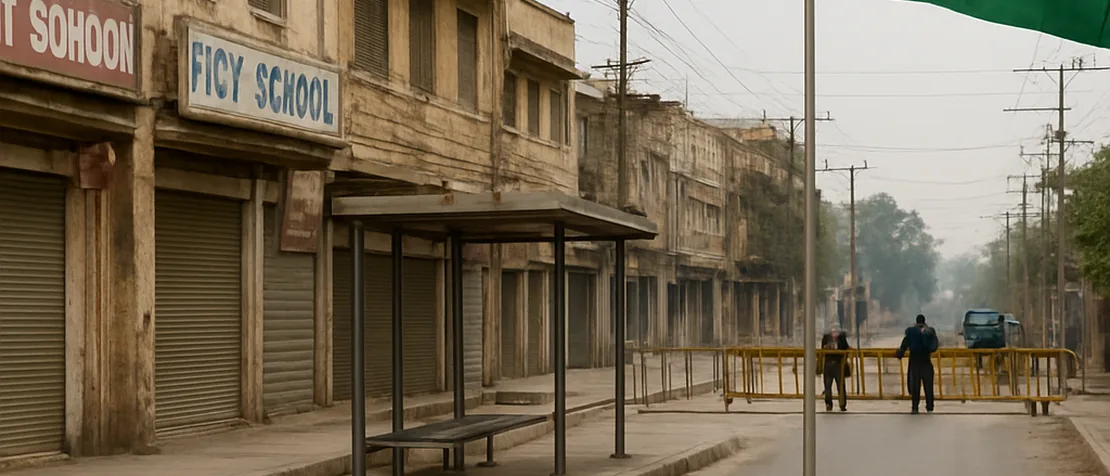
Access within Peshawar Cantonment has been heavily restricted, with containers positioned at all entry and exit points. Roads leading to the Governor House and connecting the Red Zone with Saddar and Taxila are also blocked. Some containers have been moved to the road sides to permit limited traffic, with police officers stationed alongside barricades.
The route to the airport remains open but travellers are subjected to stringent security checks. An entry point near Tarnab Farm has been closed, prompting commuters to use alternative routes through nearby villages.
In addition, schools, colleges, and universities in the city remain closed, and public transport services have been suspended. Police are actively preventing gatherings out of concern that the protest could escalate into clashes or cause damage to government properties. Security checkpoints are enforcing strict screening before allowing movement in certain areas.
Traffic status on major motorways and roads
The M-1 Motorway linking Peshawar to Islamabad is open, as is the Swat Expressway from Colonel Sher Khan Interchange to Chakdara, according to the Motorway Police. However, the M-14 Motorway from Hakla to Dera Ismail Khan is partially closed due to rain. The GT Road between Peshawar and Islamabad remains operational as usual.
Government cites failed talks and rising militancy as reasons
The federal ministers explained that the emergency and governor’s rule were imposed after months of unsuccessful negotiations with the KP provincial leadership regarding a coordinated security strategy. They claimed the provincial administration had not implemented federal counterterrorism proposals or agreed to a joint operational framework.
Interior Minister Mohsin Naqvi highlighted a 195 percent increase in militant violence over recent months and noted that 518 police personnel had been casualties. He said residents in 12 districts were experiencing targeted attacks and movement restrictions, which justified the federal intervention. The ministers denied that the move was politically motivated, emphasizing that the measures aim to restore order, improve governance, and combat militancy rather than create division.
Constitutional provisions invoked for emergency and governor’s rule
The government’s actions are based on Articles 232, 234, and 245 of the Constitution. Article 232 allows emergency proclamation in cases of war, external aggression, or internal disturbance threatening Pakistan’s security. Article 234 applies when a provincial government cannot function according to the Constitution. Article 245 governs the deployment of armed forces to assist civil authorities.
Interim governance through advisory council and secretariat
An 11-member advisory council under Governor Faisal Karim Kundi has been established to administer the province during the interim period. A separate secretariat will focus on the 12 districts most affected by terrorism and will be led by an additional chief secretary to coordinate targeted resources and reconstruction.
The advisory council comprises professionals overseeing various sectors:
- Kifayatullah Khan – Home affairs
- Tariq Mahmood Pasha – Finance
- Amir Javed – Law
- Dr Syed Amir Abdullah – Education
- Retired Lt Gen Nigar Johar – Health
- Dr Sarfaraz Ali Shah – Mines and minerals
- Dr Muhammad Irshad – Industries and commerce
- Tayyab Qureshi – Religious affairs
- Osman Saifullah Khan – Energy
- Samar Haroon Bilour – Information and broadcasting
- Asif Rafiq Afridi – Communications, works, local government, housing, and transport
Tensions with PTI-led government and protest plans
The federal government’s decision follows escalating tensions with the PTI-led KP administration. The PTI initiated a long march towards Islamabad on October 4 after talks with the government failed, particularly over access to jailed party founder Imran Khan and cooperation on provincial counterterrorism.
The PTI has objected to the manner in which counterterrorism operations were planned, insisting on joint agreement by federal and provincial governments with political parties and tribal elders’ involvement. Interior Minister Naqvi accused Chief Minister Sohail Afridi of reneging on counterterrorism commitments, a claim rejected by the PTI.
Governor Kundi and Chief Minister Afridi also clashed over a security meeting convened by the governor, which Afridi deemed unconstitutional. Afridi stated that the province was being intimidated by emergency and governor’s rule and that any response would come from the people rather than himself. He also opposed any military operation proposals.
PTI condemns emergency rule and warns of consequences
PTI Secretary General Salman Akram Raja described the imposition of emergency and governor’s rule as a “black day” for Pakistan. He warned that political alienation and coercive tactics could provoke consequences similar to those previously seen in Balochistan. Raja urged citizens to oppose what he termed undemocratic measures through peaceful public mobilisation.
He affirmed PTI’s support for terrorism elimination but opposed counterterrorism operations conducted without consultation with political parties and affected communities. Raja said negotiations with the federal government had included discussions on revising the Parachinar agreement and establishing a mutually agreed security framework. However, he alleged the government demanded unconditional backing for its operations, which PTI could not accept.
Raja confirmed that the PTI’s announced long march would continue as planned and that the party would respond peacefully rather than with violence.
Opposition alliance and PTI leadership criticize federal actions
PTI Chairman Barrister Gohar Ali Khan criticized the emergency measures, arguing they undermine provincial autonomy and the electoral mandate of KP voters. He questioned the rationale for governor’s rule in a province where PTI holds a two-thirds majority in the assembly.
Gohar raised concerns over reported arrests of Chief Minister Sohail Afridi, the provincial assembly speaker, party workers, and Imran Khan’s sisters. He claimed approximately 1,500 PTI workers were detained in Punjab prisons and alleged that three party ministers had been arrested following gunfire incidents, though these claims were not independently verified during the press conference.
He stated that PTI had pursued parliamentary and legal channels, holding about 15 meetings with the government and two days of negotiations. Gohar emphasized that access to jailed PTI founder Imran Khan was crucial for strategic decisions regarding the party’s political activities and long march.
The Tehreek-i-Tahafuz-i-Ayeen Pakistan (TTAP), an opposition alliance, labeled the federal measures unconstitutional and an infringement on provincial rights. It questioned the differing approaches toward KP and Balochistan and announced plans to consult allies for a coordinated response.
Federal government defends intervention citing security concerns
The federal government justified its decision by pointing to deteriorating security conditions and the provincial administration’s alleged failure to effectively counter militancy. President Asif Ali Zardari approved the emergency and governor’s rule under constitutional provisions, following advice from Prime Minister Shehbaz Sharif and the federal cabinet.
These measures transfer executive authority in KP to the governor, supported by the advisory council. The ongoing dispute underscores persistent divisions over provincial autonomy, security policies, and conditions necessary for resuming political dialogue.