

Polling began on Monday for eight reserved seats in the Azad Jammu and Kashmir (AJK) Legislative Assembly, marking a key step in finalizing the assembly’s composition after the recently held phased general elections. These reserved seats consist of five designated for women, one for a technocrat, one for Ulema and Mashaikh, and one for an overseas Kashmiri representative.
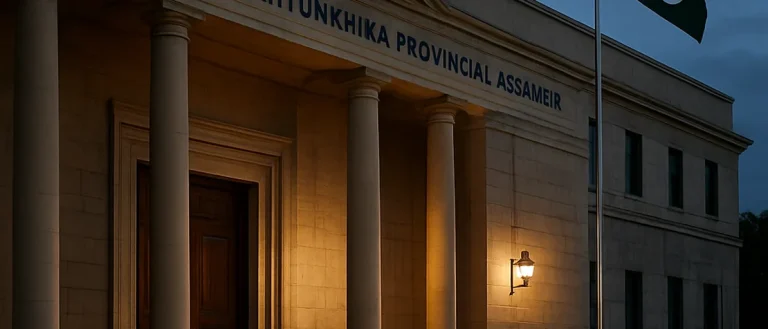
The voting started at 10am and is scheduled to continue until 2pm at the AJK Legislative Assembly building in Muzaffarabad. The secretary of the AJK Election Commission is overseeing the process as the presiding officer for this election.
Once the reserved seats are filled, the newly elected members are expected to take their oaths of office. This will be followed by the election and swearing-in of the assembly’s speaker and deputy speaker, completing the legislative setup.
Meanwhile, the government formation process in the region is ongoing without the participation of seven members, as elections in seven constituencies from the Poonch and Sudhnoti districts are still pending.
These developments come on the heels of the recently concluded three-phase general elections in AJK, where the Pakistan Muslim League-Nawaz (PML-N) emerged as the largest party with 25 seats, while the Pakistan Peoples Party (PPP) secured 11 seats.
In the first phase, held across 13 constituencies in the Mirpur Division, the PML-N won nine seats and the PPP four. The second phase, conducted on August 2 in eight constituencies of Muzaffarabad Division and all 12 refugee constituencies, saw the PML-N capture 15 seats compared to the PPP’s six.
The third phase, covering two constituencies, added one seat each to both the PML-N and PPP, finalizing their tallies at 25 and 11 seats, respectively.
However, the elections were clouded by allegations of rigging from the PPP, which questioned the integrity of the polling process. Following the second phase, PPP Chairman Bilawal Bhutto Zardari criticized the federal government and indicated that his party would escalate its political opposition.
In response, the PML-N dismissed these allegations, with its President Nawaz Sharif calling on political actors to avoid converting rivalries into hostility. He expressed concern over the current political climate in the region and emphasized the importance of constructive dialogue.